
Service History
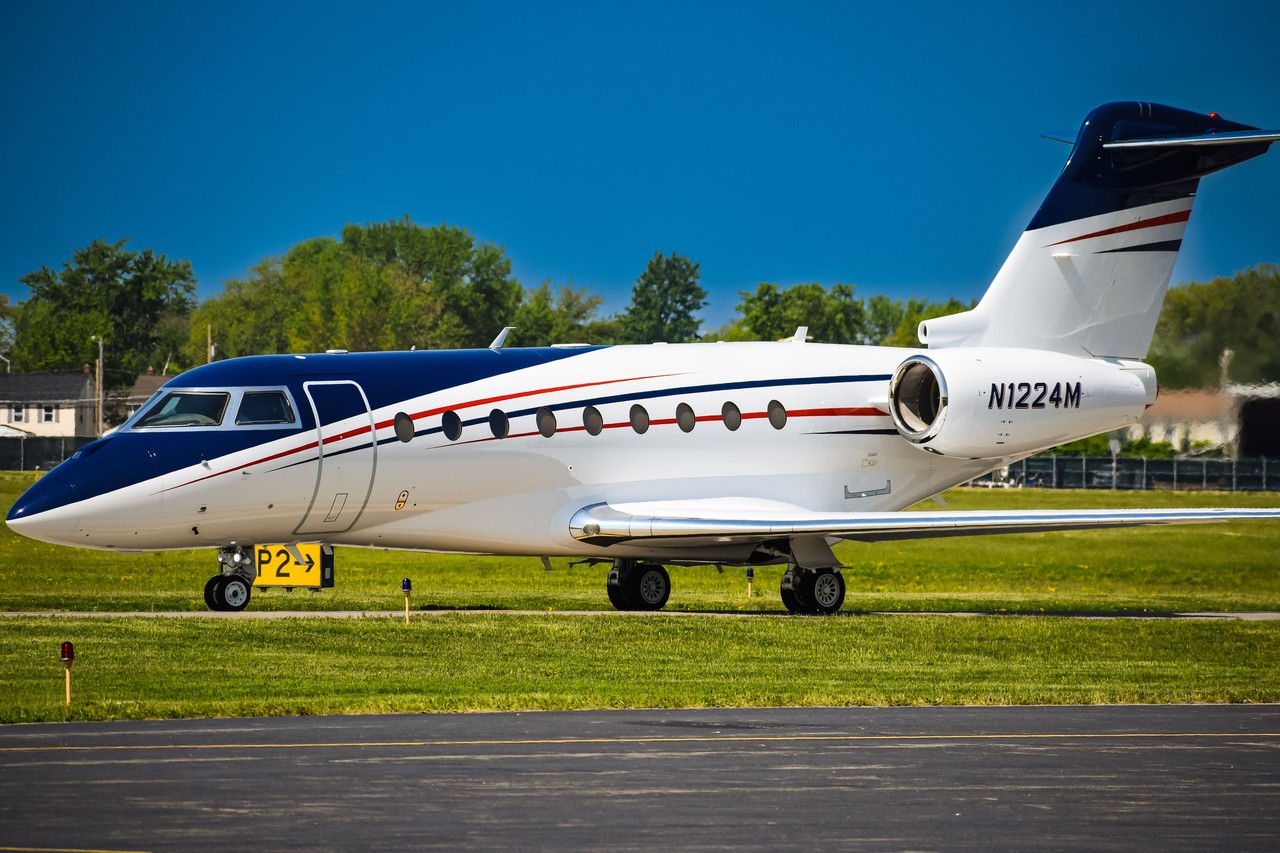
Since entering service in 2012, the G280 has established itself as the dominant aircraft in the mid-size business jet market. The fleet of 296 operational aircraft has accumulated 236,100 flight hours and 145,000 landings as of April 2020, achieving an exceptional 99.81% dispatch reliability according to NBAA statistics. The aircraft has set 75 city-pair speed records, demonstrating its performance capabilities on routes like London-New York and Dubai-Singapore.
Operators appreciate the G280's payload flexibility, carrying 4,050 pounds with external baggage space for 10 suitcases. The typical executive configuration features two club-four seating arrangements plus a three-place divan, though the aircraft can accommodate between 10 and 19 passengers depending on layout requirements.
The Manufacturer
Gulfstream Aerospace Corporation traces its origins to the late 1950s when Grumman Aircraft Engineering Company developed the original Gulfstream I turboprop at Bethpage, New York. The Gulfstream I first flew in 1958, with 200 units produced over 11 years, establishing the foundation for what would become a business aviation empire.
Now a wholly-owned subsidiary of General Dynamics based in Savannah, Georgia, Gulfstream has produced over 2,000 aircraft since 1958. A key acquisition occurred in June 2001 when Gulfstream purchased Galaxy Aerospace, renaming the Astra Galaxy as the G200, which became the direct predecessor to the G280. This acquisition provided the technical foundation and manufacturing partnership with Israel Aerospace Industries that would prove crucial for the G280 program.
Design Development
Gulfstream launched the G280 program in 2005 as a direct response to competition from the Bombardier Challenger 300 and Cessna Citation X+. The design team, led by Gulfstream engineers working with Israel Aerospace Industries, focused on addressing customer feedback collected through Gulfstream's Advisory Board.
Originally designated G250 when launched on October 5, 2008, the aircraft underwent a significant rebranding in July 2011. The name change to G280 occurred due to cultural concerns about the number 250, which carries negative connotations in Mandarin Chinese, potentially limiting sales in Asian markets.
The design improvements over the G200 were substantial. Engineers removed a rear-fuselage fuel tank to add 17 inches of usable cabin space, incorporated four additional windows, and provided in-flight access to cabin baggage compartments. The wing design was completely new and larger, while the T-tail featured bigger stabilizers with heated leading edges using engine bleed air.
Engine & Technical Innovation
Two Honeywell HTF7250G turbofan engines power the G280, each producing 7,624 pounds of thrust. These engines represent a significant advancement over previous models, delivering improved climb rates and fuel efficiency while reducing operating weights. The powerplants feature a 7,000-hour overhaul interval, contributing to the aircraft's exceptional dispatch reliability.
The cockpit incorporates Gulfstream's PlaneView280 avionics system with Future Air Navigation System 1/A+ capability. This glass cockpit represents a major technological leap from the G200, providing pilots with enhanced situational awareness and navigation precision. The aircraft also received certification for steep-approach operations and Enhanced Flight Vision Systems, expanding its operational envelope to challenging airports.
Performance & Pilot Perspective
Pilots praise the G280's climb performance, reaching 43,000 feet in less than 23 minutes with a service ceiling extending to 51,000 feet. The aircraft cruises at Mach 0.80 for long-range missions, delivering its maximum range of 3,600 nautical miles while maintaining fuel efficiency that operators find economically attractive.
The two-pilot crew configuration reduces operational costs compared to larger aircraft requiring three crew members. The improved wing design and T-tail configuration provide stable handling characteristics across the flight envelope, while the enhanced avionics reduce pilot workload during complex approach procedures.
Production & Manufacturing
The G280's unique international manufacturing arrangement involves multiple suppliers across two continents. Israel Aerospace Industries produces the fuselage, empennage, and landing gear systems at facilities in Israel, while Triumph Group (previously Spirit AeroSystems) manufactures the wings. Final assembly occurs in Israel before aircraft are ferried to Dallas, Texas, for interior installation and paint application.
This distributed manufacturing model has proven successful, with Gulfstream delivering the 300th G280 in June 2025. Total production reached 307 aircraft by that date, with manufacturing continuing despite the September 30, 2025 unveiling of the successor G300 model.
Legacy
The G280 fundamentally changed expectations for mid-size business jets when it entered service. Its combination of range, payload flexibility, and reliability set new benchmarks that competitors struggled to match. With an equipped price of $24.5 million in 2021, the aircraft provided exceptional value proposition for operators requiring transcontinental range without the operating costs of larger aircraft.
While the G300 successor promises further improvements, the G280's impact on business aviation remains significant. Its production run of over 300 aircraft represents substantial market penetration in a competitive segment, establishing Gulfstream's continued leadership in business jet manufacturing.