
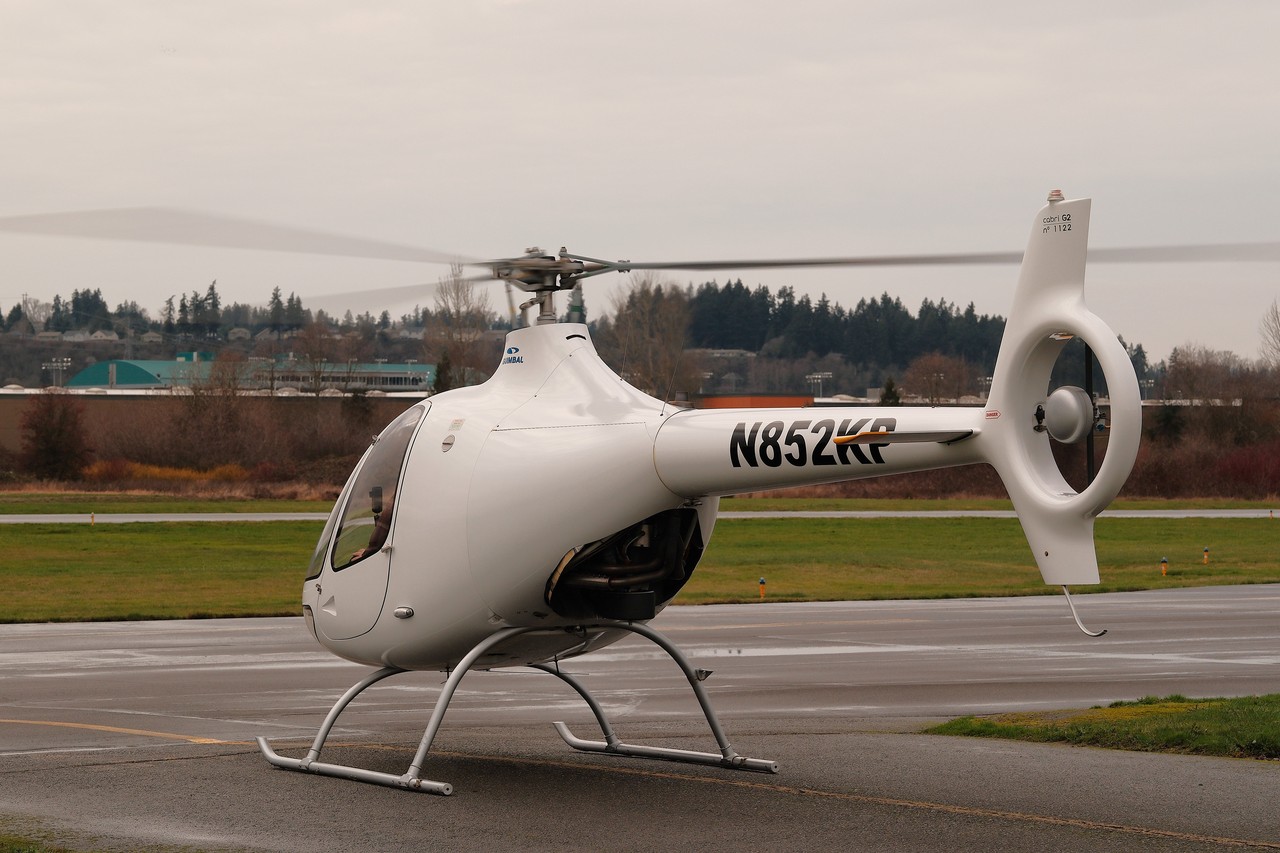
Design Genesis and Innovation
Bruno Guimbal, a French engineer working at Eurocopter, began developing the Cabri concept during his personal time in the early 1980s. His design philosophy centered on "Comfort in autorotation better with rotor inertia," which formed the acronym CABRI. Guimbal's vision was ambitious: create a piston helicopter incorporating advanced safety technologies typically reserved for expensive turbine aircraft, while maintaining affordability for training operations and private owners.
The prototype F-PILA achieved its maiden flight on April 11, 1992, at Marignane with test pilot Etienne Herrenschmidt and flight engineer Bernard Certain at the controls. Four years later, on May 22, 1996, test pilot Claude Aubé demonstrated the aircraft's capabilities by establishing a world distance record for light piston helicopters under 500 kilograms, covering 481.34 kilometers in a single flight—a record that remains unbroken.
Manufacturing Evolution
At age 41, Bruno Guimbal made the bold decision to leave Eurocopter and establish Hélicoptères Guimbal on September 8, 2000, at Aix-en-Provence airfield. The company's singular focus was developing, certifying, and producing the Cabri G2. The first pre-production aircraft, F-WYHG, took flight on March 31, 2005, with test pilot Olivier Gensse conducting the evaluation.
After accumulating 300 flight test hours and completing extensive ground testing over two and a half years, the European Aviation Safety Agency awarded the EASA Type Certificate on December 15, 2007, at Le Bourget. EASA director Alain Leroy personally presented the certification, marking a significant milestone for European helicopter manufacturing.
Production and Global Expansion
Serial production commenced in 2005, with the first customer delivery occurring on September 19, 2008. Aircraft F-GXRU, bearing serial number 1003, was delivered to IXAIR, coinciding with the inauguration of Guimbal's new 2,000-square-meter assembly facility at Aix-les-Milles aerodrome in Provence. This EASA Part-21G certified factory performs complete aircraft assembly, maintaining strict European manufacturing standards.
International certification followed steadily, with the Federal Aviation Administration granting Certificate No. R00005RD on January 25, 2015, opening the crucial American market. By June 2019, Guimbal had completed 250 helicopters, with the global fleet accumulating more than 260,000 flight hours across 24 certified countries.
Safety Revolution
The Cabri G2 represents a paradigm shift in light helicopter design, becoming the first piston helicopter engineered specifically for occupant protection. Unlike existing training helicopters that met older certification standards, the Cabri fully complies with modern EASA CS-27 and FAR-27 regulations requiring high impact energy absorption for aircraft under 3,175 kilograms maximum gross weight.
The fuel system incorporates combat helicopter and Formula 1 racing technologies, featuring a dual-structure design with an untearable fuel bladder and reinforced fittings to prevent fuel leakage during crashes. These innovations directly address safety concerns that had plagued earlier piston helicopter designs.
Training Dominance
Approximately 90 percent of Cabri flight hours have been logged in training operations, where the aircraft competes directly with the Robinson R22 and Sikorsky S-300 for helicopter flight school business. The Cabri's enhanced safety features and modern design appeal to training organizations seeking to reduce insurance costs and improve student safety margins.
In 2015, following the Heli-Expo exhibition in Orlando, Florida, a demonstration flight showcased the aircraft's capabilities when Cabri G2 N371PA completed a 6,000-kilometer transfer flight to Portland, Oregon. The journey crossed 12 states with 42 stops and 14 demonstration flights, ultimately establishing Precision Helicopters as the first American Cabri operator and distributor.
Technical Specifications
The Cabri G2 employs a Lycoming O-360-J2A piston engine producing 180 horsepower, though derated to 145 horsepower for helicopter operations. This Textron Aviation powerplant provides reliable performance while maintaining fuel efficiency crucial for training operations. The two-seat configuration accommodates instructor and student pilots in side-by-side seating, optimizing communication and instruction effectiveness.
Current Operations and Legacy
Hélicoptères Guimbal continues production at its Provence facility, maintaining the distinction of producing Europe's only indigenous piston helicopter. The aircraft operates globally in flight training schools, private ownership, and specialized missions where its safety features provide operational advantages over conventional light helicopters.
The Cabri G2's significance extends beyond its technical innovations—it demonstrates that modern safety standards can be successfully integrated into light helicopter design without compromising economic viability. As the global fleet continues expanding, the aircraft establishes European engineering expertise in the competitive light helicopter market previously dominated by American manufacturers.