
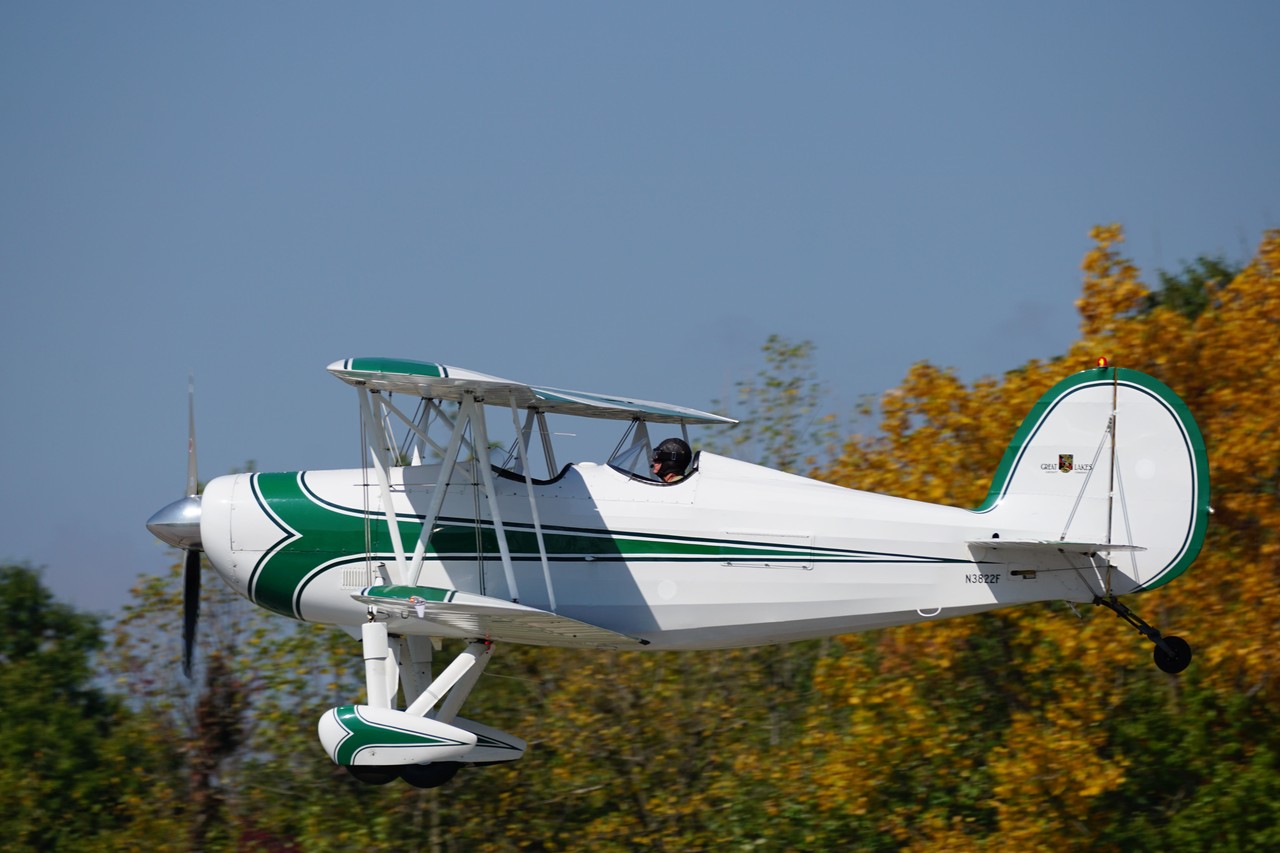
Design and Development
Charles W. Wittman led the engineering team that created the Great Lakes 2T-1 in early 1929 for the newly-formed Great Lakes Aircraft Corporation in Cleveland, Ohio. The company had been established in October 1928 after Glenn L. Martin relocated his operations to Baltimore, leaving the Cleveland facility available. Wittman's design focused on creating an exceptionally lightweight yet robust aerobatic trainer capable of withstanding +9G and -6G load factors.
The engineering team achieved significant weight savings through innovative construction techniques, including aluminum wing ribs fabricated from 17ST .016 material and precisely sized hardware that eliminated 32 pounds compared to standard fasteners. The first prototype encountered spin and stability issues during initial flight testing by Charlie Meyers due to an aft center of gravity, problems that were resolved before production began.
Production History and Variants
Great Lakes Aircraft Corporation manufactured approximately 250-262 aircraft between 1929 and 1933, producing two primary variants during this period. The original 2T-1 featured an 85-horsepower American Cirrus III inline engine and smaller tail surfaces, with roughly 40 examples built. The improved 2T-1A incorporated a 90-horsepower Cirrus Ace inline engine and enlarged tail surfaces for better handling characteristics, accounting for approximately 200 aircraft.
Despite receiving orders for more than 650 aircraft with deposits, the Great Depression forced Great Lakes Aircraft Corporation into bankruptcy in 1933. Production briefly continued under Allied Motor Industries until 1936, when manufacturing ceased entirely. The company's rapid demise represented one of aviation's most promising ventures cut short by economic circumstances.
Revival and Modern Production
The design experienced a remarkable renaissance when Harvey Swack acquired the rights in the 1960s and began selling plans to homebuilders. Doug Champlin purchased the rights in 1972 and established a new Great Lakes Aircraft Company with facilities in Wichita, Kansas, and Enid, Oklahoma. This second production run lasted from 1973 to 1978, yielding 137 aircraft powered by modern Lycoming engines.
Two variants emerged during the 1970s revival: the 2T-1A-1 with a 140-horsepower Lycoming O-320 engine and fixed-pitch propeller, and the more popular 2T-1A-2 featuring a 180-horsepower Lycoming IO-360 with constant-speed propeller and four ailerons instead of two. The IO-360 variant became the preferred choice among aerobatic pilots for its superior power-to-weight ratio.
Engine Evolution
The original American Cirrus inline engines that powered early Great Lakes aircraft represented cutting-edge powerplant technology of the late 1920s. However, many surviving aircraft from the original production run were later modified with radial engines, particularly the Warner Scarab 165-horsepower and various Jacobs radials, which provided improved reliability and power.
Modern WACO Classic Aircraft production, which resumed in 2011 under John Duncan's ownership in Battle Creek, Michigan, utilizes either the Lycoming IO-360-B1F6 for touring applications or the AEIO-360-B1G6 for dedicated aerobatic use. These engines provide the reliability and performance characteristics demanded by contemporary pilots while maintaining the aircraft's classic handling qualities.
Aerobatic Legacy
The Great Lakes 2T-1A achieved legendary status in aerobatic circles when Jim Moss established a world record for 131 consecutive outside loops in 1929, flying a modified Hunt Special variant powered by a Warner Scarab radial engine. This achievement demonstrated the aircraft's exceptional structural integrity and aerobatic capabilities, establishing a reputation that endures today.
The aircraft's lightweight construction and powerful control response made it ideal for precision aerobatics, influencing generations of aerobatic aircraft design. Its tandem cockpit configuration allowed experienced pilots to train newcomers in advanced maneuvers while maintaining full control authority.
Current Status
WACO Classic Aircraft continues limited production of the 2T-1A alongside their YMF series, making the Great Lakes design the oldest certificated aircraft still in production. The company has incorporated modern improvements including metal wing spars while preserving the aircraft's original flying characteristics and classic appearance.
Museum examples include a Great Lakes 2T-1A Sport Trainer displayed at Yanks Air Museum, preserving the type's heritage for future generations. The exact number of airworthy examples remains unknown, but the design's popularity among sport pilots and aerobatic enthusiasts ensures its continued presence at airshows and fly-ins across America, nearly 95 years after its first flight.