
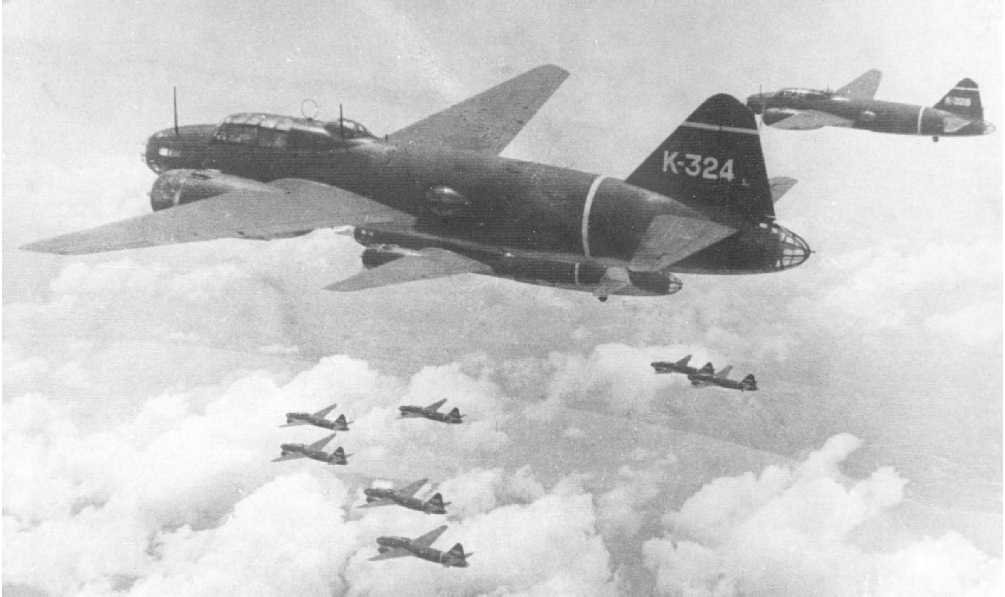
The Mitsubishi G4M, designated by the Imperial Japanese Navy as the Type 1 land-based attack aircraft and known by the Allied code name "Betty," served as the principal long-range bomber for Japan during World War II. Developed to meet the 12-Shi specification to replace the Mitsubishi G3M, the aircraft was designed to provide the extreme range and offensive capabilities prioritized by Admiral Isoroku Yamamoto. The first prototype was completed in September 1939 and took its maiden flight on October 23, 1939. It was officially accepted into service as the Model 11 in April 1941.
Produced by the Mitsubishi Aircraft Company, a division of Mitsubishi Heavy Industries, the G4M was manufactured exclusively at Mitsubishi plants. Production figures vary slightly across sources, with estimates ranging from 2,414 to 2,435 airframes built between 1941 and 1945. The aircraft's design featured a streamlined, nearly circular fuselage that earned it the Japanese nickname "Hamaki" (cigar). To achieve its high speed and long range, the design sacrificed protection, utilizing unprotected fuel tanks and minimal armor. This vulnerability led Allied forces to nickname the bomber the "one-shot lighter."
Technical specifications for the G4M1 included two Mitsubishi MK4A Kasei 11 14-cylinder air-cooled radial piston engines, each producing 1,530 hp. This configuration allowed for a maximum speed of 428 km/h and a combat range of 2,850 km, which could extend to over 5,000 km for ferry flights. The aircraft could carry a crew of seven and was armed with a 20 mm cannon in the tail and four 7.7 mm machine guns. Its offensive load consisted of either 800 kg of bombs or a single Type 91 aerial torpedo.
In combat, the G4M operated across nearly every major Pacific and Indian Ocean campaign. On December 10, 1941, G4M torpedo bombers achieved a historic milestone by sinking the British battleship HMS Prince of Wales and battlecruiser HMS Repulse off Malaya, marking the first time capital ships were sunk solely by air attack. However, the aircraft also suffered heavy losses; in January 1942, 15 of 17 G4Ms attacking the USS Lexington were shot down. One of the most notable events involving the type occurred on April 18, 1943, when Admiral Yamamoto was killed after his G4M transport was intercepted and shot down by P-38 Lightning fighters over Bougainville.
Later variants included the G4M2 (Model 22), which featured a laminar-flow wing and Kasei 21 engines, and the G4M2e, modified to carry Ohka manned rocket bombs. The final version, the G4M3 (Model 34), introduced self-sealing fuel tanks. The G4M's final mission took place on August 17, 1945, transporting the Japanese delegation to Ie Shima for surrender negotiations. Today, the only substantially complete G4M1 is preserved at the Museum of Aviation in Santa Monica, while the Smithsonian National Air and Space Museum holds the forward fuselage of a G4M3.