
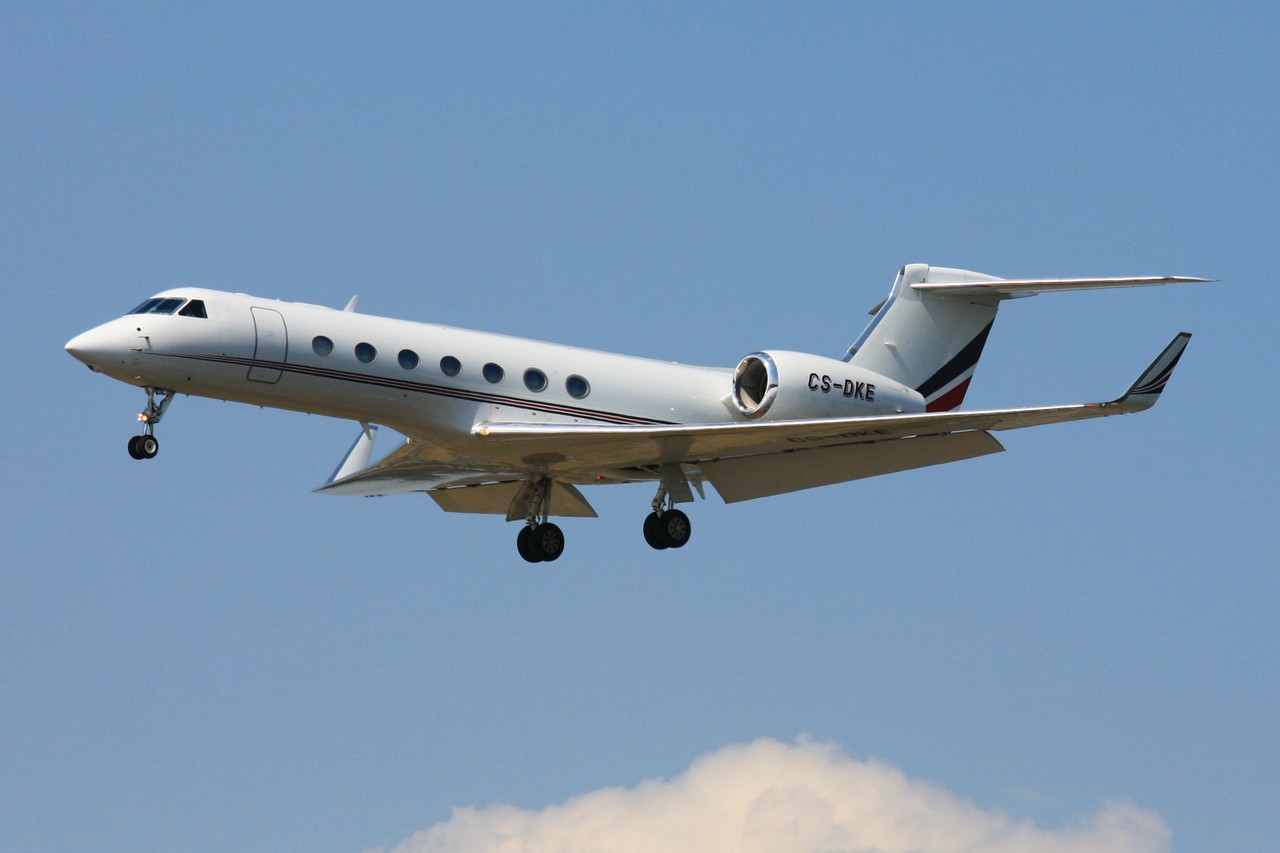
Dominating the Ultra-Long-Range Market
The G550 transformed business aviation by achieving what competitors could not: consistent ultra-long-range performance with unprecedented reliability. From its 2003 service entry through 2021, the aircraft accumulated over one million flight hours while maintaining a 99.9% dispatch reliability rate—equivalent to missing just one trip in five years of regular operation. This reliability, combined with its 7,500-nautical-mile range, made it the preferred choice for Fortune 500 companies requiring dependable global connectivity.
By 2016, more than 450 G550s were in active service worldwide, connecting financial centers from New York to Hong Kong without technical stops. The aircraft's ability to fly nonstop routes that previously required refueling gave corporate executives a significant competitive advantage in international business dealings.
Government and Military Applications
While designed for civilian use, the G550 found important roles in government service. The United States military operates the type as the C-37B for high-ranking official transport and the EA-37B Compass Call for electronic warfare missions. These specialized variants continued production beyond the 2021 commercial cutoff date, demonstrating the platform's adaptability to mission-specific requirements.
Unlike combat aircraft, the G550 serves in a support capacity, providing secure, long-range transportation for diplomatic missions and special operations command structures. Its reliability and global range made it particularly valuable for time-sensitive government operations requiring immediate deployment to remote locations.
Gulfstream Aerospace Legacy
Gulfstream Aerospace Corporation, a wholly-owned subsidiary of General Dynamics, built upon decades of business aviation expertise when developing the G550. The company traces its origins to the late 1950s when Grumman Aircraft Engineering developed the original Gulfstream I at Bethpage, New York. Since 1958, Gulfstream has delivered over 2,000 aircraft, establishing itself as the premier manufacturer of ultra-long-range business jets.
The transition from Grumman to Gulfstream occurred through strategic acquisitions and corporate evolution, ultimately placing the company under General Dynamics' aerospace division. This corporate backing provided the substantial resources necessary to compete against established rivals like Bombardier's Global Express series.
Engineering Excellence and Innovation
Announced on October 9, 2000, the G550 represented a systematic evolution of the successful Gulfstream V platform. Gulfstream's engineering team focused on extending range by 250 nautical miles through aerodynamic drag reduction while incorporating the advanced Honeywell Primus Epic PlaneView flight deck system. These innovations earned the aircraft the prestigious 2003 Robert J. Collier Trophy for aeronautical achievement.
The heart of the G550's performance lies in its twin Rolls-Royce BR710 C4-11 turbofan engines, each producing 15,385 pounds of thrust. These powerplants feature 8,000-hour overhaul intervals, significantly reducing maintenance costs compared to earlier business jet engines. The engines' reliability directly contributes to the aircraft's exceptional dispatch rate, crucial for corporate operations where schedule adherence determines business success.
Operational Characteristics
Pilots appreciate the G550's advanced avionics suite, which reduces crew workload during long-duration flights typical of intercontinental business operations. The standard two-pilot crew configuration, enhanced by sophisticated automation systems, enables efficient operation while maintaining the highest safety standards. The aircraft's ability to access shorter runways than competing aircraft expands destination options for corporate flight departments.
The G550's high-speed cruise capability supports time-critical business schedules, while its spacious cabin accommodates productive work environments during extended flights. Executive configurations typically seat 12-16 passengers in comfort levels matching luxury hotels, with full communications systems enabling continuous business operations at altitude.
Production Success and Market Impact
From 2003 through July 2021, Gulfstream delivered over 600 G550s from its Savannah, Georgia manufacturing facility. More than 500 aircraft had been delivered by May 2015 alone, demonstrating strong market acceptance during the program's peak years. The final commercial delivery occurred in June 2021, marking the end of an 18-year production run.
The G550's market success influenced competitor designs and established new benchmarks for large-cabin business jets. Its combination of range, reliability, and operational economics forced rivals like Dassault's Falcon 8X and later Bombardier Global 7500 to match its performance standards.
Current Operations and Legacy
As of 2017, approximately 540 G550s remained in active service globally, with only 40 aircraft listed for sale—indicating strong owner satisfaction and market value retention. The type continues serving corporations, governments, and private individuals requiring reliable ultra-long-range transportation.
The G550's legacy extends beyond its own service record, providing the technological foundation for Gulfstream's current G500 and G600 models. Its proven systems integration and operational reliability established design principles that continue influencing business aviation development, cementing Gulfstream's position as the industry's performance and reliability leader.