
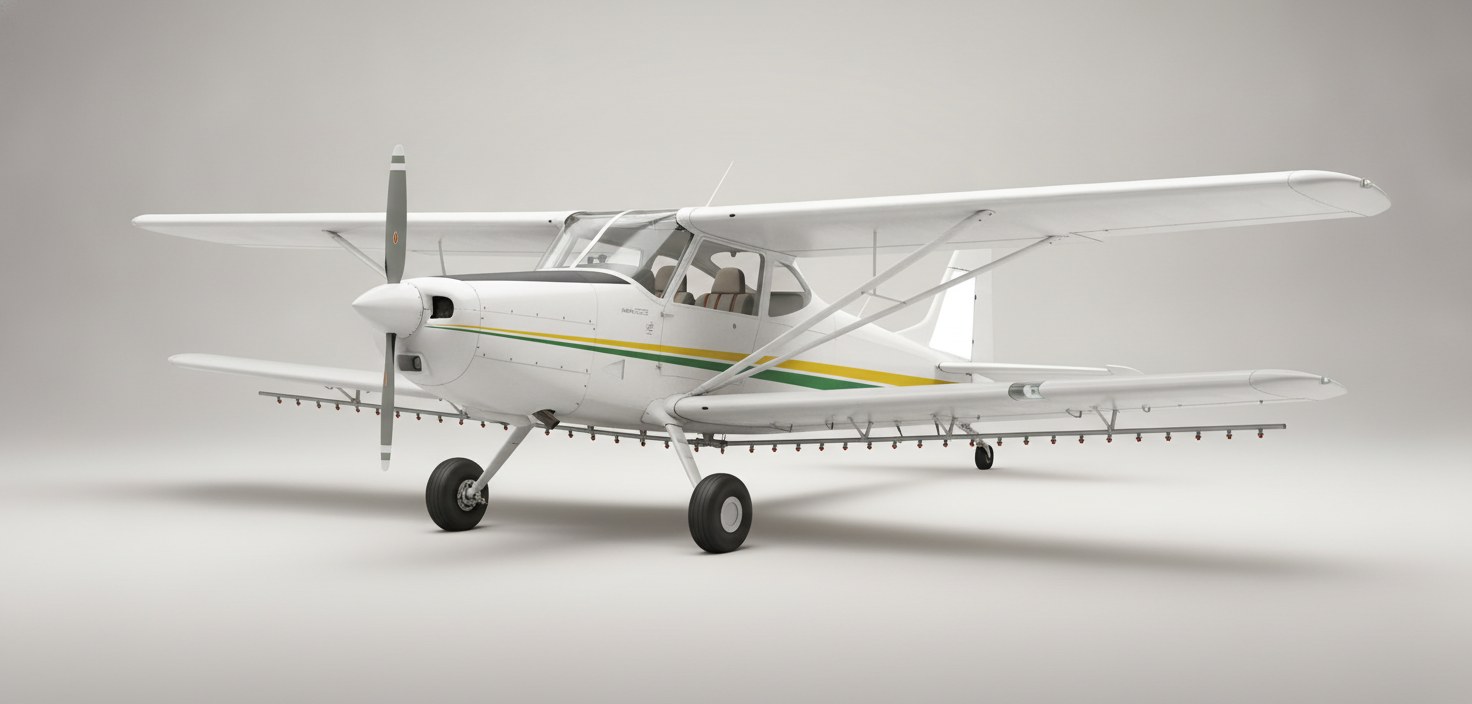
Agricultural Innovation
The GA200 represented a watershed moment for Australian aviation manufacturing, breaking a two-decade drought in new aircraft type certifications since the Government Aircraft Factory Nomad. Unlike competitors relying on converted military trainers from the 1940s, the GA200 was purpose-built for agricultural operations, delivering 30 to 50 percent better performance than existing alternatives while maintaining lower operating costs than turbine-powered aircraft.
Production totaled exactly 50 aircraft between 1991 and the late 1990s, with 28 exported internationally. China received nine aircraft through the Agricultural Aviation Experimental Station, while New Zealand imported eight. The remaining exports were distributed among the United States, Canada, South Africa, and Brazil. The first production aircraft was delivered to Innisfail, Queensland on April 11, 1991.
The Manufacturer's Evolution
Gippsland Aeronautics Pty. Ltd. emerged from humble beginnings as Latrobe Valley Aviation Services in 1984, founded by George Morgan and Peter Furlong at Latrobe Valley Airport in Victoria. The company initially specialized in modifying Piper PA-25 Pawnee agricultural aircraft, developing expertise that would prove crucial to the GA200's success. Early modification work included the PA-25-235A-8 prototypes VH-GWS in 1980 and VH-NLP in 1984.
The transition from modifier to manufacturer represented a significant leap in capability and ambition. Operating from their Traralgon base, the company achieved Australian Civil Aviation Authority type certificate number 83-6 on March 1, 1991, certifying the GA200 under Civil Aviation Orders 101.16 and 101.22 as well as US FAR Part 23 standards. This dual certification facilitated international sales and established the aircraft's credibility in export markets.
In 2010, India's Mahindra Aerospace acquired the company, transforming it into Mahindra Aerospace Australia. While GA200 production had already concluded, the new ownership revitalized manufacturing of the company's larger GA8 Airvan, demonstrating the enduring value of the engineering expertise developed during the GA200 program.
Engineering Excellence
The GA200's design philosophy centered on addressing the specific shortcomings of converted military aircraft in agricultural service. The engineering team, led by founders Morgan and Furlong, developed an all-metal low-wing configuration with full-depth laminated wing spars designed for easy field repair and replacement. This fail-safe approach recognized the demanding operational environment where aircraft routinely operated from rough strips far from maintenance facilities.
The cockpit arrangement featured side-by-side seating with the chemical hopper positioned forward of the pilot, optimizing weight distribution and pilot visibility during spraying operations. The right seat could accommodate a loader operator, while the Agtrainer variant incorporated dual controls and a smaller hopper for pilot training applications.
Optional wingtip extensions of 0.7 meters enhanced short-field performance, addressing the reality that many agricultural strips were minimally maintained. Larger flaps and improved aerodynamics over the Pawnee baseline contributed to the aircraft's superior lifting capability and handling characteristics.
Powerplant Evolution
The GA200's engine installations reflected the ongoing development of agricultural aviation technology. Initial GA200 and GA200B variants employed the Lycoming IO-540-H2A5, a six-cylinder horizontally-opposed engine producing 190 kilowatts (250 horsepower), deliberately derated from its 260-horsepower potential for enhanced reliability. This powerplant drove a fixed-pitch McCauley IA200/FA 84 52 propeller measuring 2.13 meters in diameter.
Beginning with approximately the 21st production aircraft in 1993, the GA200C variant introduced the more powerful Lycoming IO-540K1A5 generating 224 kilowatts (300 horsepower) and utilizing a constant-speed propeller for improved efficiency across varying flight conditions. The ultimate powerplant development occurred on February 11, 2003, when the first GA200 flew with the Textron Lycoming AEIO-580 engine producing 246 kilowatts (330 horsepower).
Operational Impact
The GA200's performance capabilities transformed agricultural aviation economics for operators seeking alternatives to expensive turbine conversions. The aircraft's maximum hopper capacity of 1,050 liters and one-tonne payload capacity, combined with its 9,144-kilogram-per-hour spread rate, enabled single aircraft to cover substantially more acreage per day than competitors.
In China, at least six GA200s remained active as of 2014, including B-8512 (construction number 9203), demonstrating the type's longevity in challenging operating conditions. The aircraft's success in diverse international markets validated the original design philosophy of purpose-built agricultural aviation.
Legacy and Conclusion
By February 2007, all 50 GA200s had been delivered, with production shifting to the larger GA8 Airvan that would eventually reach 110 aircraft by the same date. The GA200's primary legacy lies not in production numbers but in proving Australian manufacturing capability and establishing the foundation for subsequent GippsAero success. The aircraft demonstrated that modern engineering could significantly improve upon decades-old converted military designs, paving the way for continued innovation in specialized aviation markets.