
Design Innovation and Development
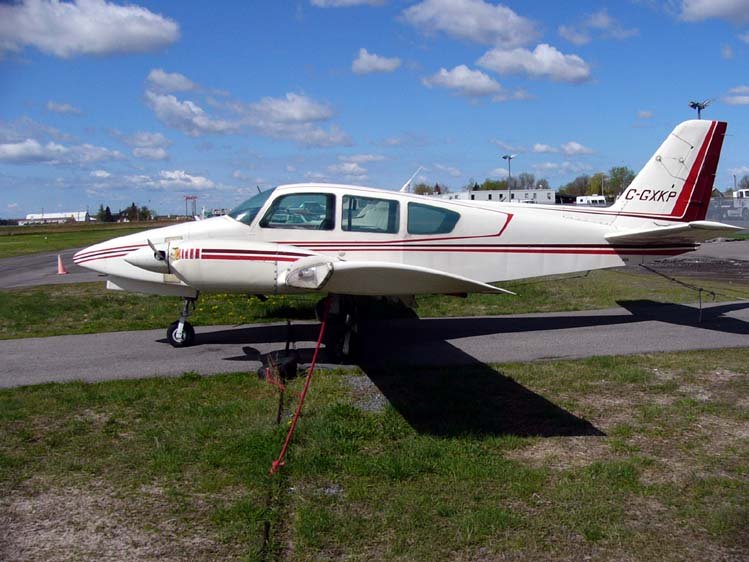
The GA-7 Cougar represented Grumman American's ambitious attempt to create a new category of light twin aircraft. The design team at Grumman American Aviation Corporation targeted owners stepping up from single-engine aircraft like the AA-5 Traveler, Cheetah, and Tiger series, seeking to provide better engine-out performance than existing competitors such as the Beechcraft Duchess and Piper Seminole.
The prototype that first flew in December 1974 underwent extensive re-engineering before reaching production. Engineers widened the fuselage, replaced the original sliding canopy with a conventional cabin door, switched from outward to inward-retracting landing gear, and introduced a "wet" double-spar wing design. Most significantly, they pioneered the use of bonded wing skins among Grumman's light aircraft line—a construction technique that proved remarkably durable, with aircraft still showing structural integrity more than 40 years later.
Manufacturing and Production
Grumman American Aviation Corporation, formed in 1971 when Grumman acquired American Aviation, initiated the GA-7 project but never completed production under that name. The company was sold to American Jet Industries in 1978 and renamed Gulfstream American, which took over manufacturing at their Savannah, Georgia facility. Type certification occurred in fall 1977, with production models certified by early 1978.
The first deliveries began in February 1978, with 71 aircraft completed that year and 44 in 1979. Production ceased after exactly 115 aircraft were built, ending a brief but intensive manufacturing run. Gulfstream American discontinued piston-engine light aircraft production in 1979, shifting focus to jets amid the aviation industry downturn of the 1980s.
Technical Specifications and Performance
The GA-7's powerplant consisted of twin Lycoming O-320-D1D engines, flat-four air-cooled units producing 160 horsepower each. Grumman American selected these proven engines over more powerful 180-horsepower alternatives, prioritizing reliability and the O-320's established 2,000-hour time between overhaul rating. The engines were manufactured by Lycoming Engines, a division of Textron, and represented part of the O-320 series that had been in production since the 1950s.
With a maximum loaded weight of 3,800 pounds and useful load of approximately 1,200 pounds, the GA-7 achieved a cruise speed of 160 knots. The aircraft featured retractable tricycle landing gear and incorporated high-strength aluminum honeycomb sandwich construction throughout its structure. Two variants were offered: the basic GA-7 and the GA-7 Cougar with enhanced avionics and interior appointments.
Corporate Transitions and Type Certificate History
Following Gulfstream American's exit from piston aircraft manufacturing, the GA-7's manufacturing rights changed hands multiple times without resulting in renewed production. American General Aircraft in Mississippi acquired rights in 1989 but never manufactured aircraft. In 1991, the rights transferred to Tbilisi Aircraft Manufacturing Association in the Republic of Georgia, again without production.
Socata in France obtained the rights in 1995, redesignating the aircraft as the TB-320 Tangara and building prototypes, but never entered full production. Most recently, in May 2019, the type certificate transferred to Cougar Aircraft Company, while True Flight Aerospace in Valdosta, Georgia, holds related certificates for the AA-1 through AG-5B series.
Market Position and Legacy
The GA-7 competed directly with other light twins in the training and personal transportation market, targeting pilots seeking multi-engine capability without the complexity of larger aircraft. Its four-seat cabin used club seating arrangement, with the airframe designed to accommodate six passengers in a higher-density configuration that was never implemented.
Despite its innovative construction and reliable powerplants, the GA-7's brief production run limited its market impact. The timing of its introduction coincided with significant changes in the general aviation market, as manufacturers increasingly focused on jet aircraft and the light piston twin market contracted.
Current Status
As of 2022, at least one GA-7 remains airworthy—N722GA, which received a reissued certificate on December 12, 2022. The aircraft's bonded aluminum construction has proven remarkably durable, with examples demonstrating the structural integrity of Grumman's advanced manufacturing techniques decades after production ended.
No company currently manufactures the GA-7, and the type certificate, while still valid under Cougar Aircraft Company ownership, remains inactive. The 115 aircraft built represent a complete production run of this innovative design, making the GA-7 Cougar a rare example of 1970s light twin technology and a testament to Grumman American's engineering capabilities during the company's brief existence.