
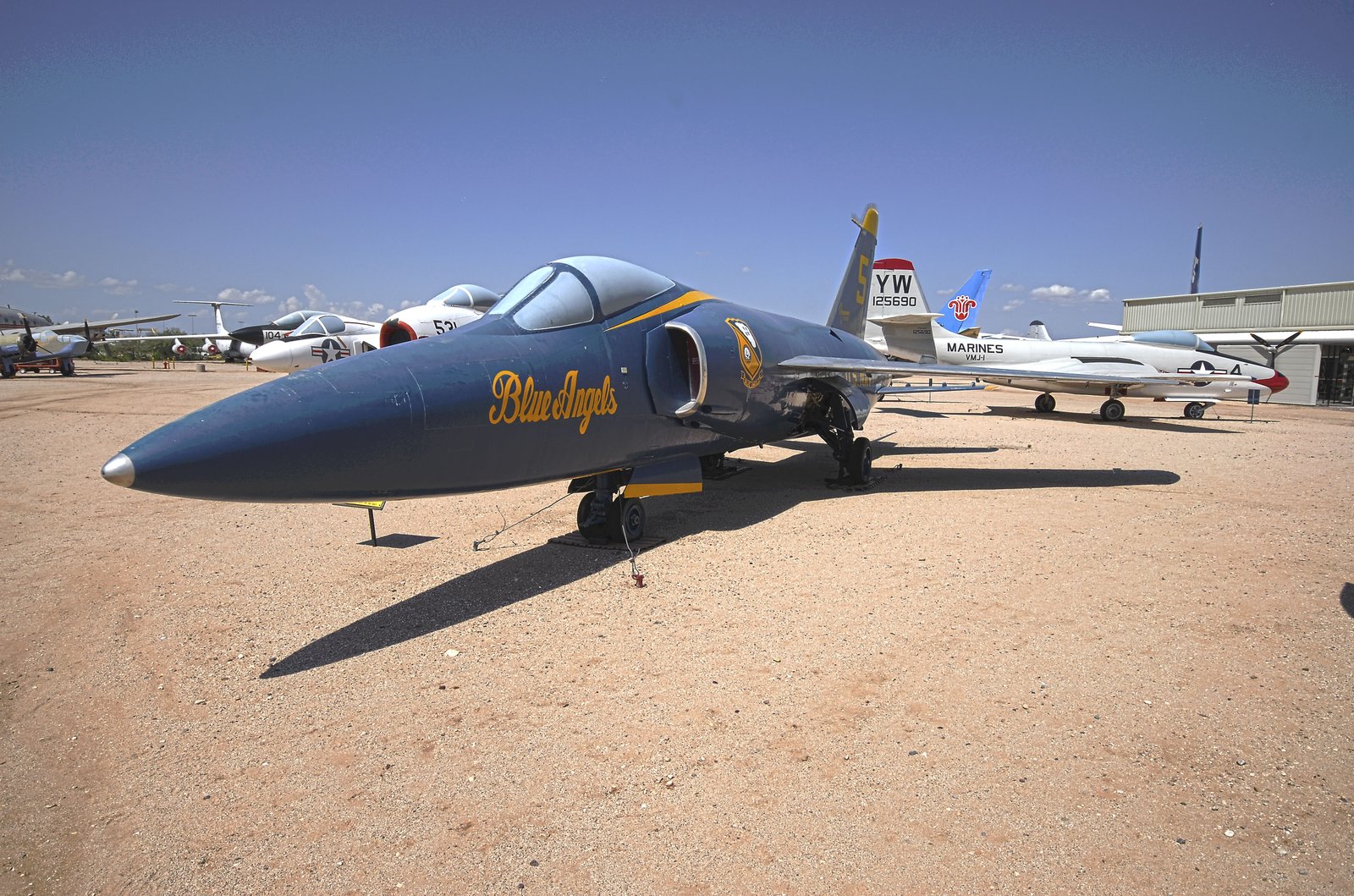
The Grumman F11F Tiger was developed in the early 1950s as a lightweight, supersonic successor to the F9F Cougar. Designed and manufactured by the Grumman Aircraft Engineering Corporation in Bethpage, New York, the aircraft was internally designated as the G-98 before being adopted by the U.S. Navy as the F11F-1 in April 1955. Following the 1962 tri-service redesignation, the model became known as the F-11A. The prototype made its maiden flight on July 30, 1954, nearly reaching Mach 1, while carrier suitability trials commenced on April 4, 1956, aboard the USS Forrestal (CVA-59).
Technically, the Tiger was a milestone for Grumman as its first aircraft capable of supersonic flight in level flight. To reduce transonic drag, the aircraft featured a "wasp-waist" fuselage based on the Whitcomb area rule. The standard production model was powered by a single Wright J65-W-18 turbojet, producing approximately 7,400–7,450 lbf of dry thrust and 10,500 lbf with an afterburner. This configuration allowed production Tigers to reach speeds of approximately Mach 1.1. A more powerful variant, the F11F-1F "Super Tiger," utilized a General Electric J79 engine; in April 1958, these prototypes set a world absolute altitude record of 76,828 feet and a level-flight speed record of 1,386.47 mph.
Production took place between 1954 and 1959, with the final aircraft delivered on January 23, 1959. While sources vary slightly, documentation suggests a total production run of approximately 199 to 201 aircraft, including 42 units from the first contract and 157 from a second order. The Tiger entered fleet service in 1956, with the first production units delivered to Attack Squadron VA-156 in March 1957. Armed with four 20 mm cannons and provision for four AIM-9 Sidewinder missiles, it served in fleet air defense and later as an advanced jet trainer. However, its front-line carrier service ended by 1961 due to limited range, J65 engine reliability issues, and the arrival of superior fighters like the F-8 Crusader and F-4 Phantom II.
The Tiger is perhaps most famous for its role with the U.S. Navy Blue Angels, which operated the type from 1957 until 1969. It also gained notoriety in 1956 when a test pilot accidentally flew into his own bullet stream during a high-speed diving pass, causing the aircraft to crash. Today, the F11F is preserved in several museums, including the National Naval Aviation Museum, the Planes of Fame Air Museum, the Yanks Air Museum, and the Valiant Air Command Warbird Museum.