
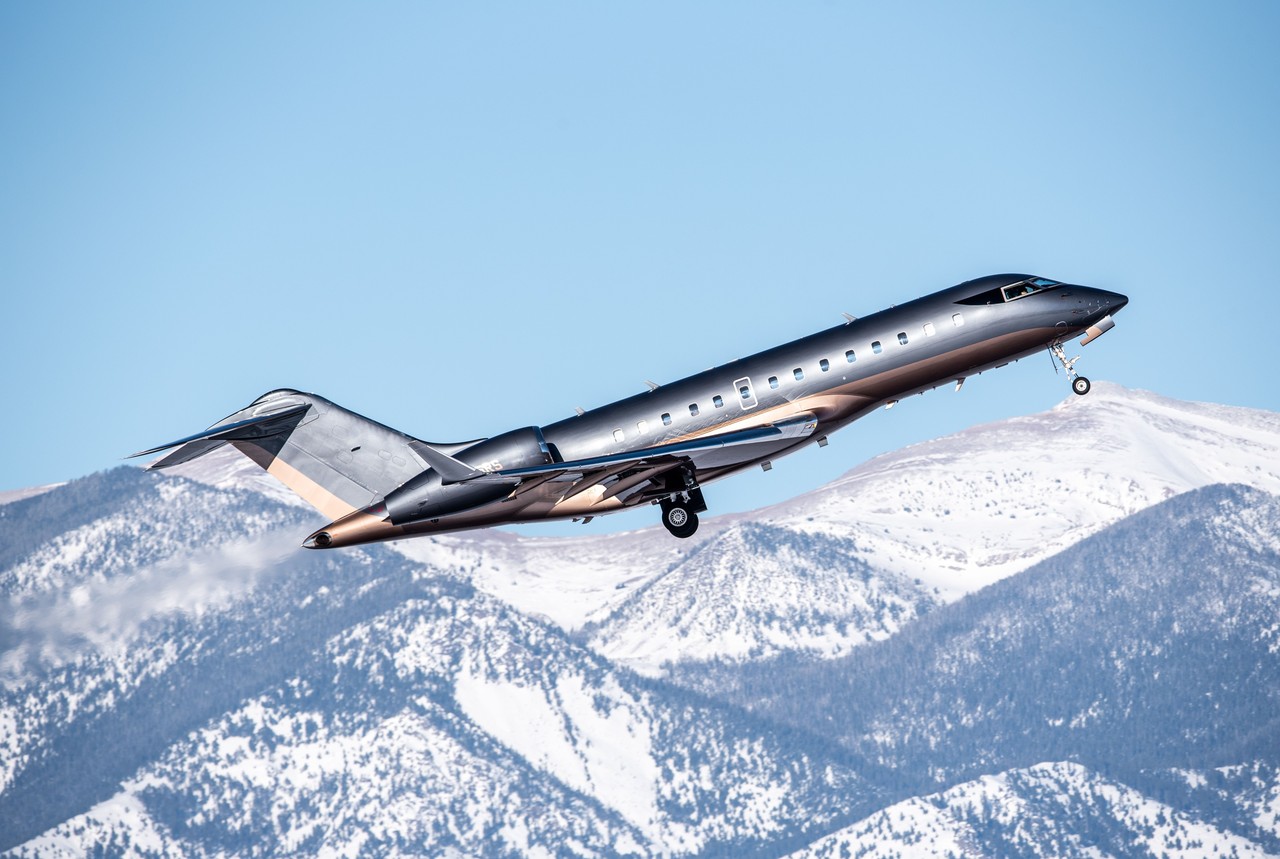
Development and Design Innovation
Bombardier launched the Global 5000 program in February 2002, building upon the success of their Global Express to create a refined ultra-long-range business jet. The aircraft incorporated several advanced design elements, including a newly developed super-critical airfoil with 35-degree wing sweep and winglets, paired with an innovative T-tail configuration that distinguished it from competitors in the large-cabin segment.
Following its maiden flight in March 2003, the Global 5000 underwent extensive certification testing before receiving both FAA and JAA type certification in October 2004. Customer deliveries commenced in April 2005, marking Bombardier's entry into direct competition with established players like Gulfstream's GV series.
Manufacturing and Production
Bombardier manufactured the Global 5000 at their Wichita, Kansas facility, the former home of the legendary Learjet line. Over its 15-year production run from 2005 to 2020, the company delivered approximately 238 aircraft to customers worldwide. By July 2013, 139 Global 5000s were actively operating across the globe, serving corporate flight departments and charter operators.
The aircraft's production represented a significant investment in Bombardier's business jet portfolio, with new aircraft carrying a price tag of $46 million during the program's final years. Used aircraft values have stabilized between $9.4 million and $21 million, depending on age, condition, and equipment.
Powerplant and Performance
The Global 5000's performance credentials stem from its twin Rolls-Royce BR710-A2-20 turbofan engines, each generating 14,750 pounds of thrust. These powerplants consume 558 gallons per hour during typical operations and require overhaul every 8,000 hours of operation. The engine selection proved reliable in service, with hourly operating costs averaging $400 per engine.
This powerplant combination enables the Global 5000 to achieve a maximum cruise speed of Mach 0.90, approximately 690 miles per hour, making it one of the fastest aircraft in its category. The jet maintains this performance while delivering a maximum range of 5,520 nautical miles, sufficient for non-stop transatlantic crossings and routes such as Dubai to Paris.
Cabin Design and Configuration
The Global 5000's cabin measures 42.47 feet in length, 8.17 feet in width, and 6.25 feet in height, creating 1,884 cubic feet of interior volume. This spacious environment typically accommodates 13 passengers in a standard configuration, though the aircraft can seat up to 17 passengers when required. The cabin features three distinct zones, including fully berthable seats and an aft lounge that converts to a bedroom.
Operators can configure the interior with a full galley and two lavatories, providing the amenities expected in ultra-long-range operations. The cabin's dimensions and flexible layout have made the Global 5000 popular with both corporate operators and charter companies, including NetJets and VistaJet.
Advanced Avionics Systems
Bombardier equipped the Global 5000 with the ProLine Fusion avionics suite as standard equipment, later upgrading to the Bombardier Vision flight deck in 2012. This advanced avionics package represents one of business aviation's most sophisticated systems, providing pilots with enhanced situational awareness and reduced workload during complex operations.
The aircraft requires a crew of three and incorporates a Honeywell RE220 auxiliary power unit for ground operations and in-flight backup power. These systems contribute to the Global 5000's reputation for dispatch reliability and operational flexibility across diverse operating environments.
Market Position and Legacy
Throughout its production run, the Global 5000 competed successfully in the ultra-long-range segment by combining high-speed performance with shorter runway requirements than many competitors. In 2008, Bombardier increased the aircraft's certified gross weight, allowing operators to carry additional fuel for extended range missions.
The program's evolution culminated in 2018 with the introduction of the Global 5500, featuring updated avionics, a redesigned wing, and new Rolls-Royce Pearl engines. The Global 5500 received FAA certification in June 2019, extending the aircraft family's legacy with a maximum range of 5,900 nautical miles.
As of recent market data, approximately 8 percent of the Global 5000 fleet remains available for purchase, representing 19 aircraft actively marketed to potential buyers. This relatively low availability reflects the type's continued desirability among operators seeking proven ultra-long-range performance in the large-cabin business jet category.