
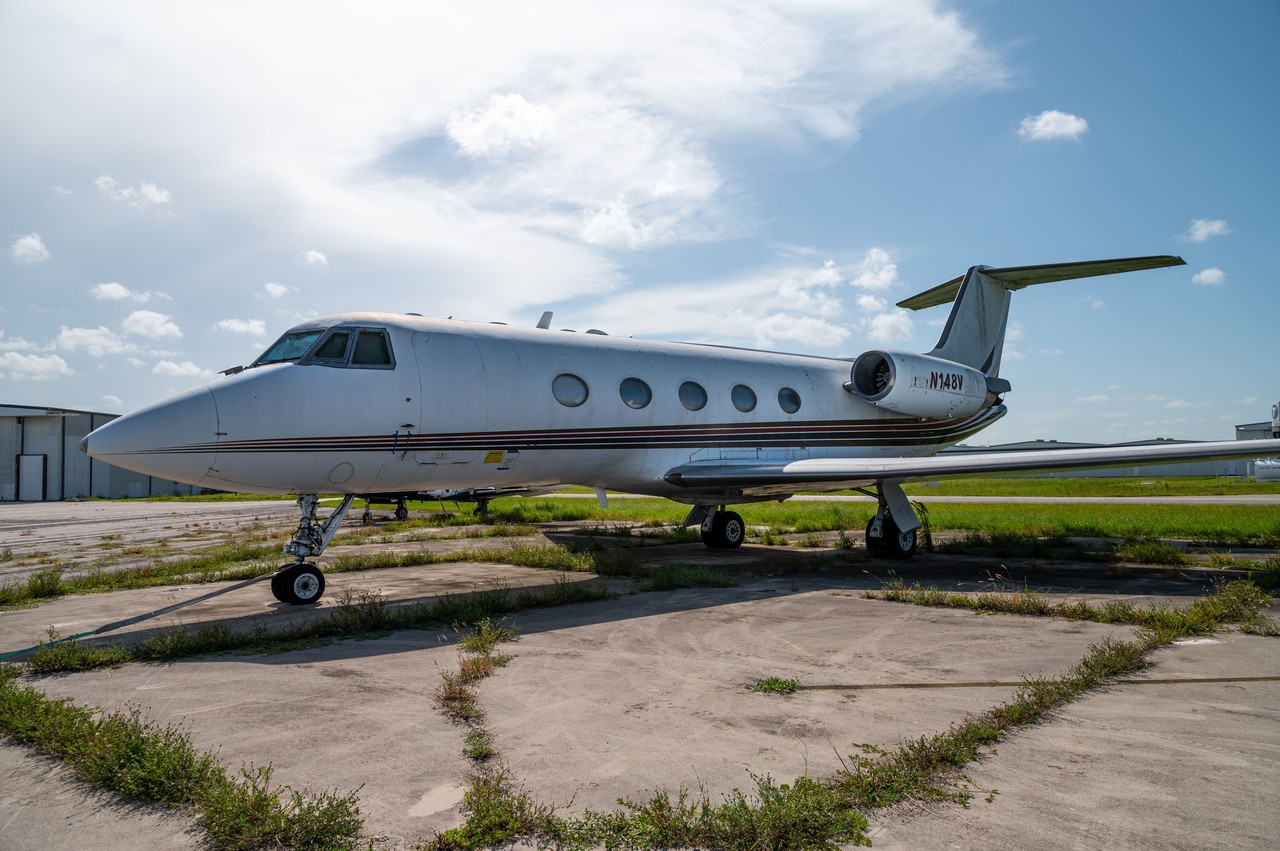
Service History
The Gulfstream II transformed executive aviation by becoming the first business jet capable of true transcontinental operations with unprecedented comfort. On May 17, 1968, just months after entering service, a Gulfstream II belonging to National Distillers and Chemical Corporation completed the first nonstop transatlantic flight by a business jet, flying from Teterboro, New Jersey to London's Gatwick Airport. This historic achievement demonstrated the aircraft's capability to connect major business centers worldwide, fundamentally changing how corporations conducted international operations.
By the mid-1970s, the Gulfstream II dominated the large-cabin business jet market, standing virtually alone in its class for nearly a decade. Its combination of transcontinental range, jet speed, and the industry's only stand-up cabin made it the preferred choice for Fortune 500 companies and high-net-worth individuals requiring efficient long-distance travel.
The Manufacturer
Grumman Aircraft Engineering Company, based in Bethpage, New York, launched the Gulfstream II program on May 5, 1965, as a jet-powered successor to their successful Gulfstream I turboprop. Having delivered over 150 Gulfstream Is by the mid-1960s, Grumman recognized the growing demand for jet-powered business aircraft as competitors like the Lockheed JetStar and Dassault Falcon 20 gained market share.
Production began at Grumman's Bethpage facility, where the first 40 aircraft were completed. In 1967, Grumman opened a dedicated facility in Savannah, Georgia, specifically for Gulfstream production. The first Savannah-built aircraft flew in December 1967, establishing what would become the world's premier business jet manufacturing center.
In 1978, Grumman sold its civilian aircraft division to focus on military contracts, and the company became Gulfstream American, later Gulfstream Aerospace. Today, as a subsidiary of General Dynamics, Gulfstream Aerospace continues operating from Savannah, having produced more than 2,000 aircraft since the original Gulfstream I's introduction in 1958.
Engine & Technical Innovation
The Gulfstream II's success stemmed largely from its powerplant selection: two Rolls-Royce Spey RB.168 Mk 511-8 turbofan engines, each producing 11,400 pounds of thrust. These second-generation turbofans provided the fuel efficiency and reliability necessary for transcontinental operations while maintaining the power required for the aircraft's 58,000-pound maximum takeoff weight.
Grumman's engineers mounted the Spey engines on pylons positioned ahead of an innovative T-tail configuration, which provided several aerodynamic advantages including improved elevator effectiveness and reduced cabin noise. The aircraft's fuel capacity of 28,300 pounds enabled the impressive 3,600-nautical-mile range that set it apart from competitors.
The stand-up cabin, measuring over six feet in height, represented a significant advance in business aviation comfort. This spacious interior could accommodate various configurations, from executive layouts for smaller groups to high-density arrangements seating up to 14 passengers.
Performance and Pilot Perspective
With a maximum speed of 589 miles per hour and a service ceiling exceeding 40,000 feet, the Gulfstream II delivered airline-class performance in a business jet package. Pilots appreciated the aircraft's stable handling characteristics and robust systems, which contributed to its excellent safety record throughout its operational history.
The two-pilot flight deck featured comprehensive instrumentation for all-weather operations, enabling the aircraft to meet public transport certification standards despite being designed for private use. This certification level provided operators with flexibility for various mission profiles and enhanced resale value.
Variants and Special Applications
Grumman introduced the Gulfstream II TT in 1977, featuring tip tanks that significantly extended range for operators requiring maximum distance capability. The modification received FAA certification on May 13, 1977, and became popular among international operators.
Between 1981 and 1987, 43 aircraft underwent conversion to Gulfstream IIB standard, incorporating winglets, Gulfstream III instrumentation, and increased maximum takeoff weight of up to 69,711 pounds. This variant received FAA certification on September 17, 1981, extending the aircraft's operational life significantly.
The Gulfstream II also served specialized government roles. NASA employed the type for space shuttle pilot training, while the Missile Defense Agency modified a Gulfstream IIB with a large dorsal fairing housing a telescope for the HALO2 program. Most notably, NASA contracted Lockheed-Georgia to modify one aircraft with an Allison 570 turboprop engine and Hamilton Standard SR-7 propfan for advanced propulsion research, first flying in March 1987.
Production Legacy
Production concluded in 1979 after 258 aircraft were completed, representing one of the most successful business jet programs of its era. The aircraft's enduring value is demonstrated by the fact that 200 Gulfstream IIs remain in active service today, decades after the last example rolled off the Savannah production line.
Modern Gulfstream IIs typically feature extensive avionics upgrades including terrain awareness systems, traffic collision avoidance equipment, and reduced vertical separation minimum capabilities. Early model aircraft can be acquired for approximately $300,000, while late-model Gulfstream IIBs command average asking prices of $800,000, reflecting their continued utility in business aviation.
The Gulfstream II's influence extends far beyond its production numbers, establishing Gulfstream as the premium brand in business aviation and proving that purpose-built business jets could successfully compete with converted airliners for executive transport roles.