
Service History
The Gulfstream III carved out a commanding position in the high-end corporate aviation market during the 1980s, filling the gap between medium-range business jets and intercontinental airliners. Its 3,650 nautical mile range enabled non-stop flights from New York to London or Los Angeles to Honolulu, capabilities that transformed executive travel patterns. The aircraft attracted prestigious operators including Fortune 500 corporations, government agencies, and high-profile individuals such as NBA legend Magic Johnson, who acquired a 1982-built example.
Military and Government Operations
The United States military recognized the Gulfstream III's strategic value, ordering approximately 72 aircraft under various C-20 designations by 1980. The U.S. Air Force, Army, and Navy employed C-20A through C-20E variants for operational support airlift, VIP transport, and special missions. NASA utilized several examples as flying laboratories for research programs.
Specialized military variants expanded the aircraft's operational envelope beyond executive transport. The Gulfstream III SRA-1 served reconnaissance and surveillance roles, while the SMA-3 maritime patrol variant featured advanced Texas Instruments APS-127 radar systems. The Royal Danish Air Force operated three SMA-3 aircraft from 1983 for fisheries protection and search-and-rescue missions until tragedy struck on August 3, 1996, when F-330 crashed into a mountain near Vagar Airport in the Faroe Islands, killing all nine occupants including Danish Chief of Defence Jørgen Garde.
The Manufacturer
Gulfstream Aerospace Corporation emerged from a complex corporate evolution beginning in the early 1970s. Following Grumman's 1973 merger with American Aviation, the company spun off civilian aviation operations into Grumman American Aviation Corporation. In 1978, American Jet Industries acquired these assets, later becoming Gulfstream American. The company operated independently until General Dynamics purchased Gulfstream Aerospace for $5.3 billion on July 30, 1999.
Today, Gulfstream Aerospace continues as a General Dynamics subsidiary, maintaining production facilities in Savannah, Georgia, where all 202 Gulfstream III aircraft were manufactured. The company has evolved into one of the world's premier business jet manufacturers, with the Gulfstream III serving as a crucial stepping stone in their product development trajectory.
Engine and Technical Innovation
Rolls-Royce Spey RB.163 Mk 511-8 turbofan engines provided the Gulfstream III with 11,400 pounds of thrust each, representing a significant improvement over the Spey variants powering the earlier Gulfstream II. These British-manufactured engines, part of the proven Spey family first running in 1964, delivered enhanced reliability, reduced fuel consumption, and quieter operation that met stringent noise standards.
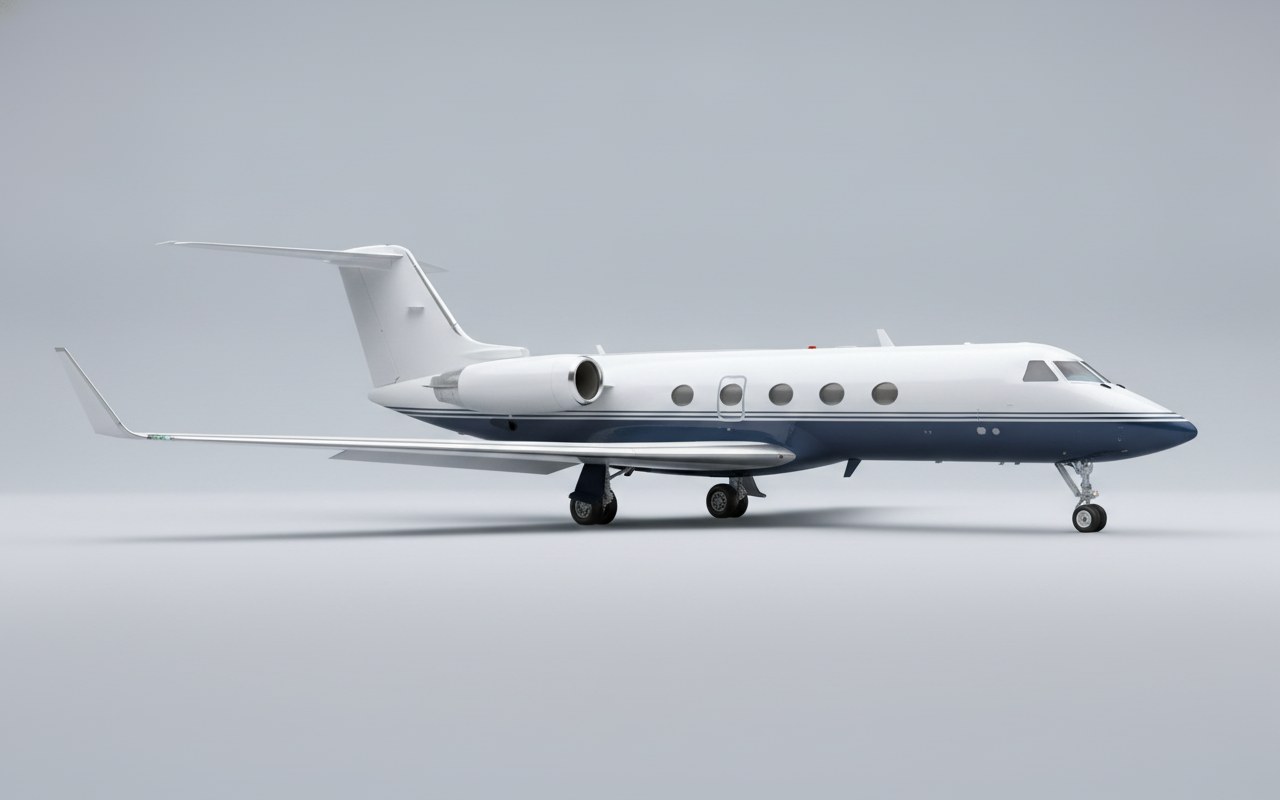
The aircraft's most revolutionary feature was its factory-installed winglets, making it the first corporate jet to incorporate these drag-reducing devices as standard equipment. The winglets, combined with a six-foot wingspan extension and modified supercritical airfoil concepts, improved fuel efficiency and extended range capabilities. The fuselage stretched two feet aft of the main door, while a curved windshield enhanced aerodynamic performance.
Performance and Pilot Experience
Pilots praised the Gulfstream III's combination of performance and handling characteristics. The aircraft achieved maximum cruise speeds of 577 mph (Mach 0.80) at altitude, with approach speeds of 135 knots ensuring manageable airport operations. Its maximum takeoff weight of 69,700 pounds enabled transcontinental flights while maintaining short-field capabilities crucial for accessing smaller corporate airports.
The cockpit accommodated two or three crew members with advanced avionics systems representing 1980 state-of-the-art technology. Flight crews appreciated the aircraft's stability and predictable handling characteristics, factors that contributed to its safety record and operator confidence.
Production Legacy and Current Status
Certified by the Federal Aviation Administration on September 22, 1980, the Gulfstream III entered service as production ramped up in Savannah. The seven-year production run concluded in 1986 with 202 aircraft delivered, as Gulfstream transitioned manufacturing resources to the more advanced Gulfstream IV.
Dozens of Gulfstream III aircraft remain in active service today, testament to the type's robust construction and enduring utility. However, the aircraft's operational history includes notable accidents, including the March 29, 2001 Avjet crash in Aspen that claimed 18 lives, and the July 4, 2017 loss of a Venezuelan government aircraft with nine presumed fatalities.
The Gulfstream III's introduction of winglet technology and long-range capabilities established design principles that influenced subsequent business jet development. Its successful integration of advanced aerodynamics with proven systems created a template for corporate aviation that continues influencing aircraft design four decades after its first flight.