
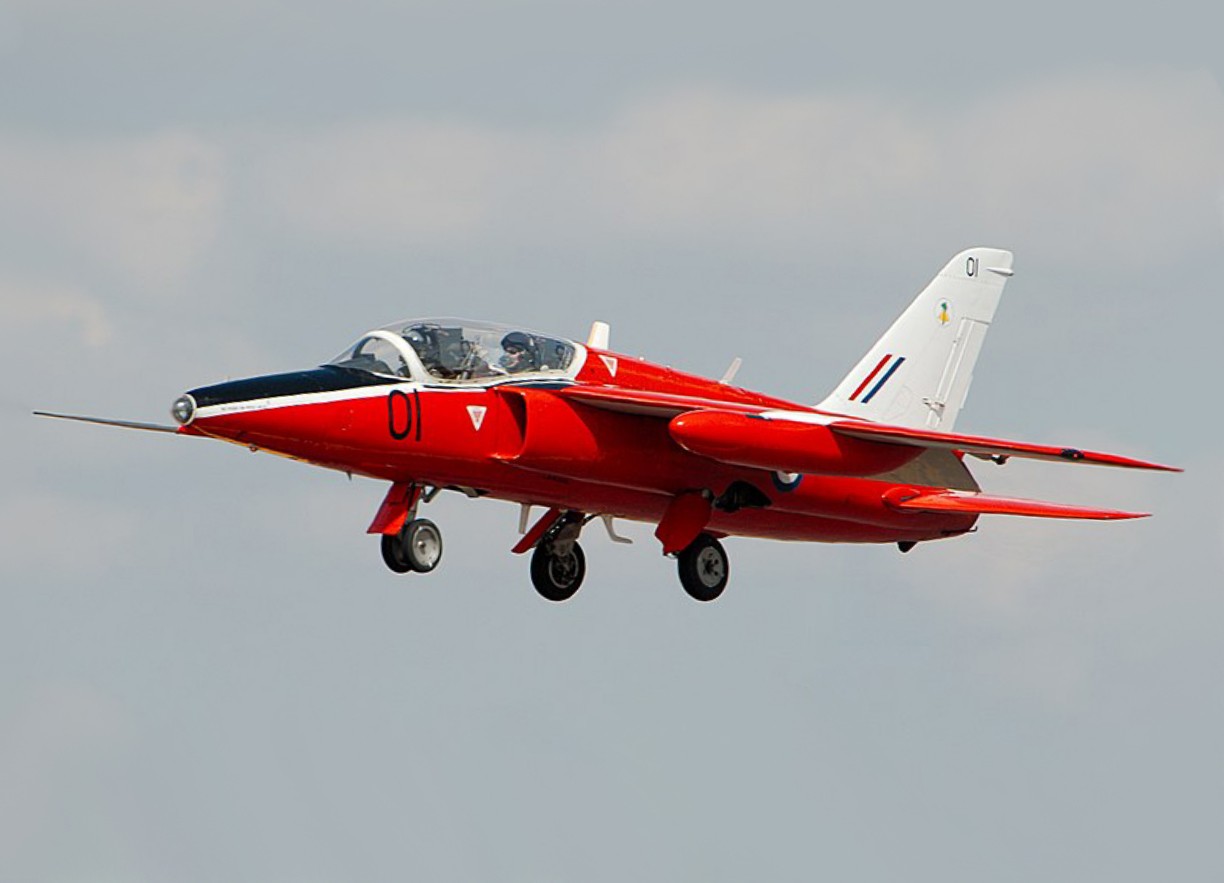
Service History
The Gnat T.Mk.1 entered Royal Air Force service in 1959, transforming British jet pilot training with its exceptional maneuverability and economical operation. The RAF operated approximately 450 Gnats across all variants, with the T.Mk.1 serving as the primary advanced trainer until the 1980s. Its lightweight design and responsive handling made it ideal for teaching fighter pilot techniques, while its relatively low operating costs allowed extensive flight training during an era of defense budget constraints.
The aircraft gained international recognition when the RAF's Red Arrows aerobatic team adopted the Gnat T.Mk.1 from 1963 to 1980, showcasing its precise handling characteristics to audiences worldwide. The team's performances demonstrated the aircraft's capabilities and helped establish its reputation as one of the finest training aircraft ever built.
Combat Legacy
While the T.Mk.1 variant remained a trainer, the single-seat Gnat F.Mk.1 fighter variant proved its combat worth during the Indo-Pakistani conflicts of 1965 and 1971. Indian Air Force pilots flying Gnats claimed 10 aerial victories against Pakistani F-86 Sabres during the 1965 war, with Squadron Leader J.K. Mohlah scoring the type's first air-to-air kill. No. 2 Squadron IAF, known as "Second to None," operated Gnats extensively in these conflicts, though India lost approximately 30 aircraft to ground fire and combat during the 1965 war.
The Manufacturer
Folland Aircraft Ltd was founded on December 24, 1937, when Henry P. Folland, former chief designer at Gloster Aircraft Company, acquired the failing British Marine Aircraft Limited. Operating from the Hamble facility near Southampton, the company initially survived World War II through subcontract work on aircraft including the Bristol Blenheim, de Havilland Mosquito, and Vickers Wellington.
Henry P. Folland served as both managing director and chief designer, leading the transition from wartime subcontracting to original jet aircraft design in the 1950s. The company's independence ended in 1959 when Hawker Siddeley acquired it during government-mandated industry consolidation. The Folland name disappeared in 1963, though production continued under Hawker Siddeley until the final aircraft rolled off the line that same year. The Hamble facility later became part of British Aerospace in 1977 and produced Harrier and Hawk components until the airfield's closure in 1986.
Engine and Technical Innovation
The Gnat T.Mk.1 was powered by a single Bristol Siddeley Orpheus turbojet engine producing 4,705 pounds of thrust. This reliable powerplant, manufactured by Bristol Siddeley Engines (later absorbed by Rolls-Royce), was specifically designed for smaller jet aircraft and proved exceptionally dependable throughout the Gnat's service life. Over 1,000 Orpheus engines were produced during its production run from the mid-1950s to early 1970s.
Folland's design philosophy emphasized extreme weight reduction and structural efficiency. The aircraft's empty weight of under 2 tons was revolutionary for a jet trainer, achieved through innovative construction techniques and careful material selection. The swept wings and compact fuselage provided exceptional maneuverability while maintaining structural integrity at high speeds.
Pilot Experience
Pilots consistently praised the Gnat T.Mk.1 for its responsive controls and forgiving flight characteristics. The tandem seating arrangement provided excellent visibility for both instructor and student, while the aircraft's small size required precise flying techniques that translated well to larger, more complex fighters. With a service ceiling of 48,000 feet and an impressive climb rate of 20,000 feet per minute, the Gnat could simulate high-altitude combat conditions effectively.
The aircraft's 500-mile range was adequate for training missions, though longer cross-country flights required careful fuel management. Its relatively high landing speed demanded proficiency in approach techniques, making it an excellent preparation for contemporary jet fighters.
Production and Legacy
Exact production numbers for the T.Mk.1 variant remain unclear, though RAF records indicate receipt of approximately 450 Gnats across all variants. Manufacturing at the Hamble facility continued through 1963, with flight testing conducted at nearby Chilbolton airfield. The aircraft's export success, particularly with the Indian Air Force, demonstrated the viability of British lightweight fighter design concepts.
Today, between 20 and 30 Gnat T.Mk.1s remain airworthy, primarily in private hands as warbirds and display aircraft. Notable museum examples include XR537 at RAF Museum Cosford, aircraft at the Imperial War Museum Duxford, and examples preserved at the Indian Air Force Museum in New Delhi. The Gnat's influence on subsequent trainer design is evident in aircraft like the BAE Hawk, which adopted similar lightweight, cost-effective design principles that Folland pioneered with the Gnat series.