
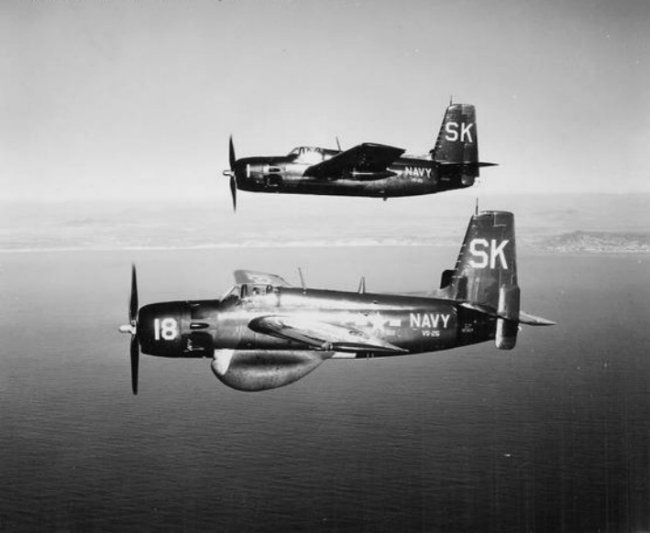
The Grumman AF Guardian was developed as a direct response to a 1944 U.S. Navy request for a replacement for the TBF Avenger torpedo bomber. The aircraft's origins lie in the XTB3F-1, a mixed-power prototype that utilized both a radial piston engine and a small jet. This prototype first flew on December 23, 1946, but the mixed-power program was cancelled the following day. Grumman subsequently reworked the airframe into a dedicated carrier-based ASW platform, resulting in the AF Guardian. The first production AF-2S flew on November 17, 1949.
Production ran from approximately 1949 to 1953, with a total of 389 airframes built, including three XTB3F-1 prototypes. The production fleet consisted of 153 AF-2W search variants, 193 AF-2S attack variants, and 40 AF-3S attack variants. The AF-2W was a four-seat aircraft equipped with a large ventral APS-20 radar dome for submarine localization, while the AF-2S was a three-seat attack aircraft featuring an internal bomb bay. The AF-3S further improved the attack role by adding fuselage-mounted magnetic anomaly detection (MAD) gear. All operational variants were powered by a single Pratt & Whitney R-2800-48W 18-cylinder radial engine producing 2,400 horsepower.
Entering fleet service on September 27, 1950, the Guardian served exclusively with the U.S. Navy, primarily operating from Commencement Bay-class escort carriers. During the Korean War, Guardians conducted maritime patrols from bases in Japan and Guam. While no aircraft were lost to enemy action during this conflict, the type suffered a high accident rate due to poor low-speed handling and heavy controls. The Guardian was phased out of front-line service by 1954–55 in favor of the S2F Tracker, though some remained in Naval Air Reserve units until 1957.
Following its military retirement, a small number of AF-2S aircraft were converted into civilian fire-fighting tankers by the Aero Union Corporation in California, where they operated until 1973. Only five aircraft are believed to have survived scrapping. One notable survivor, BuNo 123100, is preserved by the National Air and Space Museum / Naval Aviation collection. The Guardian remains historically significant as a transitional step in ASW aviation, proving the necessity of the integrated platforms that followed.