
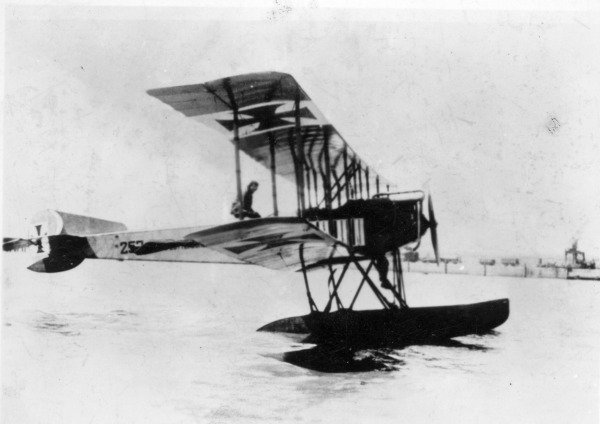
The Gotha WD.2 was a German seaplane developed by Gothaer Waggonfabrik (GWF) during the early stages of World War I. Designed as a two-seat reconnaissance floatplane, the WD.2 represented the company's first venture into large-scale seaplane production. It was specifically engineered to provide improved range over its predecessor, the WD.1, making it a more effective tool for long-range naval patrol duties.
Production of the aircraft began in 1914, with the first flight occurring in July of that year. The manufacturing process was centered in Gotha, Thuringia, Germany. While the WD.2 was the primary model, the WD.2/WD.2a family saw a combined total of 27 aircraft built. Of these, 11 units were delivered to the German Navy in 1915. Beyond German service, the aircraft was exported to Turkey; these specific export versions were modified to include a machine gun mounted on the center section for use by the observer.
Technically, the WD.2 was powered by a single piston engine, with different versions utilizing either a 100 hp Benz Bz.III or a 150 hp Rapp engine. The aircraft had an empty weight of 1,065 kg and a loaded weight of 1,630 kg. Performance varied by variant; the WD.2 reached speeds of 112 km/h (70 mph), while the WD.2a was recorded at 59.5 mph at sea level. The WD.2a offered a significant operational range of 415 miles, and the aircraft could reach a service ceiling of 3,000 m (9,840 ft).
The development of the WD.2 marked a pivotal shift for Gothaer Waggonfabrik, which had previously operated as a rail and rolling-stock manufacturer since the late 19th century. After entering the aviation sector in 1913, the company's reputation grew through the production of such naval aircraft. Following the war, the company was restricted by the Treaty of Versailles and eventually ceased aircraft construction in 1954, returning to the production of light rail vehicles and trams in East Germany. No verified airframes of the WD.2 are known to survive today.