
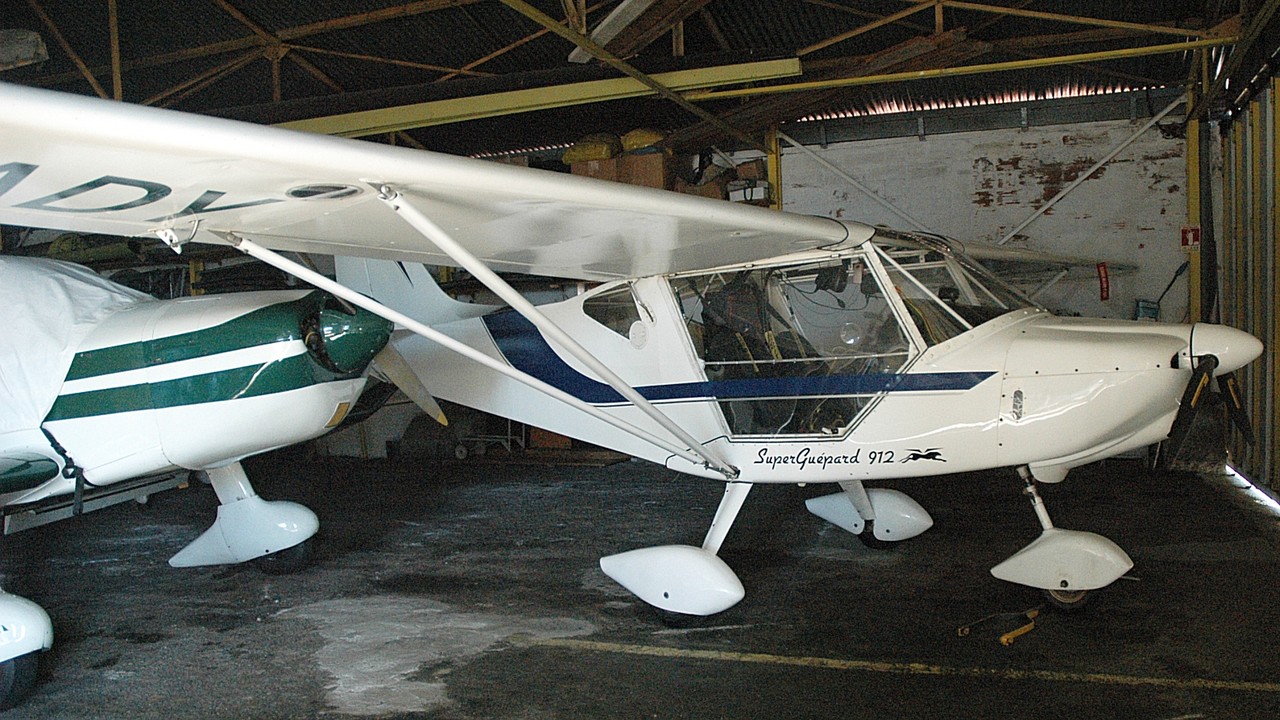
Development and Design Philosophy
The Guépard 912 emerged from France's thriving ultralight aviation movement of the 1990s, when Aéro Services Guépard sought to create a versatile microlight that would appeal to both amateur builders and pilots seeking enclosed comfort. The design team prioritized safety and performance, constructing the aircraft around a welded steel tube fuselage that provided superior crash protection compared to aluminum alternatives common in the ultralight category.
The aircraft's high-wing configuration with external bracing delivered the stable flight characteristics essential for the training and recreational roles it was intended to fill. Unlike many ultralights of the era that offered tandem seating, the Guépard 912 featured side-by-side accommodation, enhancing communication between instructor and student while providing a more conventional flying experience.
Technical Specifications and Performance
Measuring 9.6 meters in wingspan with a wing area of 14.60 square meters, the Guépard 912 struck an effective balance between performance and handling. The aircraft's empty weight of 282 kilograms allowed for a useful load that included 65 liters of fuel and a passenger, bringing maximum takeoff weight to 472.5 kilograms.
The powerplant consisted of Austrian-built Rotax 912 series engines, typically either the 80-horsepower Rotax 912 or the 100-horsepower 912S variant. These four-stroke, air- and liquid-cooled engines provided reliable operation at the 5,200 rpm maximum continuous setting while offering economical cruise performance at 4,000 rpm. The engine installation enabled the aircraft to achieve a maximum speed of 190 km/h, cruise at 170 km/h, and maintain a climb rate of 5 meters per second.
Perhaps most impressive was the Guépard 912's stall speed of just 45 km/h, which combined with its robust construction made it suitable for operations from short, unprepared airstrips. This short takeoff and landing capability became a hallmark of the Guépard family and contributed significantly to its competition success.
Manufacturing and Variants
Aéro Services Guépard offered the aircraft in both kit and complete forms, catering to amateur builders who preferred to construct their own aircraft as well as pilots who wanted a finished product. The company's attention to construction quality earned recognition from French civil aviation authorities, who approved the design for safety demonstrations.
The closely related Super Guépard variant featured slightly reduced dimensions with an 8.5-meter wingspan and 12.75 square meters of wing area, optimized for competitive flying. This variant achieved remarkable success in European microlight competitions, capturing multiple French championships and a World Cup victory that demonstrated the fundamental soundness of the basic design.
The Manufacturer
Aéro Services Guépard operated from Villefranche-de-Rouergue in southern France, though precise details about the company's founding and operational history remain limited. The manufacturer concentrated exclusively on microlight aircraft that complied with FAI standards, building a reputation for quality construction and innovative design approaches.
Production of Guépard variants continued through at least the 2010s, as evidenced by accident reports and ongoing operations, though the company's current status remains unclear. The limited production numbers typical of specialized microlight manufacturers meant that Guépard aircraft remained relatively rare even during their production years.
Operational History
The Guépard 912 found its primary market among French ultralight enthusiasts and flight training organizations seeking a robust, enclosed aircraft for instruction. The side-by-side seating arrangement and conventional control layout made it particularly suitable for converting pilots from traditional general aviation aircraft to the ultralight category.
Accident reports, including a 2012 incident involving nose gear collapse after landing, indicate that Guépard 912 aircraft remained active in civilian operations well into the 2010s. The aircraft's forgiving handling characteristics and strong construction contributed to its reputation for safety within the microlight community.
Legacy and Current Status
While never achieving the production volumes of major general aviation manufacturers, the Guépard 912 represented an important step in the evolution of European microlight design. Its emphasis on enclosed comfort, structural integrity, and short-field performance influenced subsequent ultralight development and demonstrated that small aircraft could offer both economy and capability.
Today, surviving examples continue to serve recreational pilots, though exact numbers remain unknown due to the aircraft's limited production run. The Guépard 912's contribution to ultralight aviation lies not in revolutionary technology but in the thoughtful integration of proven concepts into a package that offered genuine utility for its intended mission.