
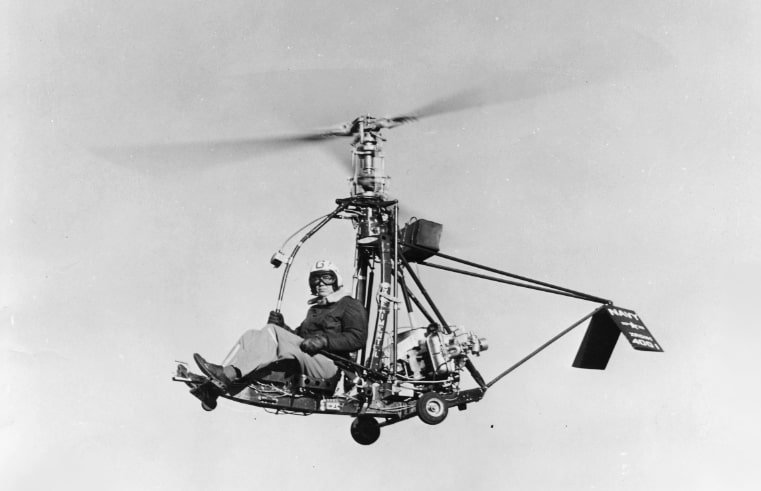
The Gyrodyne RON Rotorcycle was an experimental, single-seat helicopter developed in the United States during the mid-1950s. Designed under a U.S. Navy contract, the aircraft was intended to fulfill a 'personal helicopter' requirement, serving as a compact tool for observation, liaison, and small-unit tactical tasks. One of its most distinctive intended roles was as an emergency extraction vehicle that could be air-dropped to downed airmen behind enemy lines, allowing them to fly themselves to safety.
Technologically, the Rotorcycle was defined by its coaxial rotor system, featuring two main rotors on a single axis rotating in opposite directions. This configuration eliminated the need for a tail rotor, resulting in a highly compact airframe consisting of a simple open tubular frame that left the pilot fully exposed. The aircraft first flew on November 23, 1955. Power was provided by a Porsche YO-95-6 engine, a 72 hp (54 kW) four-cylinder, air-cooled, horizontally-opposed piston engine.
Production was limited to a prototype program, with a total of 10 airframes built by the Gyrodyne Company of America at its facilities in St. James, Long Island, New York. These prototypes carried various designations, including HOG, RON, YRON-1, and XRON-1. In 1958, the U.S. Marine Corps tested the aircraft through Marine Experimental Helicopter Squadron 1 (HMX-1) at Marine Corps Base Quantico, Virginia. However, the Marine Corps ultimately determined the Rotorcycle was too difficult to fly and too heavy for its specific requirements, leading to the termination of the program by 1959.
Despite the cancellation of the manned program, the Rotorcycle's legacy was significant. The U.S. Navy was impressed by the coaxial design and load-carrying capabilities, leading to a 1960 contract to develop a radio-controlled anti-submarine warfare (ASW) platform. By utilizing the RON's dynamic components, such as the rotor and transmission, Gyrodyne developed the QH-50 DASH drone. Today, several prototypes survive as static museum exhibits, including examples at the Pima Air & Space Museum and the National Naval Aviation Museum, with one specific airframe (serial number 4013) appearing at the Hickory Aviation Museum.