
Service History
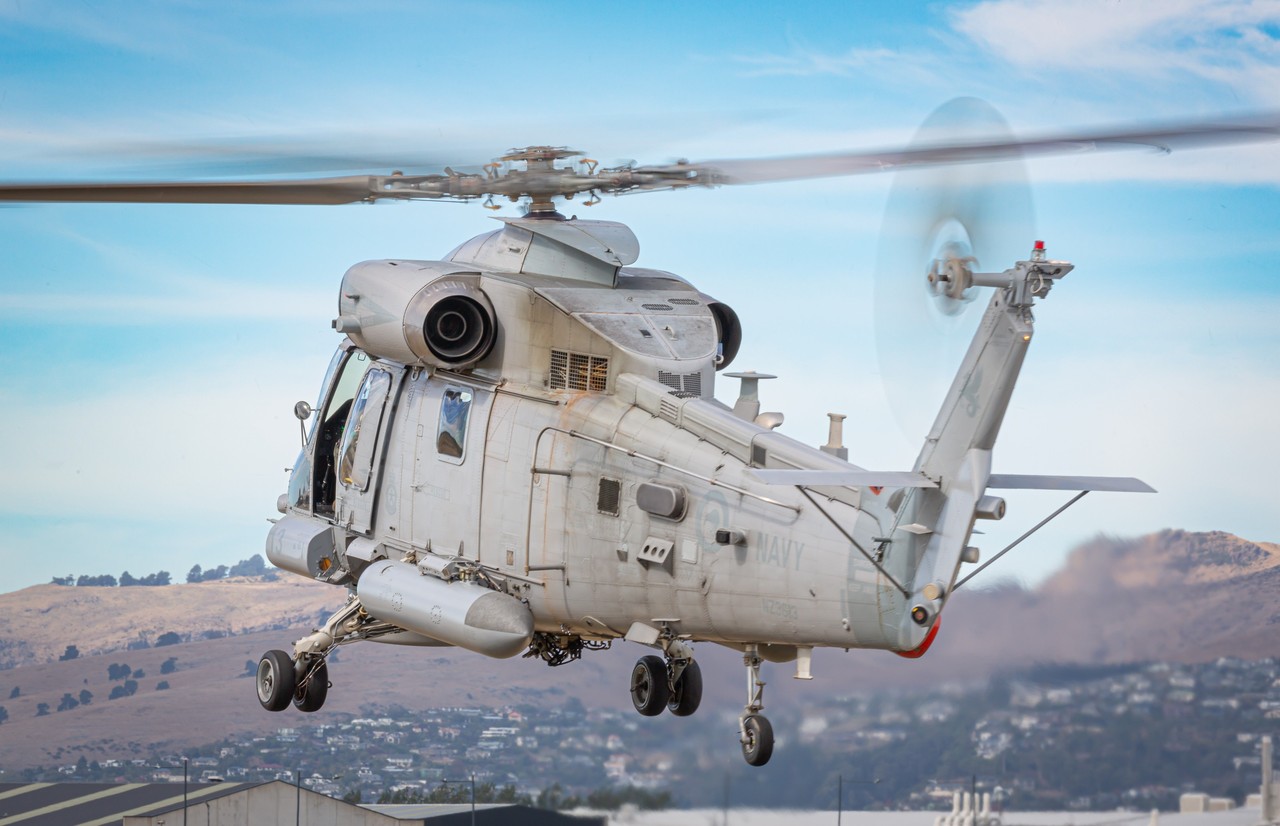
The SH-2 Seasprite established itself as the backbone of the Navy's Light Airborne Multi-Purpose System (LAMPS) program, completing over 600 deployments and accumulating 1.5 million flight hours during its 39-year service life with the U.S. Navy from 1962 to 2001. The helicopter's compact size enabled operations from frigates and destroyers previously unable to support aviation assets, revolutionizing anti-submarine warfare capabilities across the fleet. LAMPS Mk I deployment began on December 7, 1971, with the first SH-2F Pacific deployment following on September 11, 1973.
Operational Evolution
The Seasprite underwent continuous evolution through eight major variants, beginning with four YHU2K-1 prototypes and progressing through utility and anti-submarine warfare configurations. The initial HU2K-1, later redesignated UH-2A, entered service in 1962 with 88 aircraft built for utility transport and search-and-rescue missions. Kaman produced 102 UH-2B helicopters before converting 40 aircraft to the twin-engine UH-2C configuration in 1967, dramatically improving safety and performance for over-water operations.
The SH-2D marked the transition to dedicated anti-submarine warfare with its first flight on March 16, 1971. This led to the SH-2F, with 54 new-build aircraft delivered by 1989, specifically designed for the LAMPS I mission with advanced sensors and weaponry. The final U.S. Navy variant, the SH-2G Super Seasprite, first flew on April 2, 1985, featuring more powerful General Electric T700 engines and enhanced avionics.
The Manufacturer
Kaman Aircraft Corporation was founded in 1945 by Charles H. Kaman as Kaman Aircraft Engineering Corporation in Bloomfield, Connecticut. The company pioneered intermeshing rotor helicopter designs and achieved the distinction of operating the first helicopter powered by a gas turbine engine with the Kaman K-225. Under Kaman's leadership, the company developed innovative rotor systems and became a specialist in naval rotorcraft applications.
In 1999, Lockheed Martin acquired Kaman's aerospace division, though the rotorcraft business later became part of Kaman Aerospace Corporation. Since 2019, The Carlyle Group has owned the company, which continues operations today focusing on advanced aerostructures and rotorcraft components, maintaining the legacy established by Charles Kaman's engineering innovations.
Engine and Technical Innovation
The Seasprite's transformation from single to twin-engine configuration represented a crucial advancement in naval aviation safety. Early variants employed a single General Electric T58-GE-8B turboshaft producing 1,250 shaft horsepower, while later models featured twin T58-GE-8F engines delivering 1,007 kilowatts each. The final SH-2G variant upgraded to General Electric T700-GE-401 turboshafts, providing superior performance and reliability.
General Electric's T58 engine, manufactured from 1956 through the 1990s with over 18,000 units produced, proved ideally suited for naval operations. The free-turbine design offered excellent power response characteristics essential for shipboard operations, while its compact size enabled the Seasprite's four-bladed main and tail rotor system to achieve cruise speeds of 130 knots at ranges up to 411 nautical miles.
International Service
Following U.S. Navy retirement in 2001, the Seasprite found new life with international operators. Egypt operates ten SH-2G aircraft, while New Zealand acquired four SH-2G helicopters in 2001 for maritime patrol duties. Taiwan received twelve ex-U.S. Navy SH-2F aircraft, and smaller numbers serve with Peru and Poland, demonstrating the design's continued relevance in naval operations.
The Royal Australian Navy ordered eleven SH-2G Super Seasprites, though this program encountered significant technical challenges. These international sales extended the Seasprite's operational life well into the 21st century, with approximately 37 aircraft remaining in active service with various nations as of the 2020s.
Legacy and Preservation
The Seasprite's four-decade service life proved the viability of turbine-powered helicopters operating from small naval vessels, establishing principles later incorporated into the SH-60 Seahawk. Its success in the LAMPS role demonstrated how compact rotorcraft could extend the sensor and weapon reach of individual ships, multiplying fleet effectiveness in anti-submarine warfare.
Several Seasprites are preserved in museums, including an SH-2F at the Pima Air & Space Museum in Tucson, Arizona, and multiple variants at the New Hampshire Aviation Historical Society. These preserved aircraft represent a pivotal chapter in naval aviation history, when the marriage of turbine power and shipboard operations transformed maritime warfare capabilities for smaller combatant vessels throughout the world's navies.