
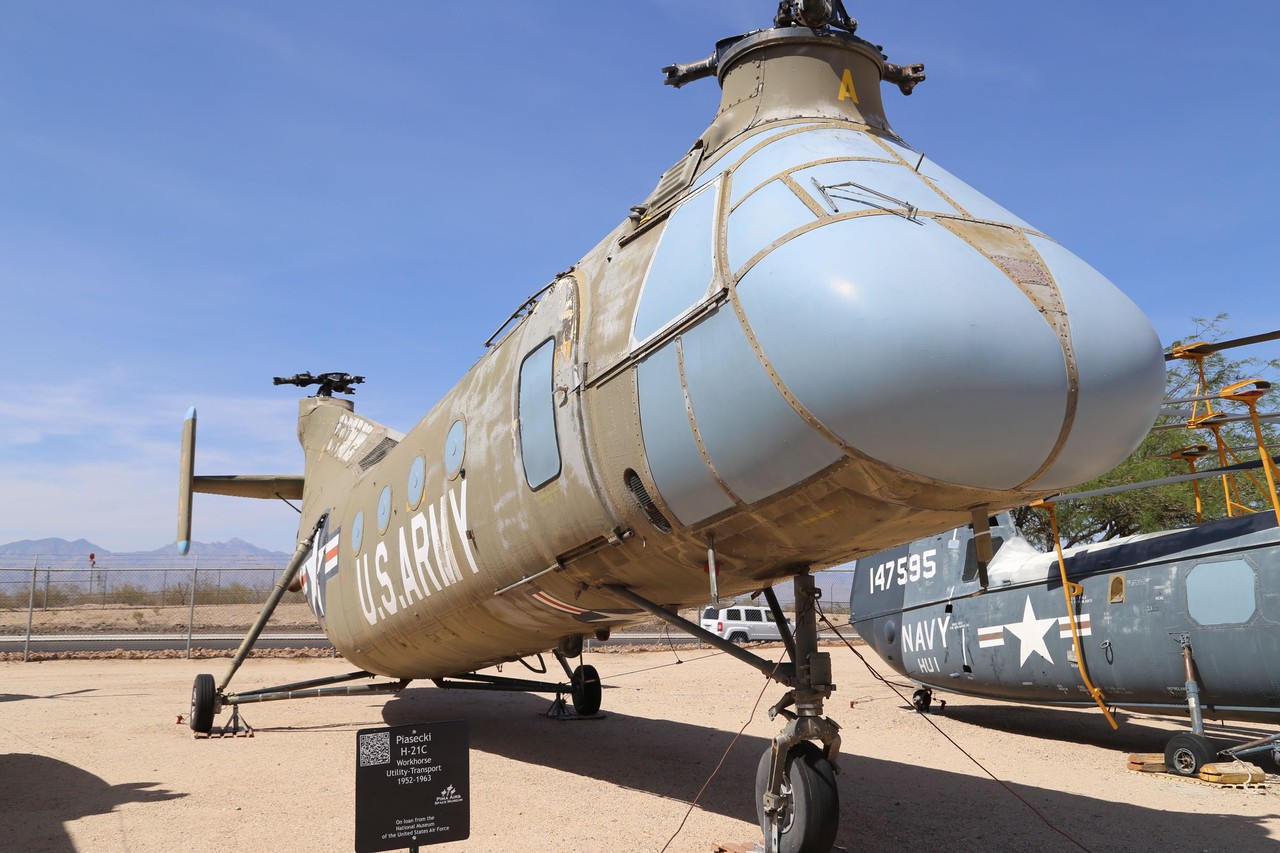
Revolutionary Design
Frank Nicholas Piasecki led the engineering team that created this groundbreaking rotorcraft at Piasecki Helicopter Corporation's facility in Morton Grove, Pennsylvania. The H-21 evolved from the earlier HRP-1 prototype, incorporating all-metal construction and enhanced cold-weather capabilities that would prove essential for Arctic operations. The distinctive curved fuselage, which earned it the nickname "Flying Banana," housed the mechanical systems needed to drive both rotors from a single engine mounted in the aircraft's nose.
Production and Variants
Between 1952 and 1959, approximately 707 H-21s rolled off the production line in various configurations. The manufacturing program began with 18 pre-production YH-21 aircraft, followed by 32 H-21A search and rescue variants for the U.S. Air Force. The H-21B assault transport version accounted for 163 units, while the U.S. Army's CH-21C Shawnee represented the largest production run with 334 aircraft delivered. Deliveries commenced in September 1954 and concluded in March 1959, with each aircraft carrying a unit cost of $406,000.
Military Service Record
The U.S. Air Force received its first H-21A models in 1953, deploying them for search and rescue missions in challenging environments including Alaska and along the DEW Line radar installations. These operations demonstrated the aircraft's exceptional cold-weather performance, operating reliably in temperatures as low as minus 65 degrees Fahrenheit. The Army's CH-21C Shawnee variants played a crucial role in early airmobility experiments during the early 1960s Vietnam conflict, transporting South Vietnamese troops before being replaced by the UH-1 Huey in 1963.
French forces employed H-21s extensively during the Algerian War throughout the 1950s, adapting some aircraft with improvised armament including .50-caliber machine guns and 20mm cannons. Despite these modifications, the H-21 proved less effective in combat roles than the competing H-34 Choctaw. International operators included Canada, West Germany, Sweden, and Japan, with approximately 150 units exported to allied nations.
The Manufacturer's Evolution
Piasecki Helicopter Corporation, founded by rotorcraft pioneer Frank Piasecki in the late 1940s, had established itself as the leading developer of tandem-rotor helicopters with the successful HRP-1. However, corporate upheaval in 1955 led to Frank Piasecki's departure and the company's reorganization as Vertol Aircraft Corporation. Boeing acquired Vertol in 1960, transforming it into Boeing Vertol and continuing the tandem-rotor legacy through the highly successful CH-47 Chinook program that remains in production today.
Technical Innovation
The heart of the H-21 was the Wright R-1820 Cyclone, a nine-cylinder supercharged radial engine that delivered 1,150 horsepower in early variants and 1,425 shaft horsepower in the improved H-21B and H-21C models. This powerplant, manufactured by Curtiss-Wright, had proven its reliability across more than 10,000 units produced for various aviation applications since the 1930s. The engine's supercharging system maintained power output at high altitudes, enabling the H-21 to achieve a service ceiling of 19,200 feet.
The tandem rotor configuration eliminated the need for a tail rotor, allowing all engine power to contribute to lift and forward propulsion. Each rotor measured 44 feet in diameter, an increase from the 41-foot rotors used on earlier Piasecki designs. This arrangement enabled the H-21 to nearly double its gross weight compared to predecessor aircraft, jumping from 7,225 pounds to 14,700 pounds.
Performance Characteristics
Pilots appreciated the H-21's stability and load-carrying capability, though the aircraft's 125-mph maximum speed and 90-mph cruising speed reflected the limitations of its piston-powered design. The helicopter achieved a maximum range of 450 miles and could maintain flight with a crew of two or three. In transport configuration, the spacious cabin accommodated 20 fully equipped soldiers, while medical evacuation missions allowed for 12 stretcher patients with attendant medical personnel.
Legacy and Preservation
By 1971, all H-21s had been retired from U.S. military service, with the Army phasing out its CH-21C fleet in 1963 and the Air Force following suit by the early 1970s. Some aircraft found civilian roles, including firefighting operations with companies like Aero Union. Today, no H-21s remain in flying condition, but several significant examples are preserved in museums including the Hill Aerospace Museum in Utah, the Vintage Flying Museum's "Shaky Magoo," and displays at the SAC Aerospace Museum and Museum of Flight.
The H-21's influence on rotorcraft development extends far beyond its service life, establishing the tandem-rotor configuration as the preferred solution for heavy-lift helicopter missions and directly inspiring the CH-47 Chinook family that continues to serve military forces worldwide.