
Revolutionary Design Philosophy
The Model 107 emerged from Piasecki Helicopter Corporation's ambitious vision to replace aging piston-powered rotorcraft with advanced turbine technology. Development commenced in 1956 under the internal designation V-107, representing a quantum leap from earlier helicopters like the H-21 "Flying Banana." The prototype utilized two Lycoming T53 turboshaft engines, each producing 877 shaft horsepower, marking a significant advancement in rotorcraft powerplant technology.
Manufacturing Evolution
The aircraft's manufacturing history reflects the dynamic nature of the aerospace industry during the jet age. Piasecki Helicopter Corporation, which had invented the tandem rotor configuration, renamed itself Vertol before being acquired by Boeing in 1960. Under Boeing ownership, the aircraft became the Boeing Vertol Model 107, establishing the foundation for both military and commercial variants.
In a strategic move during 1965, Boeing Vertol transferred manufacturing rights to Kawasaki Heavy Industries of Japan, along with worldwide sales rights for the Model 107-II commercial variant. Kawasaki continued production under the designation KV-107-IIA until 1990, when the production line finally closed after 25 years of Japanese manufacturing.
Military Dominance
The Model 107's military variants achieved legendary status across multiple service branches. The U.S. Army initially ordered the type as the YHC-1A in June 1958, though this order was later reduced to three aircraft. The U.S. Marine Corps adopted it as the HRB-1, later redesignated CH-46A and officially named "Sea Knight," though Marines affectionately called it the "Phrog."
The CH-46 Sea Knight dominated Marine Corps operations from the Vietnam War through its frontline retirement in 2014, serving across every operational environment the Marines encountered. The U.S. Navy also utilized the type for utility missions, while the Royal Canadian Air Force operated it as the CH-113 Labrador. International operators included the Swedish military, which designated their aircraft HKP-4.
Commercial Operations
New York Airways became the first commercial operator, ordering the BV 107-II variant during 1960. The airline configured their aircraft to seat 25 passengers, with the first three helicopters delivered in July 1962. This commercial variant represented an early attempt to establish scheduled passenger helicopter service in urban environments.
The aircraft's commercial potential was somewhat limited by the specialized nature of tandem rotor operations and the economics of helicopter passenger service. However, it found success in specialized heavy-lift and utility roles, particularly with operators requiring the unique capabilities of tandem rotor aircraft.
Modern Renaissance
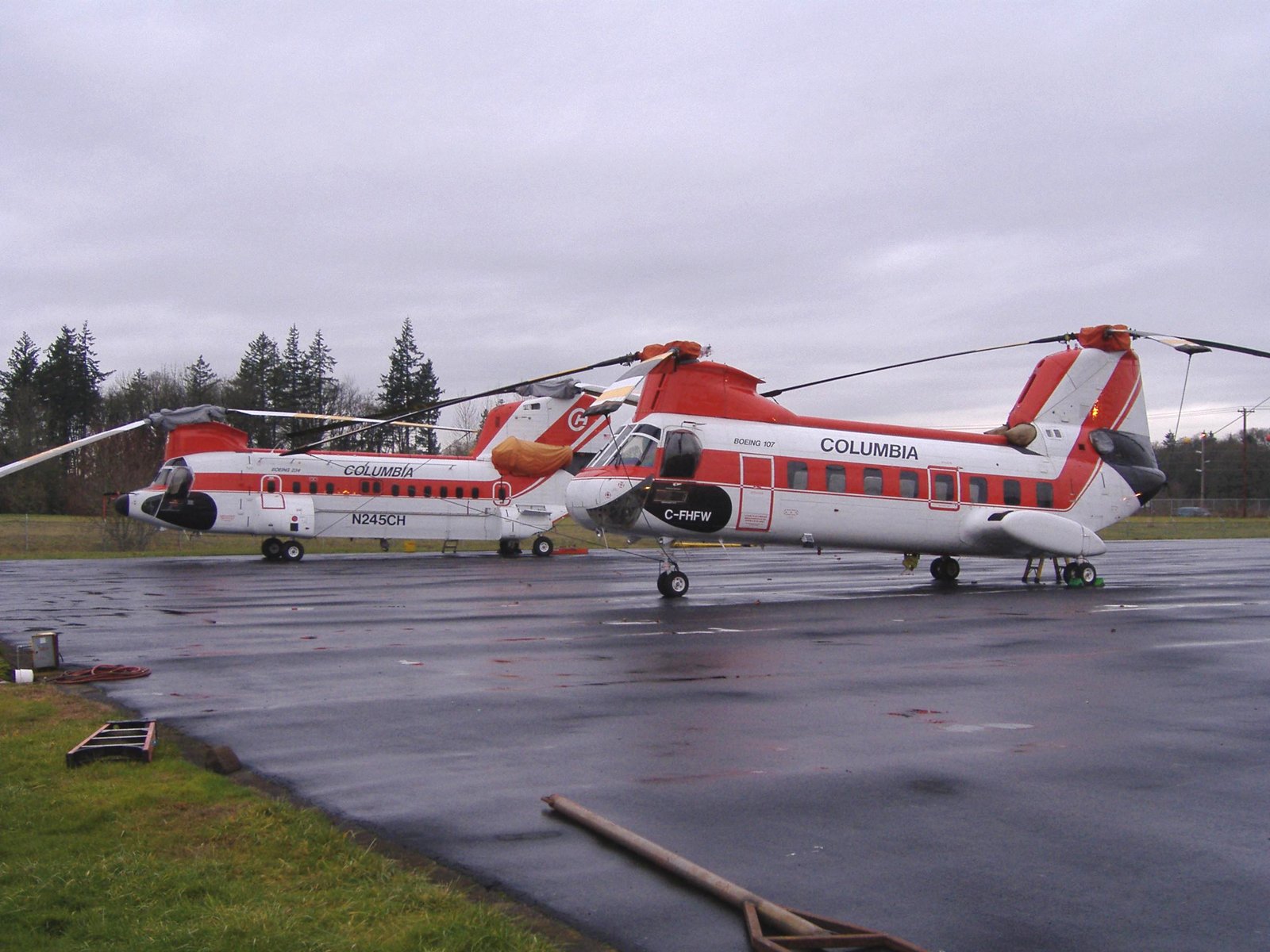
Columbia Helicopters has emerged as the aircraft's most significant modern advocate. In December 2006, Columbia purchased the type certificate from Boeing, becoming the official support organization for all Model 107-II and CH-46 helicopters worldwide. The company established an international reputation as the premier civil operator of both Model 107 and Model 234 helicopters.
Columbia identified approximately 90 airframes suitable for remanufacturing and partnered with Piasecki Aircraft Corporation to develop the upgraded Model 107-III variant. This collaboration, officially launched in July 2024, combines surviving 107-II and CH-46E airframes from both Boeing and Kawasaki production, primarily sourced from retired foreign military aircraft.
Technical Innovation
The Model 107-III upgrade incorporates significant improvements over earlier variants. The new configuration utilizes CT58-GE-16 engines, which provide approximately 20 percent more horsepower than the CT58-140 engines used in the 107-II. These engines represent the commercial designation for the T58-GE-16 powerplants used on military CH-46E helicopters.
Columbia has established comprehensive support infrastructure, including Total Logistics Support for all GE T58 and CT58 engines. The company is developing an FAA Part 145 repair station at Piasecki's Coatesville Heliplex facility to provide complete product support for the 107-III variant.
Production Legacy
The remanufacturing program represents a unique approach to aircraft production in the modern era. Piasecki has already inducted four CH-46E airframes at its Pennsylvania facility, with plans to deliver six upgraded helicopters initially before ramping up to full-rate production of 12 aircraft annually. This production model demonstrates how classic aircraft designs can be revitalized with modern technology and manufacturing techniques.
The Model 107's enduring appeal lies in its proven tandem rotor configuration and heavy-lift capabilities. While exact total production numbers remain undisclosed, the aircraft's military variants numbered in the hundreds, ensuring a substantial pool of airframes for potential conversion to the new 107-III standard.