
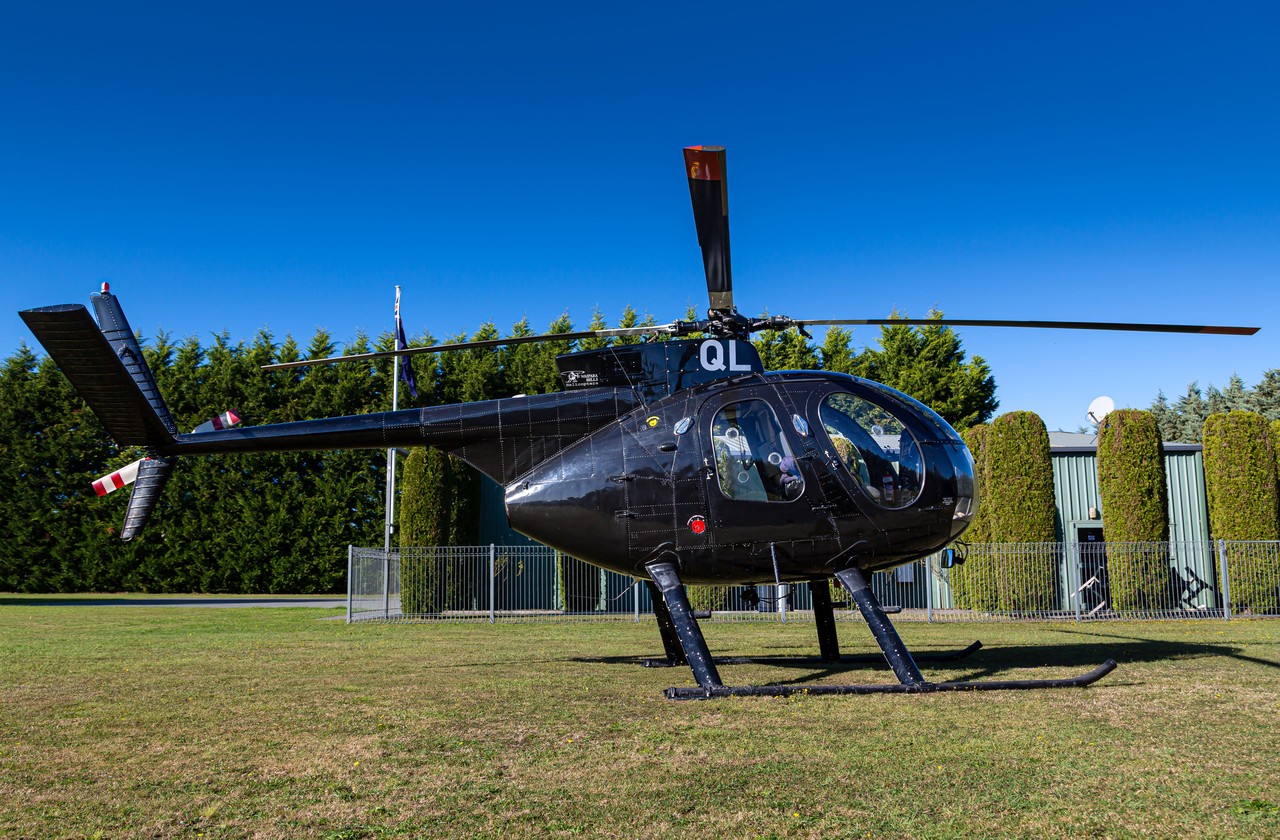
Military Dominance and Vietnam Service
The Hughes 500 achieved its initial fame as the OH-6A Cayuse, serving extensively throughout the Vietnam War from March 1967. The U.S. Army operated 1,434 of these light observation helicopters, employing them for reconnaissance, command and control, and light attack missions. Despite suffering significant losses—658 aircraft lost in combat and 269 in accidents—the OH-6A proved its worth in the challenging Southeast Asian environment. Early mechanical issues with Teflon uniball flaking in the rotor head were resolved by 1967, establishing the aircraft's reputation for reliability under combat conditions.
The helicopter's compact size and agility made it ideal for low-level reconnaissance missions, earning it the nickname "Loach" among military personnel. By 1970, sixteen countries had adopted various military versions of the 500 series, including the export-oriented 500M Defender introduced in 1968.
The Hughes Legacy
Hughes Tool Company's Aircraft Division, led by the eccentric Howard Hughes himself, secured the original military contract through aggressive bidding tactics. In 1965, Hughes underbid competitors by offering the OH-6A at $19,860 per unit, significantly lower than Fairchild-Hiller's $29,415 proposal. This bold pricing strategy, while causing initial production challenges, established Hughes Helicopters as a major player in the rotorcraft industry.
Operating from Culver City, California, Hughes Helicopters had introduced its first production helicopter, the Model 269, in 1960. The company's ownership changed hands multiple times: McDonnell Douglas acquired Hughes Helicopters in 1984, Boeing purchased McDonnell Douglas in 1997, and RDM Holdings bought the helicopter division in 1999, renaming it MD Helicopters, which continues operations today.
Engineering Excellence
The Hughes 500's design philosophy emphasized low drag, minimal weight, and reduced maintenance requirements. The prototype, designated N9696F, achieved its first flight on February 27, 1963, with test pilots Raleigh Fletcher and James Albert Vittitoe at the controls. The aircraft's innovative design incorporated a lightweight structure that contributed to its competitive advantage over rival designs from Bell and Hiller.
Powering the 500 series was the reliable Allison 250 turboshaft engine, manufactured by what is now Rolls-Royce. Early OH-6A models used the T63-A-5A military variant, derated to 278 shaft horsepower. Civil variants progressed through increasingly powerful versions: the 500C featured the Allison 250-C20, while the 500D and 500E models employed the 250-C20B, derated to 375 horsepower. The Allison 250 series proved exceptionally successful, with over 30,000 units produced across all variants since the early 1960s.
Civilian Success and Global Production
Civil production commenced in May 1969 with FAA certification of the 369HS and 369HE models on January 3 and May 21, 1969, respectively. The baseline Model 500 received certification in July 1969, offering civilian operators an affordable entry into turbine-powered helicopter operations. The aircraft's five-seat configuration (pilot plus four passengers) made it attractive for utility operations worldwide.
International licensing agreements expanded production beyond California. Breda Nardi in Italy, Kawasaki in Japan beginning in 1969, and RACA in Argentina all manufactured versions of the 500 series. This global production network helped establish the aircraft's international presence and support network.
Performance and Capabilities
The Hughes 500 delivered impressive performance figures for its size and era. Maximum speed reached 168 mph, with a service ceiling of 17,000 feet and a range of 354 miles. The helicopter's climb rate of 2,200 feet per minute demonstrated the effectiveness of its power-to-weight ratio. Overall length measured 32 feet 3 inches, with a height of 8 feet 10 inches, creating a compact footprint suitable for operations in confined areas.
Military variants could be equipped with various armament packages, including machine guns, rockets, and miniguns, transforming the basic observation platform into a light attack helicopter when required.
Enduring Legacy
Nearly 5,000 MD 500 series helicopters have been produced since the 1960s, encompassing both civil and military variants. The aircraft earned its place in aviation history by proving that lightweight turbine helicopter designs could be both viable and successful. Production of derivatives continued into the 1990s and beyond under MD Helicopters, with variants like the MD 500 and MD 600 still in production today.
The Hughes 500's cultural impact extends beyond aviation, becoming an icon of the Vietnam War era and appearing in numerous films depicting that conflict. Hundreds of MD 500 series aircraft remain in active service worldwide, testament to the soundness of the original Hughes design team's vision and Howard Hughes's ambitious gamble on the future of rotorcraft technology.