
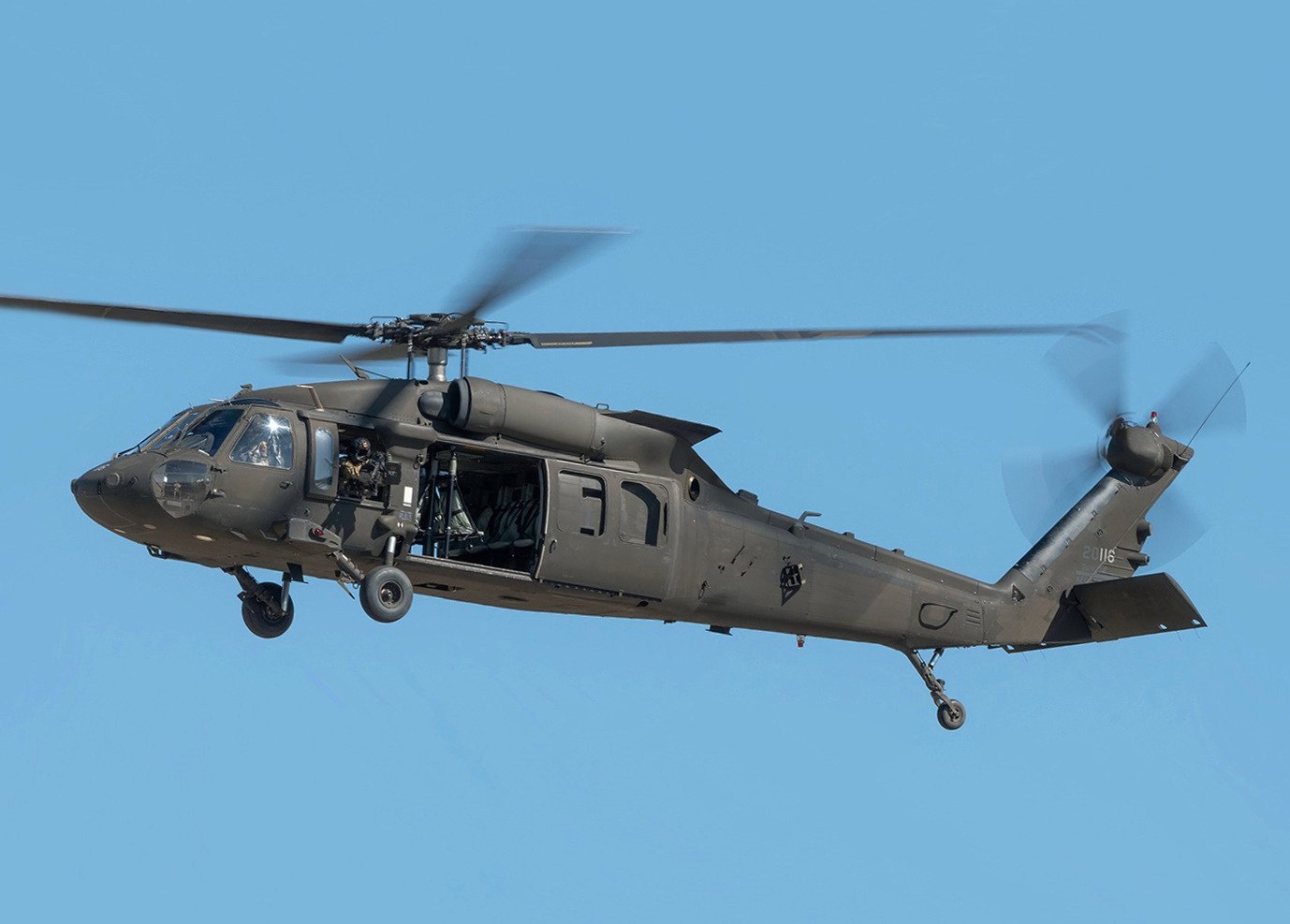
Service History
The S-70A-42 entered service with the Austrian Air Force in 2002 as part of Austria's modernization of its rotary-wing fleet. This specialized export variant represents a small production run within the massive S-70/Black Hawk family, which has dominated military utility helicopter operations worldwide since the late 1970s. The broader UH-60A series first entered U.S. Army service in 1979 with the 101st and 82nd Airborne Divisions, quickly establishing itself as the backbone of American air mobility operations.
Military Heritage
The S-70A-42 inherits its operational DNA from the UH-60A Black Hawk, which proved itself in numerous conflicts including Grenada in 1983, Panama in 1989, and the Gulf War in 1991. The Black Hawk family gained worldwide recognition during the 1993 Battle of Mogadishu in Somalia, where despite heavy losses, the aircraft demonstrated remarkable survivability and mission capability. By 1993, exports of H-60/S-70 variants had reached 1,816 units across more than 20 nations, establishing the design as a global standard for military utility helicopters.
The Manufacturer
Sikorsky Aircraft Corporation, founded in 1923 by aviation pioneer Igor Sikorsky, produced the S-70A-42 at their Stratford, Connecticut facility. The company faced significant financial challenges in the 1970s before winning the U.S. Army's UTTAS (Utility Tactical Transport Aircraft System) competition on December 23, 1976, which revived the company's fortunes. Under president Eugene Buckley, who joined in 1976 and retired in 1999, Sikorsky delivered over 3,200 helicopters including the early Black Hawks. Originally acquired by United Technologies Corporation in 1976, Sikorsky later became part of Raytheon Technologies in 2020, and following a 2023 corporate restructuring, now operates as Sikorsky, a Lockheed Martin company.
Engine and Technical Excellence
The S-70A-42 is powered by two General Electric T700-GE-700 turboshaft engines, each producing 1,163 kilowatts (1,560 shaft horsepower). General Electric developed the T700 series beginning in the 1970s, and by the 2020s had produced over 30,000 units across all variants, powering more than 50 different helicopter types worldwide. The engines provide exceptional reliability in hot and high-altitude conditions, featuring a modular design that enables rapid field maintenance—a critical capability for military operations.
Design Innovation
The S-70 family's design emphasized air transportability as a key requirement, with dimensions carefully calculated so that one helicopter could fit inside a C-130 Hercules cargo bay, two in a C-141 Starlifter, or six in a C-5 Galaxy. The design team adapted the original YUH-60A prototype, which first flew on October 17, 1974, defeating Boeing-Vertol's YUH-61A in the competitive UTTAS program. Advanced crashworthiness features and later innovations including all-composite rotor blades established new standards for military helicopter safety and performance.
Performance Characteristics
With a length of 19.76 meters and rotor diameter of 16.36 meters, the S-70A-42 achieves a maximum speed of 295 kilometers per hour and operational range of 537 kilometers. The aircraft maintains a service ceiling of 5,790 meters with a climb rate of 488 meters per minute, making it suitable for operations in diverse geographic conditions. Standard crew complement ranges from three to four personnel, with passenger capacity for 11 combat-equipped troops or medical evacuation configuration accommodating 6 stretchers with attendants.
Production Legacy
The S-70A-42 represents a specialized subset within the broader UH-60A production run, which totaled approximately 1,000 units manufactured from 1976 to 1989. The original U.S. Army contract in December 1976 covered 15 units for Low Rate Initial Production, followed by options for 353 additional aircraft. Overall S-70/H-60 family production exceeded 5,000 units by 2024, with over 4,000 variants remaining in active service worldwide, testament to the design's enduring operational value and continued relevance in modern military aviation.