
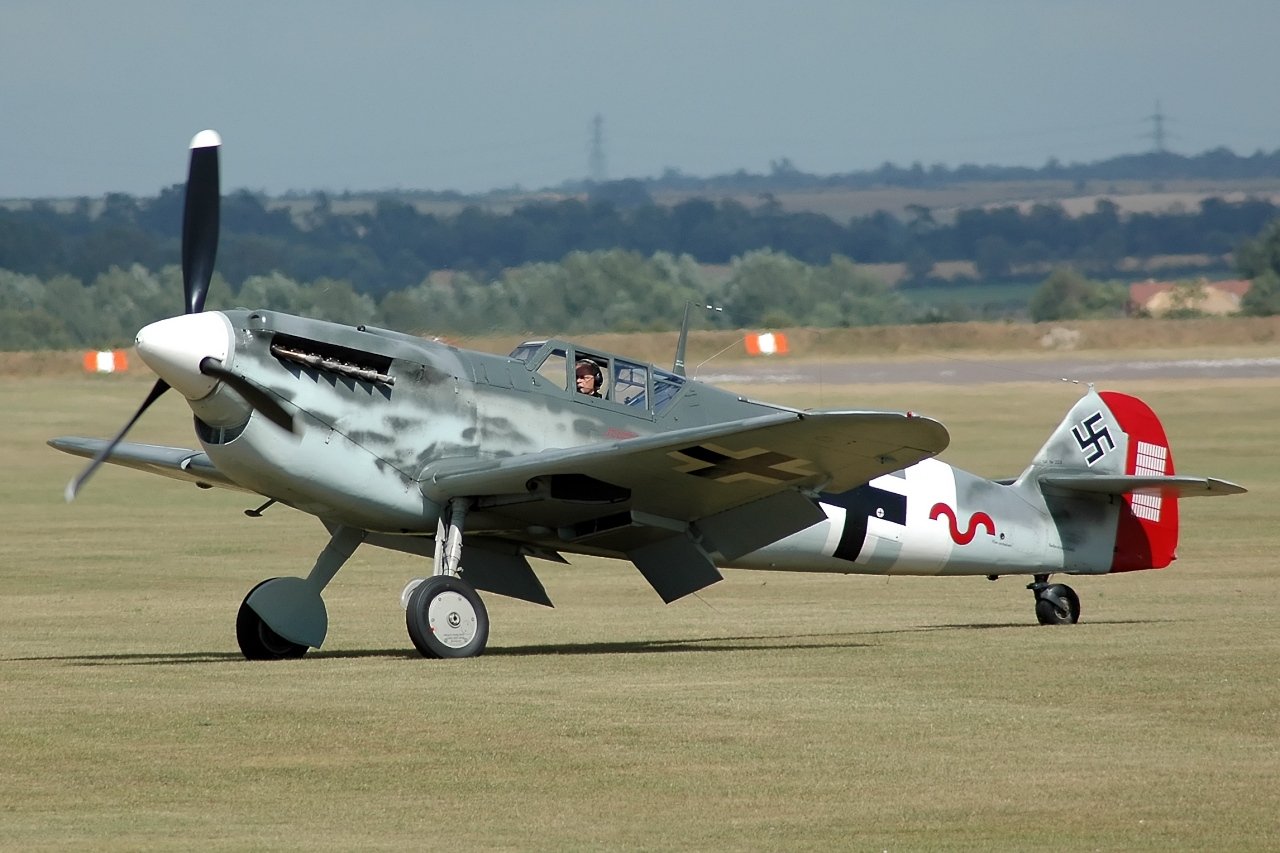
The Hispano Aviación HA-1112 was a Spanish development of the Messerschmitt Bf 109G-2, produced under license by La Hispano Aviación S.A. in Spain. The aircraft's origins trace back to a license agreement where 25 engine-less German airframes were delivered to Hispano Aviación. These were initially completed as HA-1109-J1L models using Hispano-Suiza engines before evolving into the HA-1112 series. The HA-1112 family, which includes the K1L and M1L variants, was produced within a broader production window spanning 1942 to 1961.
Two primary configurations defined the HA-1112. The HA-1112-K1L, known as the "Tripala," was created by re-engining HA-1109-J1L airframes with the Hispano-Suiza Z 12-17 engine. Of the 65 K1L units built, 25 were conversions from the J1L standard. These aircraft were taken into service by the Spanish Air Force in May 1951 to serve as operational trainers and were armed with two 12.7 mm Breda machine guns and two under-wing rocket racks. The more famous HA-1112-M1L, dubbed the "Buchón," first flew on March 29, 1954. This variant featured a liquid-cooled V-12 Rolls-Royce Merlin 500-45 engine producing between 1,400 and 1,600 hp, paired with a four-blade Dowty Rotol propeller. A total of 172 HA-1112 aircraft were built, including the M1L fighters and a single factory-built HA-1112-M4L two-seat dual-control trainer.
In military service, the Buchón (designated C.4K) entered the Spanish Air Force in 1957, with the 71 Escuadrón Táctico formed specifically to operate the type. While intended as fighters, they were primarily utilized for counter-insurgency and close air support during the Ifni War (1957–1958) in Spanish Sahara and Ifni. This conflict marked the final combat appearance of any aircraft in the Bf 109 lineage. The Buchón's military career ended in October 1965.
Following their retirement, the HA-1112 achieved cultural prominence. Group Captain Hamish Mahaddie collected 27 Buchones—including 26 single-seaters and one M4L trainer—to serve as stand-ins for Bf 109s in the 1968 film Battle of Britain. This transition into the warbird circuit ensured the aircraft's survival in private collections and airshows globally. Today, examples continue to be preserved, such as the M1L at the Planes of Fame Air Museum and the rare G-AWHC, the sole surviving factory-built two-seat Buchón.