
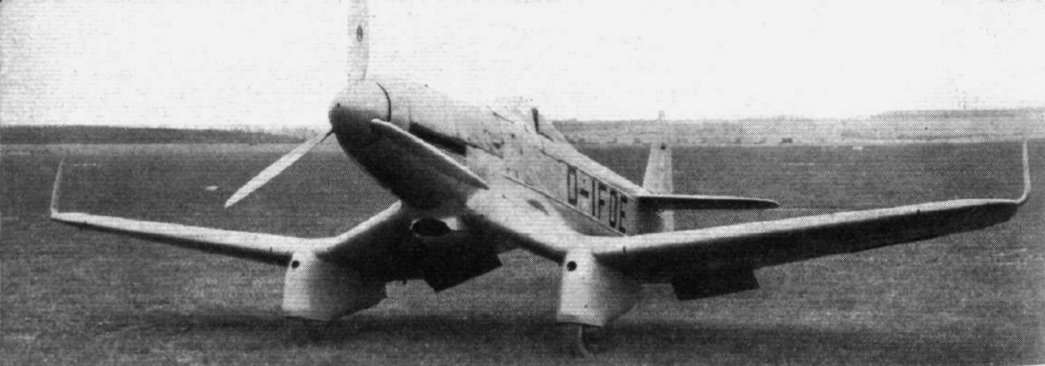
The Blohm & Voss Ha 136 was an advanced fighter trainer developed in 1933–1934 to meet a Reichsluftfahrtministerium (RLM) requirement. The goal was to create a training aircraft with handling characteristics as demanding as those of a frontline fighter, ensuring pilots were fully prepared for high-performance combat types. The aircraft was designed by Dr.-Ing. Richard Vogt, who had recently returned from Japan; the Ha 136 represented his first design for Hamburger Flugzeugbau (HFB), a subsidiary of the Blohm & Voss shipyard.
Technically, the Ha 136 was an all-metal, single-seat, low-wing cantilever monoplane. It featured an open cockpit positioned above the aft section of the wing and a fixed, spatted tailwheel undercarriage. The aircraft is most notable for its structural innovation: Vogt implemented a tubular steel wing spar that doubled as the main fuel tank. This integrated spar-tank design became a signature of Vogt's engineering and influenced many of his subsequent aircraft designs.
Only two prototypes were manufactured in Hamburg. The first was powered by a Bramo Sh 14A seven-cylinder air-cooled radial engine producing 160 hp (119 kW). The second prototype utilized an Argus As 8R air-cooled inline engine, which typically produced approximately 200 hp (147 kW). The aircraft first took flight on the afternoon of 23 August 1934 at the Hamburg-Fuhlsbüttel airfield.
Despite its technical merits and fighter-like handling, the Ha 136 never entered series production. Shortly after testing began, the RLM altered its training doctrine, deciding that advanced fighter training should be conducted using actual combat aircraft rather than specialized trainers. Consequently, the requirement was cancelled, and the two prototypes were used only for company and evaluation flight testing. The aircraft never saw operational service with the Luftwaffe or any other organization, and there is no record of it being used in combat or civil aviation.
While no examples of the Ha 136 survive today, the aircraft remains historically significant as the starting point for Vogt's career at HFB and as a precursor to the later Blohm & Voss aircraft. The lineage of the original manufacturer continues today through the Airbus facilities at Hamburg-Finkenwerder.