
Design and Development
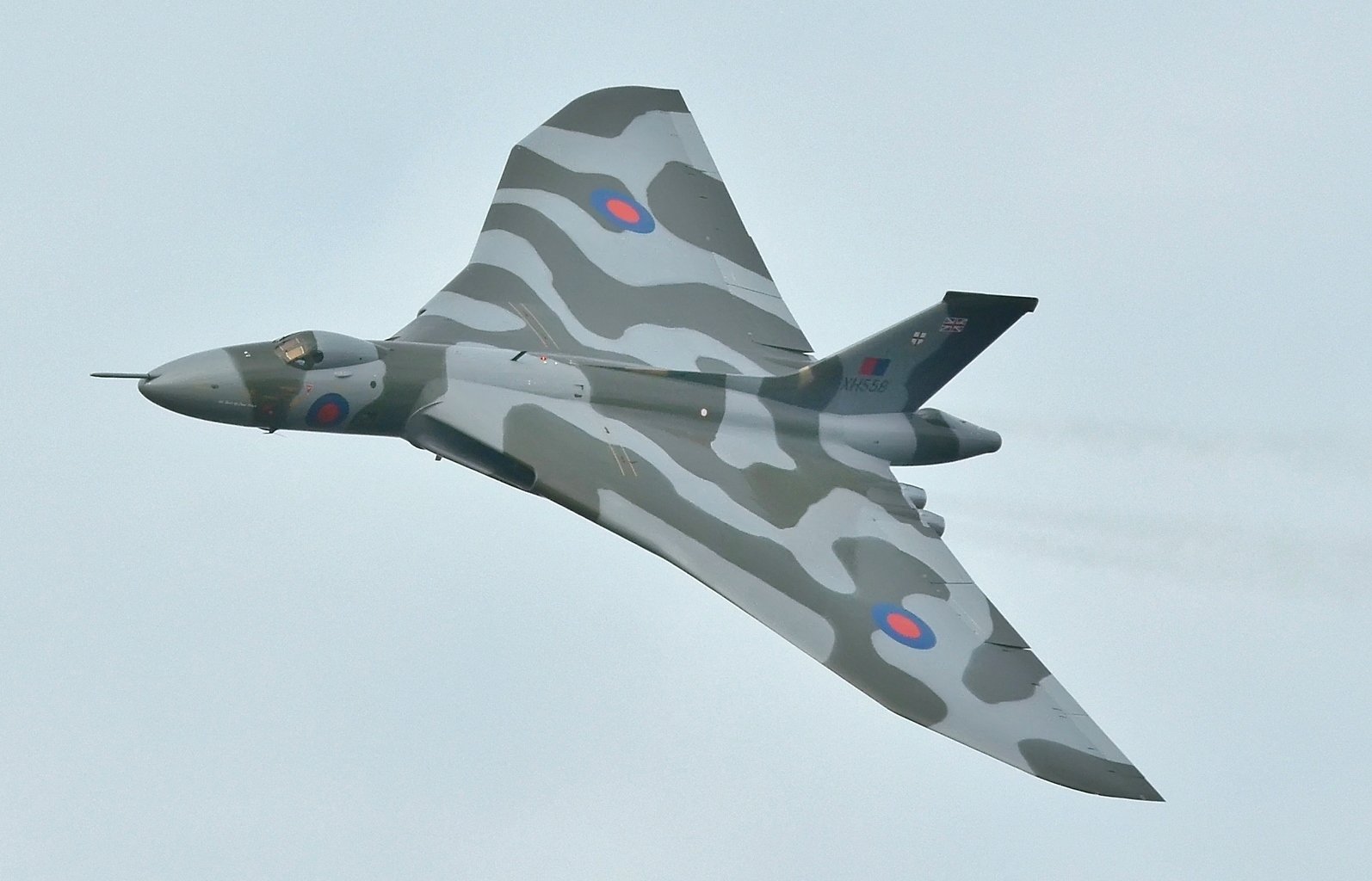
Developed by A.V. Roe and Company (Avro) to meet British Air Ministry Specification B.35/46, the Vulcan was designed as a high-altitude, long-range strategic bomber capable of penetrating Soviet airspace. The aircraft featured a distinctive tailless delta-wing configuration, which reduced drag and improved performance at high altitudes. The first prototype, Avro Type 698 VX770, made its maiden flight on August 30, 1952. The aircraft was officially named "Vulcan" during its public debut at the 1952 Farnborough Airshow.
Production and Manufacturer History
Production took place at Avro's Woodford Aerodrome near Stockport, Cheshire, with design work originating at facilities in Chadderton and Woodford. A total of 136 aircraft were built, including two prototypes (VX770 and VX777) and 134 production airframes. These production units consisted of 45 B.1 and 89 B.2 variants. Deliveries to the Royal Air Force (RAF) began in 1956 and concluded in January 1965. While originally built by Avro, the aircraft was officially redesignated as the Hawker Siddeley Vulcan in July 1963 following corporate consolidation. The lineage of the manufacturer eventually merged into British Aerospace in 1977 and later BAE Systems in 1999.
Technical Specifications
All Vulcans were powered by four Rolls-Royce turbojets. The early B.1 models utilized Avon engines, while the B.1A and B.2 variants were equipped with more powerful Olympus engines. The B.2 variant featured an enlarged wing and upgraded electronic countermeasures (ECM) systems. Capable of cruising at altitudes up to 55,000 feet, the Vulcan could carry a conventional bomb load of up to 21,000 lbs (21 × 1,000 lb bombs). Its nuclear arsenal included Blue Danube, Yellow Sun, and Red Beard bombs, as well as the Blue Steel stand-off nuclear missile.
Operational Service
The Vulcan served as the backbone of the RAF's V-force from September 1956 until 1984. Beyond its primary nuclear strike role, the aircraft was adapted for other missions; nine B.2s were converted for maritime radar reconnaissance (MRR) in the mid-1970s, and six were converted into K.2 aerial tankers. The aircraft's most famous combat deployment occurred during the 1982 Falklands War under Operation Black Buck. These missions involved long-range bombing raids against Port Stanley airfield, with some round-trips exceeding 8,000 miles, requiring extensive aerial refueling.
Legacy
Following its retirement, several Vulcans were preserved. Vulcan B.2 XL318 is a notable exhibit at the Royal Air Force Museum, having been used as a source of spare parts for the Black Buck missions while in storage. The Vulcan to the Sky Trust operated XH558 for public displays until its final flight in 2015. Today, no Vulcans remain airworthy, though they continue to be celebrated as icons of Cold War aviation.