
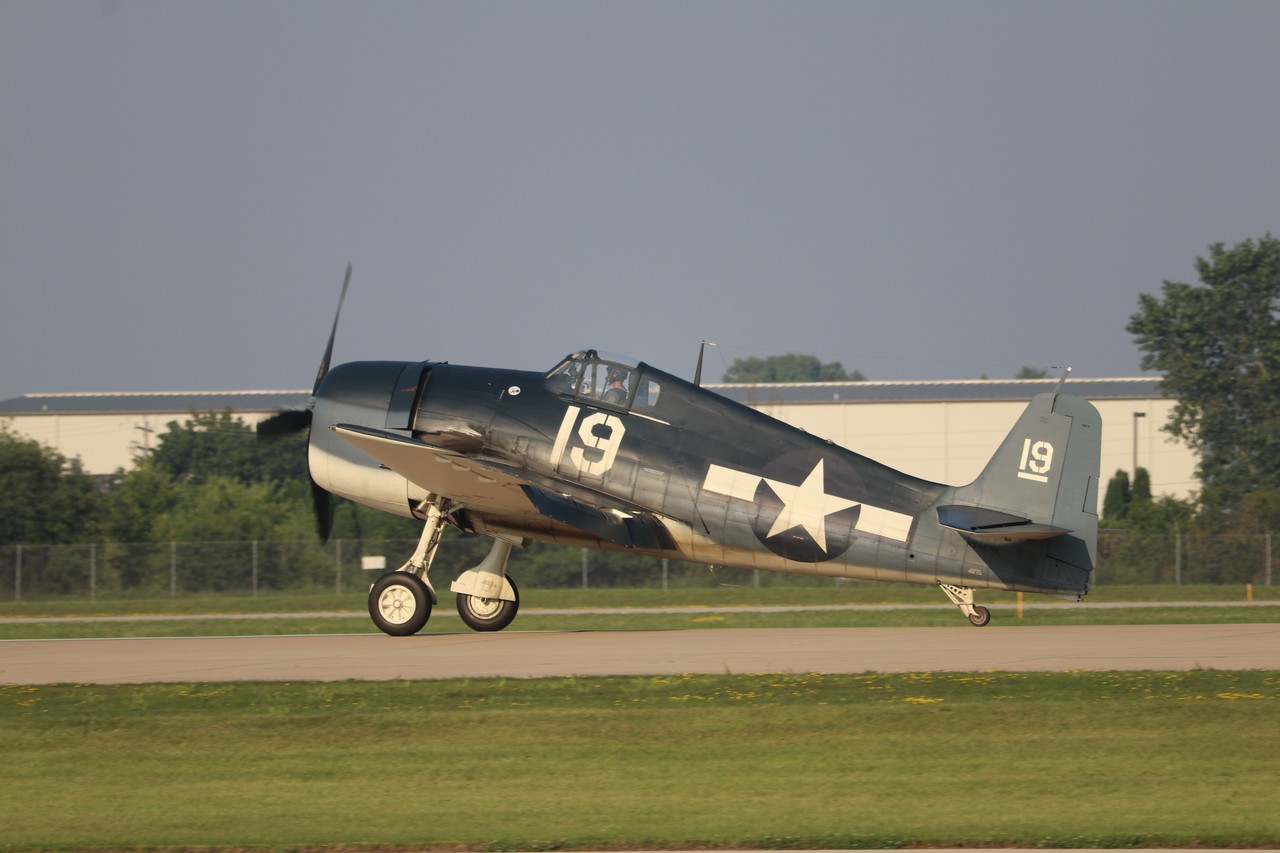
Wartime Dominance
The Hellcat entered combat in September 1943 and immediately began rewriting the rules of Pacific air warfare. Over its combat career, Hellcats flew 66,530 sorties and claimed between 5,163 and 5,223 enemy aircraft destroyed, accounting for 56 to 75 percent of all U.S. Navy and Marine Corps aerial victories. Only 270 Hellcats were lost in air-to-air combat, establishing the legendary 19-to-1 kill ratio that no other fighter has matched.
The aircraft proved its worth during major Pacific campaigns, particularly the Battle of the Philippine Sea in June 1944, where Hellcats secured decisive air superiority over the previously dominant Mitsubishi A6M Zero. U.S. Navy and Marine Corps squadrons operated the fighter extensively, while the Royal Navy's Fleet Air Arm received 1,182 examples designated as Hellcat F. Mk. I and II. The French Navy continued flying Hellcats until 1954, extending the type's service life nearly a decade beyond the war's end.
The Grumman Legacy
Grumman Aircraft Engineering Corporation, founded in 1929 by Leroy Grumman, built its reputation on rugged naval aircraft designed specifically for carrier operations. The company's engineering team developed the Hellcat as a direct successor to their earlier F4F Wildcat, applying lessons learned from early Pacific combat. Grumman signed the XF6F-1 prototype contract on June 30, 1941, demonstrating remarkable foresight in recognizing the need for a more capable fighter.
The company's rapid wartime expansion allowed it to complete the entire development and production cycle in just 30 months, from initial design to the delivery of 12,275 aircraft. Grumman operated independently until 1994, when it merged with Northrop to form Northrop Grumman, continuing the legacy through programs like the F-14 Tomcat, which served as the Navy's primary fleet defense fighter for three decades.
Engineering Excellence
The Hellcat's success stemmed from its robust design philosophy prioritizing durability and ease of manufacturing over exotic performance characteristics. Grumman's engineers equipped the aircraft with wide-track landing gear that provided exceptional stability during carrier operations, while the thick wing structure accommodated heavy armament and absorbed battle damage effectively.
The XF6F-1 prototype initially flew with a Wright R-2600 Twin Cyclone engine producing 1,700 horsepower, but Grumman quickly switched to the more powerful Pratt & Whitney R-2800 Double Wasp for the XF6F-3, which first flew on July 30, 1942. This 18-cylinder, air-cooled radial engine delivered 2,000 horsepower and featured innovations like two-stage supercharging for superior high-altitude performance. Pratt & Whitney manufactured over 125,000 R-2800 engines between 1939 and 1955, with the type proving exceptionally reliable in Pacific Theater conditions.
Combat Variants and Capabilities
Grumman produced the Hellcat in several major variants, beginning with the F6F-3, of which 4,402 examples were built including 200 F6F-3N night fighters equipped with radar. The improved F6F-5 became the most numerous variant with 6,681 aircraft produced, including 1,189 F6F-5N night fighters. The experimental XF6F-6 achieved the highest performance with a top speed of 417 miles per hour but never entered mass production.
Standard armament consisted of six .50-caliber M2 Browning machine guns mounted in the wings, while later variants could carry up to 2,000 pounds of bombs or six rockets for ground attack missions. This versatility allowed the Hellcat to serve not only as a pure fighter but also as a capable fighter-bomber and reconnaissance platform.
Pilot Excellence
The Hellcat's handling characteristics made it popular among naval aviators, combining forgiving flight behavior with devastating combat effectiveness. The aircraft's 37,300-foot service ceiling and 3,500-feet-per-minute climb rate provided tactical advantages in combat, while its 1,090-mile range enabled extended patrol missions over the vast Pacific.
Lieutenant Commander Roy M. "Butch" Voris exemplified the Hellcat pilot's skill, flying F6F-5s and later leading the first Blue Angels demonstration team when it formed in June 1946. The Blue Angels initially flew Hellcats before transitioning to jets, establishing the type's post-war role in demonstrating American naval aviation prowess.
Production Achievement and Modern Legacy
Groumman's Bethpage Plant Number 3 in New York manufactured all 12,275 Hellcats, with production beginning even as construction crews completed parts of the factory. The company delivered 11,000 aircraft in just over two years, demonstrating American industrial capacity at its peak.
Today, only seven airworthy Hellcats remain, all based in the United States and regularly flown at airshows. The National Air and Space Museum preserves F6F-3K Bureau Number 41834, built in February 1944, while the National Naval Aviation Museum displays another F6F-3. These survivors represent one of aviation history's most successful fighters, an aircraft that helped secure Allied victory in the Pacific through superior design, manufacturing excellence, and pilot skill.