
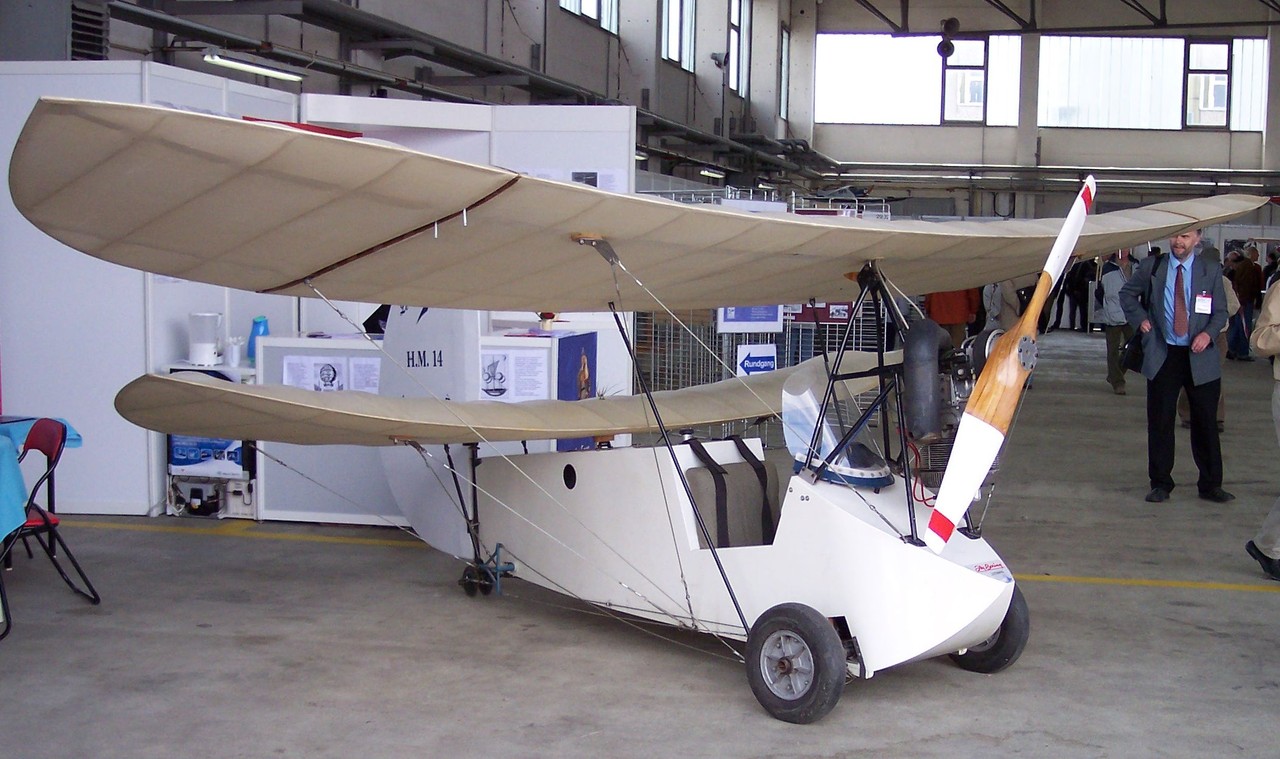
Development and Design Philosophy
Henri Mignet's HM.380 emerged as a refined evolution of his revolutionary "Flying Flea" concept, building upon nearly three decades of tandem-wing experimentation that began with his HM.1 prototype in 1920. The HM.380's development in 1957 represented Mignet's mature approach to amateur-built aviation, incorporating safety improvements developed after the troubling crashes of early Flying Flea variants in the 1930s. Unlike conventional aircraft, the HM.380 employed Mignet's signature tandem-wing arrangement where the smaller rear wing, positioned above the forward wing, provided inherent pitch stability through innovative wing interference effects.
The aircraft's design philosophy centered on simplicity and accessibility for home builders. Mignet eliminated complex control systems by utilizing pivoting tandem wings for pitch control, removing the need for traditional elevators and rudders. This configuration enabled the HM.380's wings to fold for storage in standard residential garages, addressing practical concerns for amateur aviation enthusiasts. The enclosed two-seat cockpit marked a significant advancement over earlier open-cockpit Flying Flea variants, providing weather protection and improved comfort for pilot and passenger.
The Mignet Manufacturing Legacy
Henri Mignet's approach to aircraft distribution proved as unconventional as his designs. Rather than establishing traditional manufacturing facilities, Mignet focused on publishing detailed construction plans that enabled global amateur building. His business ventures reflected this philosophy across multiple countries and decades. In France, Mignet briefly operated Le Société des Aéronéfs Mignet before 1937, primarily supporting his earlier HM.23 design.
Mignet's 1937 emigration to the United States led to the formation of American-Mignet Aircraft Corporation, where two HM.23 prototypes successfully flew in late 1938 and 1942. Following his 1939 return to France, Mignet continued developing his concepts internationally. His 1953 venture Avioes Mignet do Brazil in Sao Paulo aimed to commercialize the HM.310 Estafette but failed to achieve market success. Later work in Morocco produced the HM.320 and HM.350 variants. None of these companies survive today, though plans for various Mignet designs remain available through suppliers like Falconar Avia.
Technical Specifications and Performance
The HM.380 typically employs engines in the 60 to 100 horsepower range, with Lycoming powerplants proving popular among builders. A notable 1998 example built by Stan Grapp and Marvin Getten utilized a 65-horsepower, four-cylinder, air-cooled Lycoming engine, representing the aircraft's typical power configuration. This installation achieved a maximum speed of 90 mph while maintaining the type's reputation for stable, predictable handling characteristics.
Lycoming's O-235 series engines, which entered production in the late 1940s, have powered numerous HM.380 examples. With over 40,000 O-235 variants produced historically, these engines provide proven reliability for experimental aircraft applications. The inline piston configuration, manufactured by Lycoming Engines (a Textron division), continues in production today, ensuring parts availability for HM.380 operators.
Construction and Operations
The HM.380's construction timeline reflects the amateur-building process rather than factory production schedules. Stan Grapp's project, begun in 1963, required 35 years to complete, finishing in 1998 before flying to EAA AirVenture in Oshkosh, Wisconsin, in 1999. This timeline, while extreme, illustrates the leisurely pace often adopted by homebuilders pursuing aviation as a long-term hobby rather than urgent transportation need.
Modern HM.380 construction benefits from improved plans and building techniques developed over decades of amateur aviation evolution. The aircraft's gross weight of 1,100 pounds places it well within experimental aircraft regulations in most countries, while the two-seat configuration provides practical utility for sport flying and pilot training applications.
Safety Evolution and Modern Legacy
Early Flying Flea variants suffered from critical design flaws that caused approximately 60 fatal crashes in France during the 1930s, leading to construction bans in France and Britain. These accidents resulted from dangerous wing interference effects at high angles of attack below negative 15 degrees. Subsequent design refinements, incorporated into later variants including the HM.380, eliminated these deadly characteristics through modified wing relationships and improved control authority.
Today's HM.380 examples demonstrate significantly improved safety records, benefiting from both design evolution and enhanced builder education. Multiple examples remain active in the experimental aircraft community, supported by ongoing plans availability and a network of builders sharing construction experience. The Lane Motor Museum in Nashville, Tennessee, displays a completed 1998 HM.380, preserving the type's contribution to amateur aviation history.
The HM.380's legacy extends beyond individual aircraft to encompass its role in establishing homebuilt aviation as a viable pursuit. As aviation's first widely published kit-plane concept, Mignet's Flying Flea family inspired generations of amateur builders and contributed to the regulatory frameworks that govern experimental aircraft construction today.