
Production and Manufacturer History
Designed and originally built by Handley Page Ltd, the Halifax was produced in wartime quantities between 1940 and April 1945, though some sources suggest production continued into 1946. Total production is generally accepted as 6,176 aircraft, with some estimates reaching 6,178. Manufacturing was distributed across several sites to meet demand: Handley Page operated factories at Radlett and Cricklewood, while the English Electric Company produced large numbers under license at Samlesbury. Additionally, the London Aircraft Production Group (LAPG) utilized a consortium of factories, including Chrysler Motors at Kew and Duple at Hendon, alongside assembly at Chalgrove.
Design and Technical Specifications
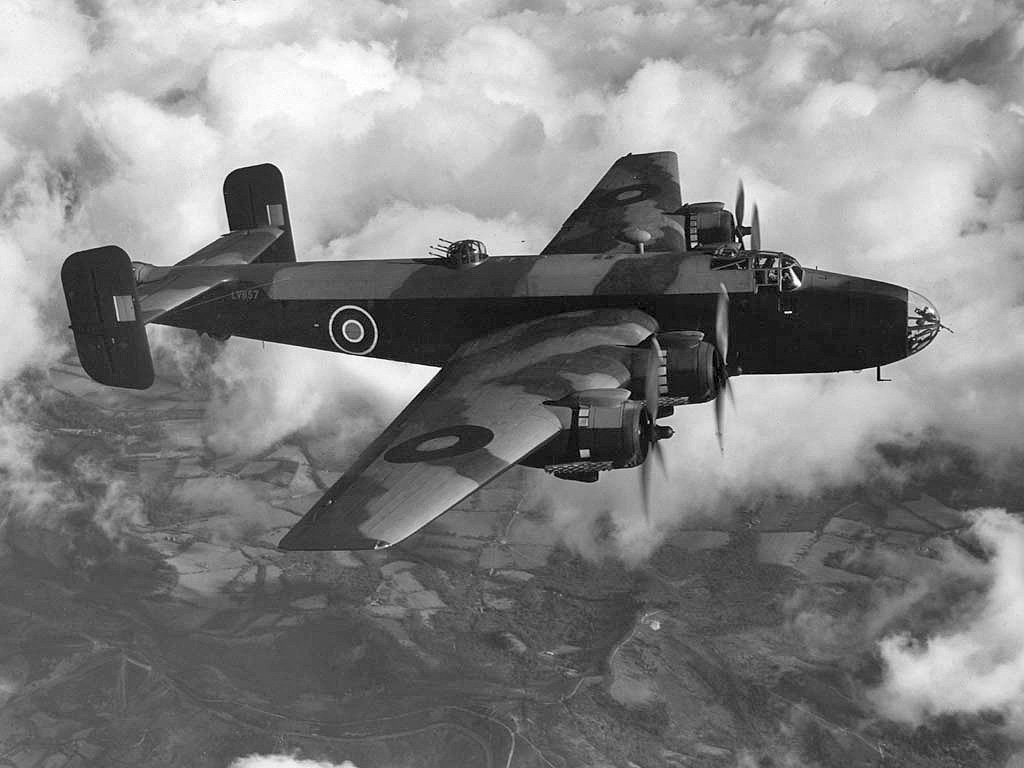
Chief designer George Rudolph Volkert led the development team, initially designing the twin-engine H.P.56 to Air Ministry Specification P.13/36. This was later revised to the four-engine H.P.57 to meet the requirement for heavy bombers. The prototype first flew on 25 October 1939 at RAF Bicester, piloted by Major James Cordes. The resulting aircraft was an all-metal stressed-skin mid-wing monoplane featuring twin fins and rudders. It possessed a large internal bomb bay and wing root cells capable of carrying up to 13,000 lb of ordnance. Defensive armament typically included nose, dorsal, and tail turrets equipped with .303 in Browning machine guns.
Engine Development
The Halifax utilized two distinct piston engine families. Early marks, such as the B.I and B.II, used liquid-cooled Rolls-Royce Merlin V-12 engines (Merlin X, XX, and 22), providing between 1,130 and 1,280 hp. Later variants, including the B.III, B.VI, and B.VII, transitioned to 14-cylinder air-cooled Bristol Hercules radial engines (Hercules VI and XVI), which offered approximately 1,615 hp. This shift improved climb performance and reduced vulnerability to battle damage by eliminating liquid-cooling systems.
Military Service
The Halifax entered RAF service with No. 35 Squadron on 13 November 1940. On the night of 12–13 March 1941, it conducted the first raid on Germany by a British four-engined bomber, targeting Hamburg. Throughout World War II, it served as a strategic night bomber, pathfinder, and special-operations aircraft for dropping SOE agents. It was also utilized by Coastal Command for anti-submarine warfare and by Transport Command for casualty evacuation. Operational statistics indicate the Halifax flew between 75,000 and 82,773 bombing sorties, dropping over 224,000 long tons of bombs—representing more than a quarter of all RAF bombs dropped on Germany. Beyond the RAF, the aircraft was operated by the RCAF, RAAF, Free French Air Force (notably No. 346 and 347 Squadrons), and Polish forces in exile. Post-war, the French, Egyptian, and Pakistani air forces operated the type in transport roles. The final RAF operational flight occurred in March 1952 in Gibraltar.
Legacy
While most were scrapped, a few reconstructed examples survive. The National Air Force Museum of Canada displays NA337, and the Yorkshire Air Museum features a reconstruction of LV907 "Friday the 13th," which flew 128 operations with No. 158 Squadron. The RAF Museum at Cosford also displays a reconstructed Halifax II (W1048).