
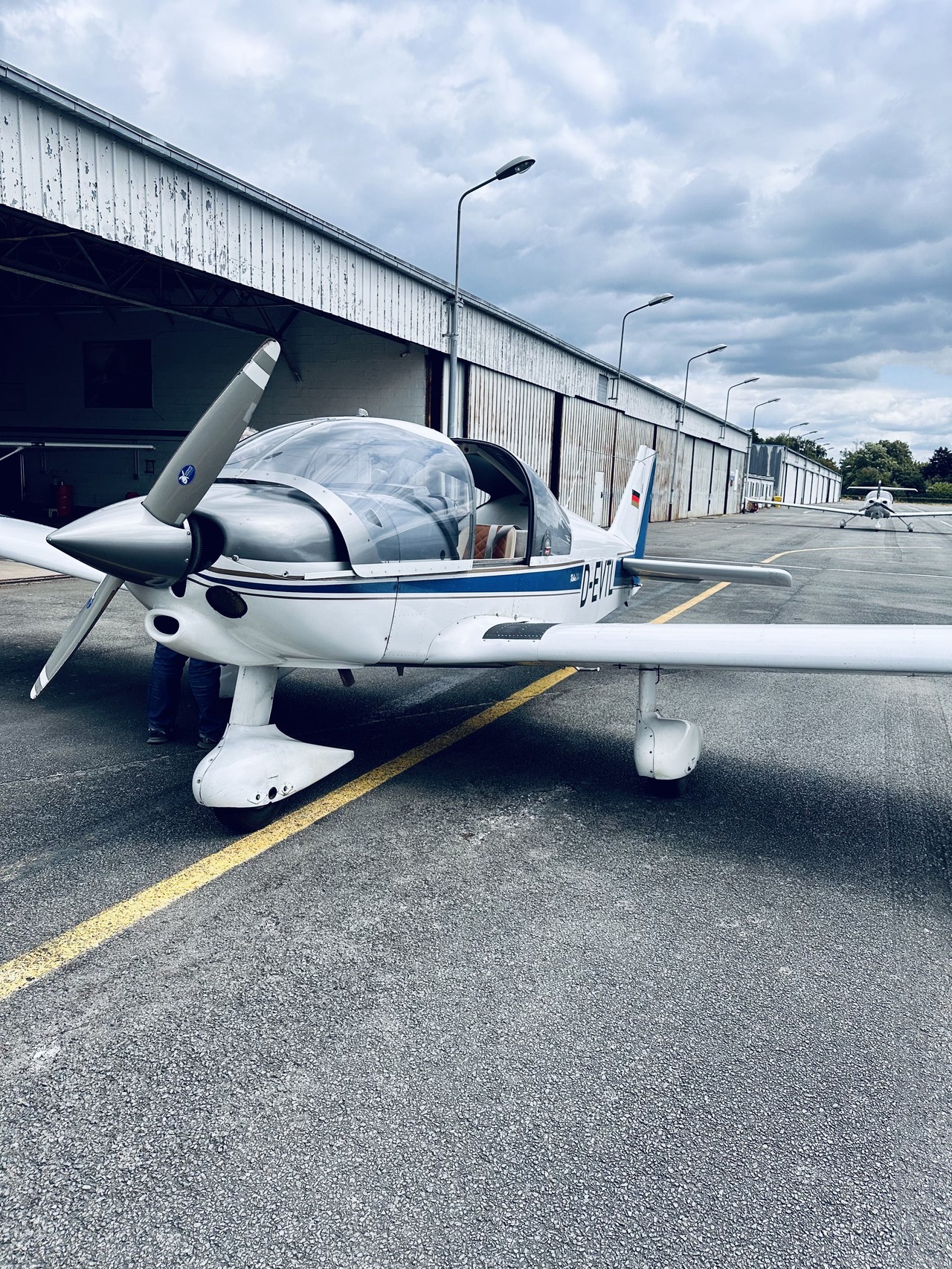
Revolutionary Design Philosophy
The HR-200 represented a fundamental shift in Robin's design philosophy, abandoning the company's traditional wooden construction methods in favor of modern all-metal stressed skin construction. Designer Christophe Heintz created an aircraft specifically tailored for French flying clubs, incorporating light alloy materials with pop rivets and featuring a sophisticated two-part wing design with an integral center section. The aircraft utilized a NACA 64 A 515 airfoil and electrically operated Frize flaps, innovations that contributed to what Pilot magazine praised as "delightful to fly" handling characteristics.
Manufacturing Legacy
Avions Pierre Robin manufactured exactly 108 examples of the HR-200 series between 1972 and 1976, with deliveries commencing in late 1973. All aircraft rolled off the production line at the company's Dijon-Darois facility in France. The manufacturer had evolved from Centre d'Études Aéronautiques, which itself had succeeded Jodel before being renamed Avions Pierre Robin in 1969. This manufacturing heritage represented over 60 years of continuous aircraft production at the Darois location.
Engine Variants and Performance
The HR-200 series utilized multiple variants of the proven Avco Lycoming O-235 four-cylinder horizontally-opposed air-cooled engine. The HR200-100 Club featured an 81-kilowatt O-235-H2C engine, while the HR200-120 employed a 93-kilowatt O-235-J2 powerplant. The most powerful variant, the HR200-160, incorporated a 119-kilowatt IO-320-D engine producing 160 horsepower. These reliable Lycoming engines, which had entered production in the late 1940s and continued for decades, provided the HR-200 with excellent training aircraft characteristics.
Operational Excellence
Pilot magazine recognized the HR-200 as a "brilliant little training aeroplane," praising its outstanding visibility and flight characteristics. The aircraft demonstrated impressive performance metrics, including a maximum speed of 265 kilometers per hour and a service ceiling of 5,000 meters. With a climb rate of 229 meters per minute and a range extending up to 1,074 kilometers, the HR-200 proved exceptionally capable for both training and cross-country touring missions. The HR200-120B variant, with its 120-liter fuel capacity, provided 4.5 hours of endurance at sea level cruise settings.
International Operations
While primarily serving French flying clubs and pilot training organizations, the HR-200 found export success in multiple markets. Notable international examples include ZK-UWZ, a HR200-120B delivered to Izard Pacific Aviation Ltd. in New Zealand and registered on May 8, 2006. British operators acquired several aircraft, including G-BNIK, which remained active as of 2019, demonstrating the type's longevity and reliability in service.
Technical Specifications
The HR-200 measured 6.64 meters in length with a wingspan of 8.34 meters and stood 1.94 meters tall. Empty weight ranged from 525 to 530 kilograms, while maximum takeoff weight reached 780 to 800 kilograms, providing a useful payload of 270 kilograms. The aircraft required a takeoff distance of 594 meters over a 50-foot obstacle and could land in just 460 meters under similar conditions, making it suitable for operations from smaller airfields.
Manufacturing Challenges and Revival
The parent company faced significant challenges in later years, with production halting around 2008 due to supplier issues with Thielert diesel engines, leading to the liquidation of partner Apex Aircraft. However, manufacturing resumed in May 2011 under the Robin Aircraft name, with type certificates held by CEAPR. The company demonstrated remarkable resilience, re-hiring staff in December 2023 and acquiring the Robin name and certificates before receiving DGAC Production Approval on September 24, 2024.
Enduring Legacy
The HR-200's influence extended far beyond its modest production run of 108 aircraft. Its all-metal construction techniques and aerobatic capabilities influenced subsequent designs, including the successor R2000/Alpha 2000 series that continues in aerobatic training service with operators like Alpha Aviation in New Zealand since 2004. Several original HR-200 aircraft remain airworthy today, including examples in the United Kingdom and New Zealand, testament to the soundness of Heintz's design and the quality of Robin's manufacturing. The aircraft stands as a significant bridge between the wooden designs of the Jodel era and modern metallic aerobatic trainers, representing a crucial evolution in European general aviation development during the 1970s.