
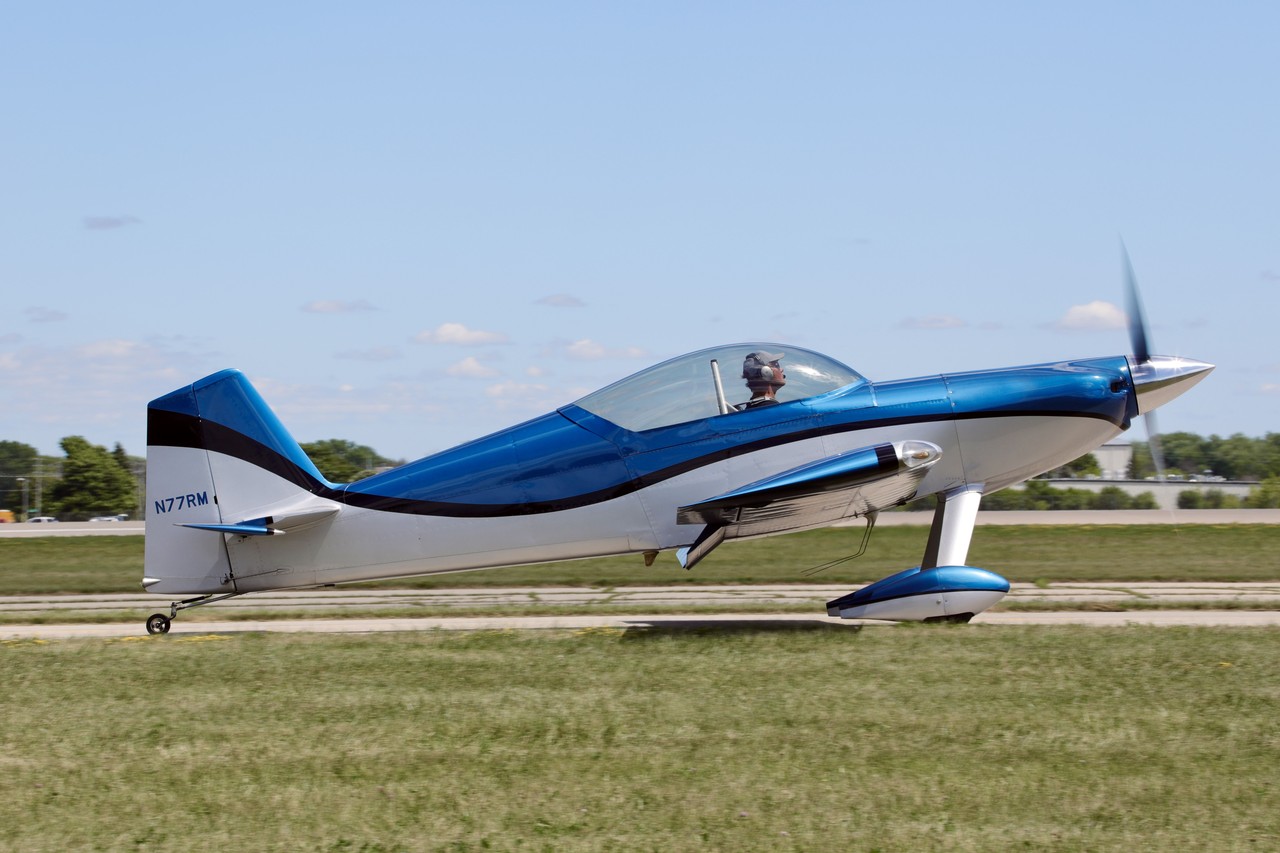
Development and Design Philosophy
John Harmon embarked on the Rocket II project in late 1990, eight months after Van's Aircraft released their RV-4 kit. His vision was ambitious: create a modification package that would accommodate a massive 250-horsepower Lycoming IO-540 engine while maintaining the RV-4's renowned short-field performance and aerobatic capabilities. The engineering challenge was substantial, requiring extensive structural modifications to handle nearly double the original aircraft's power.
The transformation was comprehensive. Harmon extended the fuselage by 18 inches and widened it by 4 inches at the front seats to accommodate the larger engine and improved pilot comfort. The wingspan was reduced by 15 inches total—7 inches per side—to increase structural strength and improve roll rate. These modifications created an aircraft capable of handling a 2,000-pound gross weight, compared to the standard RV-4's 1,550 pounds.
Engineering Excellence
The Rocket II incorporated several innovative features that set it apart from typical homebuilt aircraft. A titanium landing gear system provided the strength necessary for the increased weight while maintaining reasonable mass. Extended fuel tanks held between 42 and 55 gallons, giving the aircraft a three-hour endurance despite its thirsty engine. The structure was reinforced to handle 6G loads at aerobatic weights, with flutter testing conducted up to 300 mph indicated airspeed.
The heart of the machine was the Lycoming IO-540-C4B5 engine, a six-cylinder horizontally-opposed powerplant that delivered 250 horsepower through an 82-inch constant-speed propeller, often sourced from Cessna 180 aircraft. This engine-propeller combination enabled the Rocket II to achieve a redline speed of 275 mph and a climb rate exceeding 3,000 feet per minute.
Record-Setting Performance
John Harmon's personal Rocket II became a benchmark for homebuilt aircraft performance, setting multiple records during Triaviation testing. The aircraft achieved a maximum speed of 250.71 mph, a climb rate of 3,308 feet per minute, and a stall speed as low as 44.78 mph. These figures represented extraordinary performance for an experimental aircraft, rivaling many certified production aircraft of the era.
Typical cruise performance saw the Rocket II maintaining 230 mph at 75 percent power or 215 mph at a more economical 55 percent power setting. The aircraft's speed range was remarkable, spanning from its low stall speed to its high cruise speed, providing pilots with exceptional operational flexibility.
Production and Distribution
D & J Harmon Co., Inc., located at 2000 S. Union Ave. in Bakersfield, California, began offering Rocket II modification kits in October 1991. Rather than manufacturing complete aircraft, the company provided comprehensive modification packages that transformed standard Van's RV-4 kits into high-performance machines. Each kit included detailed engineering drawings, specialized components, and extensive documentation to guide builders through the complex modification process.
Production numbers remain unclear, but documented examples include aircraft with constructor numbers ranging from 119 to 2828, suggesting significant interest in the modification. Notable examples include ZK-RMD (c/n HR2-187-08) operating in New Zealand, VH-TAB (c/n 342) and VH-AGN (c/n 119) in Australia, and N85TP (c/n 2828) in the United States.
Operational Service
The Rocket II found its niche in the experimental aircraft community, serving as personal sport aircraft and airshow performers. The type's impressive performance capabilities made it popular at aviation events, where pilots could demonstrate the aircraft's exceptional speed and climb performance. The 1999 Boyer-Tom Harmon Rocket II appeared at the Dayton Air Show in 2023, showcasing the type's enduring appeal.
Operating from rough and short runways despite its high performance, the Rocket II maintained the RV-4's practical operational characteristics while delivering fighter-like performance. The aircraft's ability to combine extreme performance with reasonable operating costs attracted pilots seeking maximum capability from their homebuilt investment.
Legacy and Influence
The Harmon Rocket II's influence extended beyond its own production run, inspiring subsequent high-performance homebuilt designs. Mark Frederick developed the F1 Rocket using Czech-manufactured components, creating an evolution of Harmon's original concept. The Rocket series demonstrated that homebuilt aircraft could achieve performance levels previously reserved for military or high-end certified aircraft.
John Harmon's company appears to have ceased active operations, with the harmonrocket.com website now serving primarily as a historical archive. However, several Rocket II aircraft remain active as of 2023, though the type suffered a tragic setback when N85TP was destroyed in a fatal accident near Shear Airport, New York, on June 11, 2023.
The Harmon Rocket II represents a pinnacle of 1990s homebuilt aircraft development, proving that innovative engineering and careful modification could transform a standard kit aircraft into an extraordinary high-performance machine. Its combination of speed, strength, and versatility established new benchmarks for experimental aircraft capability.