
Production and Manufacturer History
The first-generation Harrier was developed in the United Kingdom during the 1960s by Hawker Siddeley Aviation. The aircraft entered service with the Royal Air Force (RAF) in April 1969, following the first flight of the operational GR.1 variant on December 28, 1967. Production of the initial GR.1 and GR.3 models, as well as two-seat trainers, continued through the mid-1970s. In 1977, the British government consolidated the aviation industry, and Hawker Siddeley's aircraft interests were merged into the newly formed British Aerospace (BAe). This entity continued the manufacture of the Harrier, eventually evolving into the modern BAE Systems through a 1999 merger with Marconi Electronic Systems.
Design and Technical Specifications
Emerging from experimental research with the P.1127 and Kestrel FGA.1, the Harrier was designed as a versatile attack aircraft capable of vertical takeoff and landing (VTOL) and short takeoff and landing (STOL). Its most defining technical feature was a single Rolls-Royce Pegasus vectored-thrust turbofan engine. This system utilized four swivelling nozzles that could be rotated downward to provide vertical lift, enabling the aircraft to hover or operate from rough strips, roadways, and small carrier decks without the need for catapults or arresting gear. In level flight, the aircraft was capable of reaching high subsonic speeds.
Military Service
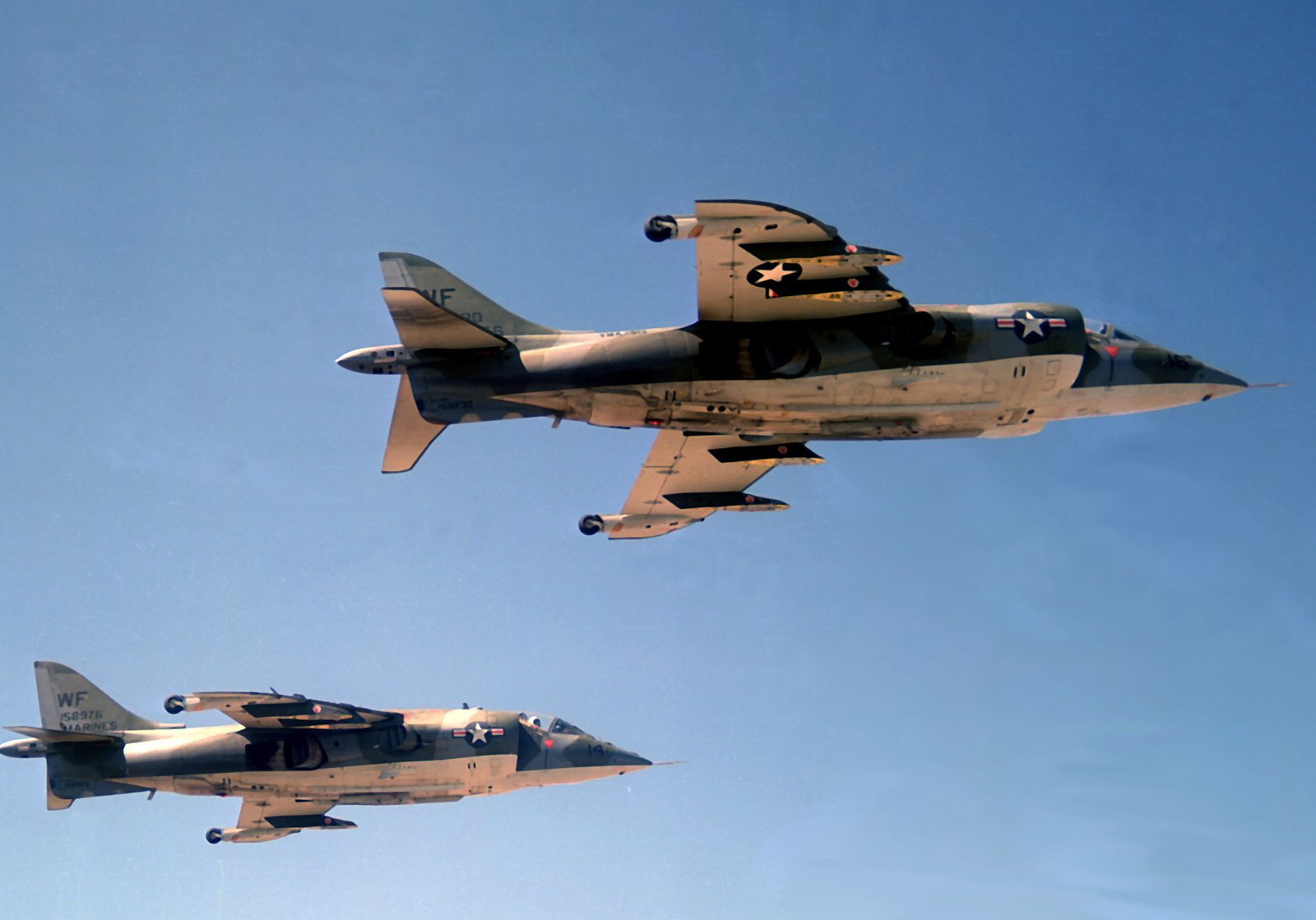
The Harrier served in several primary roles, including ground attack, reconnaissance, and close air support (CAS). The RAF operated the GR.1 and GR.3 variants, while the United States Marine Corps (USMC) fielded the AV-8A and AV-8C models, the latter also serving as Forward Air Controller (Airborne) platforms. During the Cold War, RAF Germany utilized the aircraft's V/STOL capabilities to disperse to camouflaged roadside hides to ensure survivability against airfield attacks.
First-generation derivatives played a critical role during the 1982 Falklands War. While the naval Sea Harrier provided air defense from HMS Invincible and HMS Hermes, the land-based RAF Harrier GR.3s were also deployed aboard HMS Hermes. These GR.3s conducted attack sorties from the carrier and operated from rudimentary landing strips on the islands, often flying in weather conditions that would have grounded conventional aircraft.
Legacy
As the only truly successful V/STOL combat jet of its era, the Harrier fundamentally altered NATO's approach to basing and strike survivability. Its success paved the way for the second-generation Harrier II, a joint venture between British Aerospace and McDonnell Douglas. Today, examples of the first generation are preserved in various collections, including an AV-8A at the Fort Worth Aviation Museum and a GR.3 at the RAF Museum.