
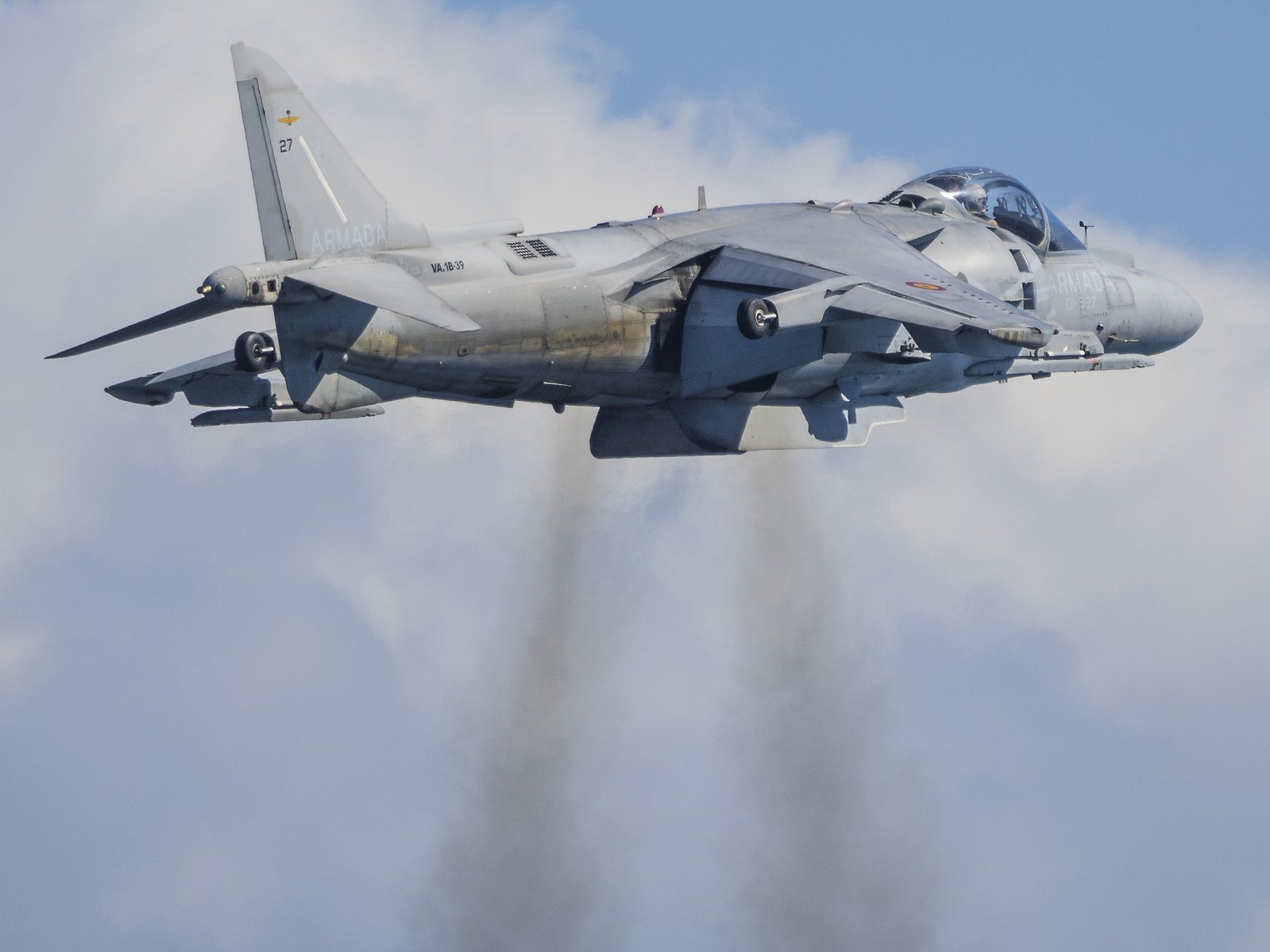
Production and Manufacturer History
The Harrier was developed by the British manufacturer Hawker Siddeley during the 1960s. The first production model, the Harrier GR.1, completed its maiden flight on December 28, 1967, and officially entered service with the Royal Air Force (RAF) in 1969. In 1977, Hawker Siddeley was absorbed into British Aerospace (BAe), which continued the aircraft's manufacture. Production expanded through a partnership with McDonnell Douglas in the United States, which produced the AV-8A and subsequent US variants. While production continued through the 1980s, the exact final year of manufacture for all variants is not explicitly recorded in the available data.
Design and Technical Specifications
Developed from earlier VTOL research aircraft such as the Kestrel and P.1127, the Harrier was designed as a single-engine fighter-bomber. Its most notable innovation is the use of a vectored-thrust turbofan engine. This system employs four rotatable exhaust ports that divert the jet blast downward, allowing the aircraft to take off vertically or with a short roll, thereby eliminating the need for conventional runways. A development milestone occurred on August 31, 1966, marking an early flight of the Harrier line. Technical improvements were introduced with the GR.3 variant, which featured a more powerful engine than the original GR.1.
Military Service
The Harrier was designed for reconnaissance, ground attack, and close air support (CAS). It saw extensive service with the Royal Air Force and Royal Navy, as well as the United States Marine Corps, which ordered 102 AV-8A aircraft in the mid-1970s for use from forward bases and amphibious assault ships. The aircraft proved its operational value during the 1982 Falklands War, where Harrier GR.3s and Sea Harriers operated from the aircraft carrier HMS Hermes and austere landing strips. During this conflict, the aircraft conducted over 2,000 sorties, including attacks on the Stanley airfield and runway. Losses during the war included six Sea Harriers and four GR.3s. Beyond the Falklands, the aircraft served in Germany, Norway, and Belize, and Sea Harriers operated over the Balkans during the 1990s.
Performance and Legacy
Performance data for the GR.3 variant indicates a service ceiling of 51,200 feet (15,600 meters), a combat radius of 670 kilometers, and a total range of 3,430 kilometers. While generally characterized as subsonic, the Harrier set several world records, including the first supersonic VTOL flight and the first VTOL crossing of the Atlantic Ocean in 1969. The aircraft's service ended at different times depending on the operator; some sources cite a general retirement in 2006, while the United Kingdom retired its fleet in 2010. Today, the Harrier is preserved in several institutions, including the RAF Museum and the Pima Air & Space Museum.