
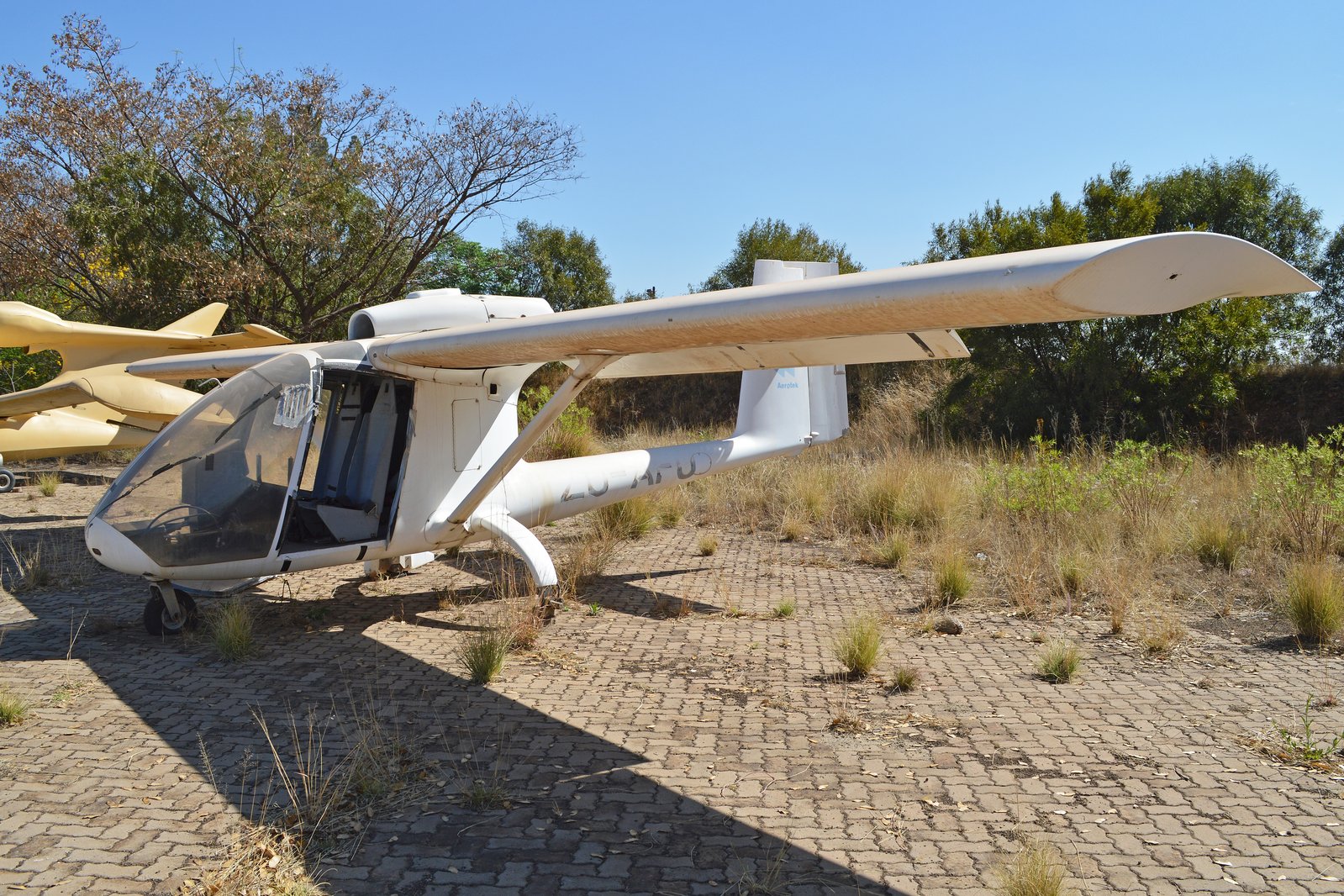
The AEROTEK (2) Hummingbird is a specialized light aircraft designed primarily for observation and surveillance. Its core design philosophy was to provide a cost-effective, fixed-wing alternative to helicopters for roles such as low-speed monitoring and aerial patrol. To achieve this, the aircraft was engineered with short take-off and landing (STOL) capabilities, allowing it to operate from restricted or rough airstrips where traditional runways are unavailable.
Technically, the Hummingbird is an all-composite aircraft, utilizing lightweight materials to maintain a low structural mass while ensuring durability. According to ICAO Doc 8643, the aircraft is classified under the L1P type, identifying it as a single-engine piston landplane. Its physical dimensions include a wingspan of 11 meters and a total length of 6.5 meters. The maximum take-off weight (MTOW) is specified as 0.7 tonnes (700 kg), and it is categorized within the light (L/G) wake turbulence class.
Regarding its production and corporate origin, the aircraft is attributed to a manufacturer listed as AEROTEK (2). The numerical designation in the ICAO registry indicates that this entity is distinct from other companies sharing the Aerotek name. While specific production dates, the total number of units manufactured, and the exact location of the factory remain undocumented, evidence of the aircraft's operation exists in South Africa. At least one airframe, registered as ZU-AFU, has been identified, confirming that the aircraft saw limited civil use within the South African registry.
Despite its specialized role as a helicopter replacement for observation tasks, there is no recorded evidence of the Hummingbird being adopted for military service or utilized in any armed conflict. Its legacy is that of a niche, low-volume composite aircraft that reached formal recognition through its ICAO type designator (HUMM), representing an experimental approach to low-cost aerial surveillance.