
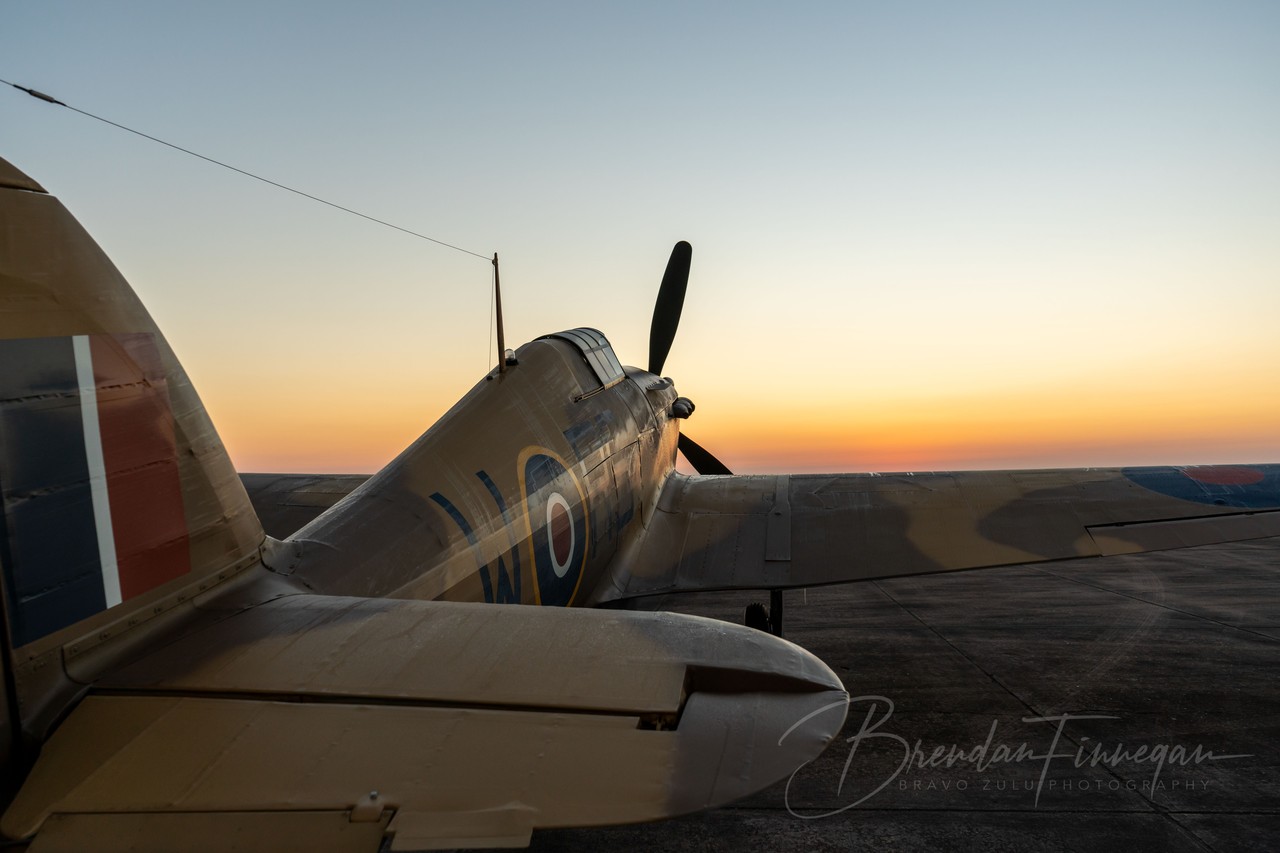
Service History
The Hurricane entered Royal Air Force service on December 15, 1937, when No. 111 Squadron at Northolt received the first four production aircraft, replacing their obsolete Gloster Gauntlet biplanes. By the outbreak of World War II, the Hurricane had become the backbone of RAF Fighter Command, with more squadrons equipped with Hurricanes than any other fighter type.
During the Battle of Britain from July to October 1940, Hurricanes bore the brunt of the fighting against the Luftwaffe. While German forces lost 1,733 aircraft during this period, the RAF lost 915 planes and 415 pilots. Hurricane losses exceeded those of the more famous Spitfire, yet the Air Ministry consistently ordered more Hurricanes than any other fighter throughout the war, recognizing their vital importance to Britain's defense.
Combat Performance and Variants
The Hurricane Mark I, armed with eight .303-inch machine guns, proved effective against German bombers but required enhanced firepower for later war conditions. The Mark IIA and IIB variants, first flown on June 11, 1940, increased armament to twelve machine guns. The Mark IIC, introduced in 1941, carried four 20mm Oerlikon cannons and became the most heavily produced variant with more than 4,700 examples built.
Naval variants included the Sea Hurricane, equipped with arresting hooks for convoy escort duties aboard merchant aircraft carriers. These adaptations demonstrated the Hurricane's versatility beyond pure fighter operations, extending British air cover over previously unprotected Atlantic convoy routes.
The Designer and Manufacturer
Sydney Camm, chief designer at Hawker Aircraft, conceived the Hurricane in response to a 1933 Air Ministry specification calling for a fighter capable of exceeding 250 miles per hour. His revolutionary design incorporated a wide-track retractable landing gear, retracting tailwheel, and enclosed cockpit—features that dramatically reduced drag compared to contemporary biplane fighters.
Hawker test pilot George Bulman flew the prototype K5083 on its maiden flight from Brooklands on November 6, 1935, powered by a 1,025-horsepower Rolls-Royce 'C' engine. Initial flight trials revealed engine reliability issues that were progressively resolved through the Merlin F, Merlin II, and ultimately the 1,030-horsepower Merlin III, which powered most early production aircraft.
Hawker Aircraft, recognizing the vulnerability of British factories to enemy attack, arranged licensed production with Canadian Car and Foundry at Fort William, Ontario. The first Canadian Hurricane flew on January 10, 1940, with the initial shipment of 20 airframes reaching England in June 1940—arriving just in time for the Battle of Britain.
Production Achievement
On June 3, 1936, Hawker received an unprecedented peacetime contract for 600 aircraft, one of the largest single military aircraft orders in history. The company delivered 40 aircraft within three months, establishing production methods that would prove crucial during wartime expansion.
Total Hurricane production reached 14,233 aircraft over seven years, with 13,132 built in Britain by Hawker, Gloster, and Fairey, while Canadian Car and Foundry manufactured 1,451 examples. Production ceased in September 1944 as more advanced fighters assumed the Hurricane's roles.
Technical Innovation
The Hurricane's mixed construction—steel tube fuselage with fabric covering and metal wings—provided an optimal balance of strength, repairability, and production efficiency. This design philosophy allowed rapid field repairs using basic materials, a crucial advantage during sustained combat operations.
Powered by the Rolls-Royce Merlin inline engine, the Hurricane achieved a maximum speed of approximately 340 miles per hour, a service ceiling above 36,000 feet, and a range of 600 miles. The wide-track landing gear provided excellent ground handling characteristics, making the aircraft more forgiving for newly trained wartime pilots than some contemporaries.
Legacy and Preservation
Of the 14,233 Hurricanes produced, fewer than 20 remain airworthy today. Notable survivors include "The Last of the Many," the final Hurricane built, which Hawker purchased and maintained in flying condition as a company memorial.
The Smithsonian Institution's National Air and Space Museum displays Hurricane Mk. IIC LF686, built at Langley in early 1944. The Military Aviation Museum operates a Canadian-built Hurricane Mk. XII, while the Hangar Flight Museum in Canada preserves Hurricane 5389 Mk. XII from 1942. A unique two-seat Hurricane, modified in 2020, represents the world's only example of this configuration.
The Hurricane's affordability and ease of manufacture made it indispensable to Allied victory, proving that practical engineering excellence often trumps cutting-edge performance in determining historical outcomes.