
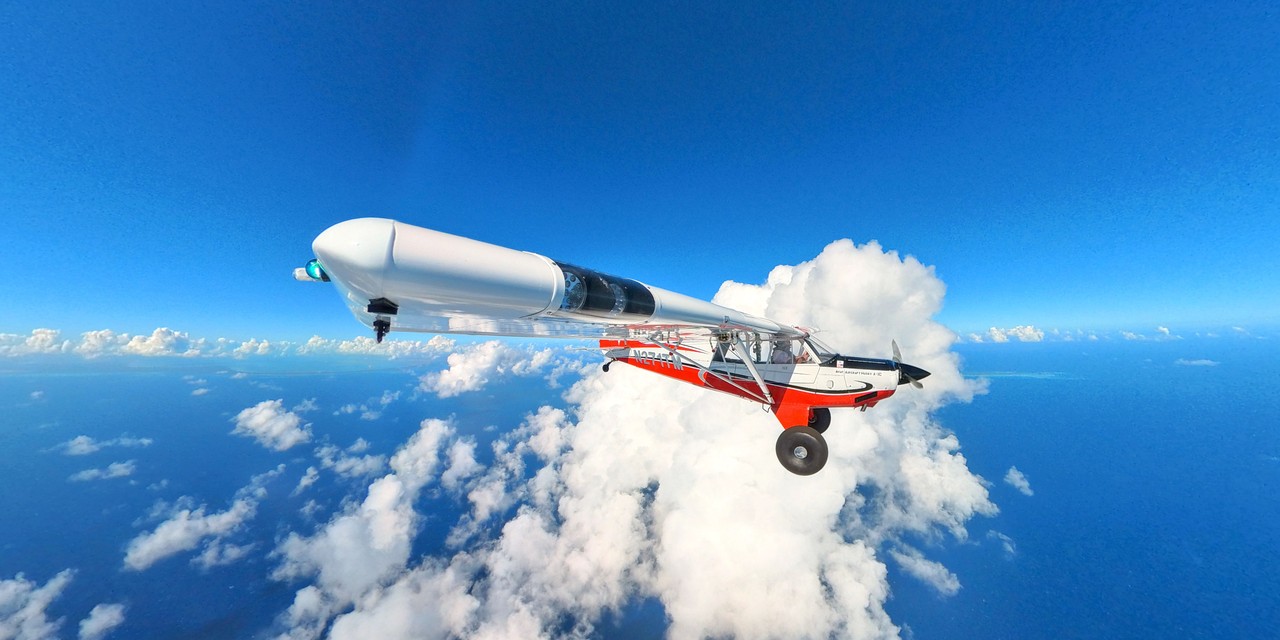
Development and Design
The Husky emerged from a lineage tracing back to the CallAir Aircraft Company, founded in 1939 by the Call family for rugged terrain operations. After World War II delays and subsequent corporate transfers through IMCO and Aero Commander, Christen Industries acquired the relevant design heritage in the 1980s. Designer E.H. "Herb" Andersen Jr. led the development team, with project initiator Christensen driving the effort to improve upon the Piper Super Cub's utility performance.
The design team conducted extensive surveys of Super Cub operations to identify improvement opportunities. Their objectives focused on enhanced short-field performance for bush pilots, farmers, ranchers, and hunters operating in the challenging terrain of the Intermountain Rockies. The Husky became the first STOL aircraft designed using computer-aided design software, enabling precise calculations of load tolerances and aerodynamics from the initial 1985 napkin sketch concept.
The prototype achieved first flight in 1986, completing an remarkably rapid development cycle. FAA certification arrived on May 1, 1987, allowing production to commence within an 18-month timeline from initial concept to certified aircraft.
Manufacturing Evolution
Christen Industries began Husky production in 1987 at their facility. In 1991, Malcolm White acquired the company, reorganizing it as Aviat Aircraft Inc. and consolidating production of the Husky alongside the Pitts and Eagle aircraft lines. Manufacturing operations established their primary base in Afton, Wyoming, which remains the longest-running production site for the aircraft.
Aviat Aircraft continues production today, having evolved the design through multiple variants. More than 650 aircraft were delivered between the initial introduction and 2008, with production ongoing into the present era.
Technical Specifications and Performance
The Husky employs Lycoming O-360-series engines as its primary powerplant. The standard configuration utilizes either the O-360-A1P or O-360-C1G producing 180 horsepower, while later variants offered the fuel-injected IO-360-A1D6 rated at 200 horsepower. These air-cooled, four-cylinder, horizontally-opposed engines provide the reliability essential for backcountry operations.
Performance characteristics demonstrate the aircraft's STOL capabilities with a maximum speed of 145 mph and a remarkably low stall speed of 53 mph. The design achieves a range of up to 800 miles, providing substantial operational flexibility for bush flying missions. Key innovations include constant-speed variable-pitch propellers that deliver 25 mph cruise speed improvements over the Super Cub baseline.
Design enhancements incorporated 60-percent span flaps, spadeless ailerons, and progressive gross weight increases across variants. The aircraft maintains consistent control response characteristics throughout its flight envelope, addressing pilot concerns with earlier STOL designs.
Variant Development
Aviat developed the Husky through four primary variants, each incorporating weight and capability improvements. The original A-1 received certification on May 1, 1987, with a maximum gross weight of 1,800 pounds. The A-1A variant, certified on January 28, 1998, increased gross weight to 1,890 pounds while retaining the standard 180-horsepower engine.
The A-1B variant, also certified on January 28, 1998, expanded gross weight to 2,000 pounds and introduced the option for the 200-horsepower IO-360 engine under supplemental type certificate. The most recent A-1C variant achieved certification in 2007 with a maximum gross weight of 2,200 pounds, representing a 22-percent increase in useful load capacity over the original design.
Civil Operations and Applications
The Husky serves primarily in private bush flying operations, government agency missions, and specialized backcountry transportation roles. The aircraft typically accommodates one pilot plus one passenger or equivalent cargo payload. Its high-wing configuration and robust landing gear enable operations from unimproved airstrips, sandbars, and challenging terrain.
Operators frequently configure aircraft with specialized equipment including floats for water operations, skis for snow landing capability, glass panel avionics, and composite propellers. Modern variants incorporate advanced features such as MT three-blade propellers and vortex generators for enhanced performance characteristics.
Current Status and Legacy
The Husky established itself as a benchmark for modern STOL utility aircraft, successfully bridging traditional bush plane capabilities with contemporary design methodologies. Its computer-aided development process pioneered modern light aircraft design approaches, while the rapid certification timeline demonstrated efficient regulatory processes.
Aviat Aircraft continues manufacturing with current A-1C models priced around $375,000 as of early 2023. The aircraft's rugged construction and ongoing factory support ensure many examples remain active in backcountry service, with documented aircraft maintaining airworthiness certificates decades after manufacture. A typical example includes a 1997 A-1 with 350 airframe hours remaining in active service, demonstrating the design's operational longevity.