
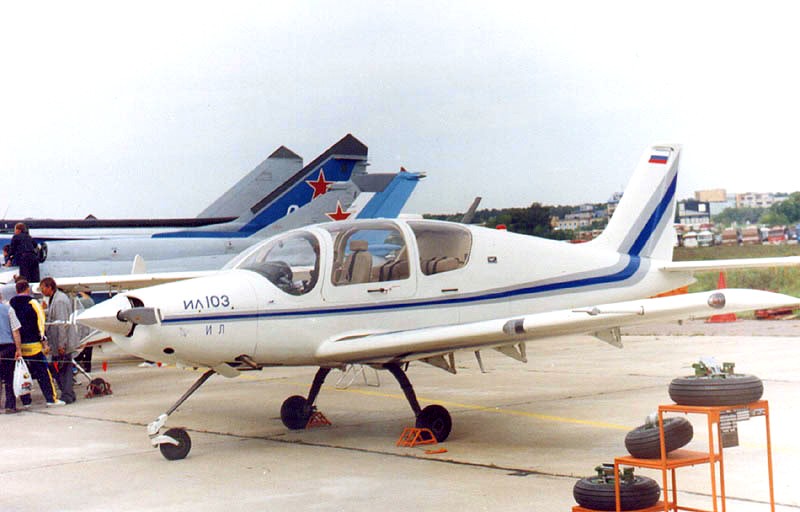
Development and Design
Development of the IL-103 began in 1990 within the Soviet Union as the Ilyushin Design Bureau sought to create a versatile training aircraft capable of withstanding harsh climates and operating from poor-quality runways. The design team prioritized economy, reliability, and all-weather capability, targeting both civil training roles and military applications. After four years of development, the prototype achieved its maiden flight in May 1994.
The aircraft's robust construction philosophy emphasized everyday operational use without requiring hangar storage, making it particularly suitable for remote locations and challenging environments. This design approach reflected Ilyushin's extensive experience in creating durable aircraft, drawing from the bureau's eight decades of aviation experience since its 1933 founding.
Certification and Production
The IL-103 achieved a significant milestone in December 1998 when it became the first Russian aircraft to receive Federal Aviation Administration certification, earning type certificate A45CE. This certification opened international markets and validated post-Soviet Russian aircraft design capabilities for export and general aviation applications.
Production commenced following Russian AP-23 certification in February 1996, with manufacturing handled by the Ilyushin Aviation Complex in Russia. In March 2021, Ilyushin signed an agreement with Aviation Engineering Zrt of Pécs, Hungary, for licensed production of a modernized version, ensuring continued availability of the type. Sergey Yarkovoy represented Ilyushin while Laszlo Boros signed for the Hungarian firm in this expansion deal.
The Manufacturer
The Ilyushin Aviation Complex operates as part of Russia's United Aircraft Corporation under the Rostec umbrella. The original Ilyushin Design Bureau, established in 1933, celebrated its 80th anniversary in 2013, having produced more than 60,000 Il-series aircraft across its various facilities. During the 2000s consolidation of Russian aerospace companies, Ilyushin integrated into the United Aircraft Corporation structure while maintaining its design and manufacturing capabilities.
Today, the company continues operations as the Ilyushin Aviation Complex within UAC, developing both civil and military aircraft while expanding international partnerships through licensing agreements.
Engine and Technical Specifications
The IL-103 employs a single Teledyne Continental IO-360-ES six-cylinder, air-cooled, horizontally-opposed piston engine producing 210 horsepower at 2,700 rpm. This powerplant, manufactured by Continental Aerospace Technologies (formerly Teledyne Continental Motors), features fuel injection, dual ignition systems, and a full-flow oil filter for enhanced reliability in demanding conditions.
The engine drives a two-bladed Hartzell BHC-C2YF-1BF/F8459A-8R constant-speed metal propeller with a 1.93-meter diameter. Supporting systems include a 28-volt, 60-amp alternator, electric auxiliary fuel pump, and 200-liter fuel capacity providing an 800-kilometer range with reserves.
Performance Characteristics
The aircraft demonstrates respectable performance with a maximum speed of 220 kilometers per hour and a cruise speed of 180 kilometers per hour. Service ceiling reaches 3,000 meters with a climb rate of 3.167 meters per second. Stall speeds vary from 117 kilometers per hour with flaps up to 111 kilometers per hour with 10-degree flap extension, providing good low-speed handling characteristics essential for training operations.
With an empty weight of 900 kilograms and maximum takeoff weight of 1,310 kilograms, the IL-103 can carry a useful load of 410 kilograms, including up to 270 kilograms of payload when configured for four passengers plus pilot.
Military and Civil Service
While primarily designed for civil training and multi-purpose roles including touring, surveillance, and agricultural applications, the IL-103 has seen limited military adoption. The Lao People's Liberation Army Air Force operates three aircraft from a 21-unit order, with three delivered in July 2004. Peru's Army operates five IL-103s from six delivered, while Somaliland Armed Forces purchased four for dual civilian-military purposes.
No combat missions or wartime service have been recorded, with military operators using the type exclusively for training purposes. Various configurations exist including the IL-103-10 export variant with advanced avionics and the IL-103-11 partially modernized export version.
Production and Legacy
Total production remains limited, with approximately 66 aircraft delivered worldwide as of recent data. This modest production reflects the specialized nature of the aircraft and competitive general aviation market conditions during its production years.
The IL-103's primary significance lies in breaking barriers for Russian aviation exports through FAA certification, demonstrating that post-Soviet aircraft could meet international standards. The 2021 Hungarian licensing agreement for modernized production ensures the design's continued relevance, potentially expanding its presence in European and international markets. The aircraft's ability to operate from unpaved surfaces in extreme conditions maintains its niche appeal for operators requiring rugged, reliable training aircraft.