
Design and Development
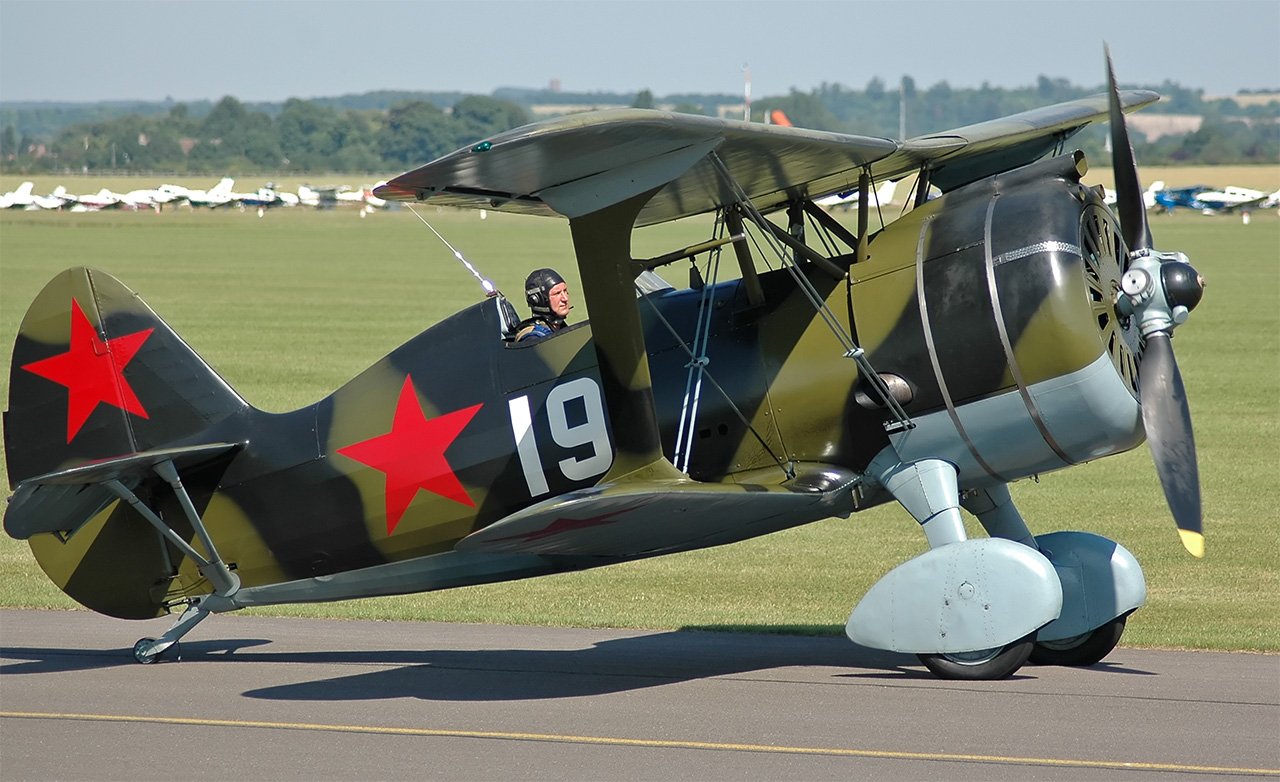
The Polikarpov I-15, known as the "Chaika" (Russian for "seagull"), was designed by Nikolai Nikolaevich Polikarpov and his design bureau (OKB Polikarpov) in the early 1930s. The aircraft's most striking feature was its gull-wing upper wing, which utilized a strong dihedral in the center section to improve pilot visibility and provide structural benefits over traditional straight-wing biplanes. The I-15 prototype, also designated as the TsKB-3, first took flight in 1933. The resulting aircraft was a single-bay, staggered biplane featuring fixed, spatted landing gear and a radial engine enclosed in a NACA-type cowling to reduce drag and improve cooling.
Production and Manufacturing
Production of the I-15 began in 1934 and continued through the mid-1930s, eventually being succeeded by the I-15bis and other derivatives by 1936–1937. The aircraft were manufactured by Soviet state aircraft factories (GAZ) under the People’s Commissariat of the Aviation Industry (NKAP). Key production sites included the Moscow aviation industry, which evolved from the pre-revolutionary Dux factory. Dux was nationalized and reorganized into numbered state plants, such as Plant №1 and Plant №30. Moscow Aviation Plant №39, named after Menzhinsky, was another significant producer of the era. While the exact number of original I-15 airframes is not reliably documented, the broader I-15 family—including the I-15bis, I-152, and I-153—exceeded 3,000 aircraft.
Technical Specifications and Performance
The operational I-15 was powered by a single Shvetsov M-25 nine-cylinder air-cooled radial piston engine, a Soviet development of the Wright R-1820 "Cyclone." This engine produced approximately 700–715 hp (520–530 kW). The aircraft had a wingspan of approximately 9.75–9.8 meters and a length of 6.3–6.4 meters. With a maximum take-off weight of around 1,600–1,700 kg, the I-15 could reach maximum speeds of 360–380 km/h and had a service ceiling of 7,500–8,000 meters. Its standard armament consisted of four 7.62 mm ShKAS machine guns, and it could carry up to 100 kg of bombs for ground-attack missions.
Military Service and Legacy
The I-15 served as a frontline fighter for the VVS RKKA and was exported to several nations. During the Spanish Civil War (1936–1939), the aircraft was supplied to the Spanish Republican Air Force, where it was known as the "Chato." It also saw action in the Second Sino-Japanese War starting in 1937, operated by the Chinese Nationalist Air Force and Soviet volunteers. By the start of the Great Patriotic War in June 1941, the I-15 was largely obsolete as a fighter but continued to serve in training and close-support roles. Today, very few original I-15 airframes survive, with most existing examples being later variants or reconstructions.