
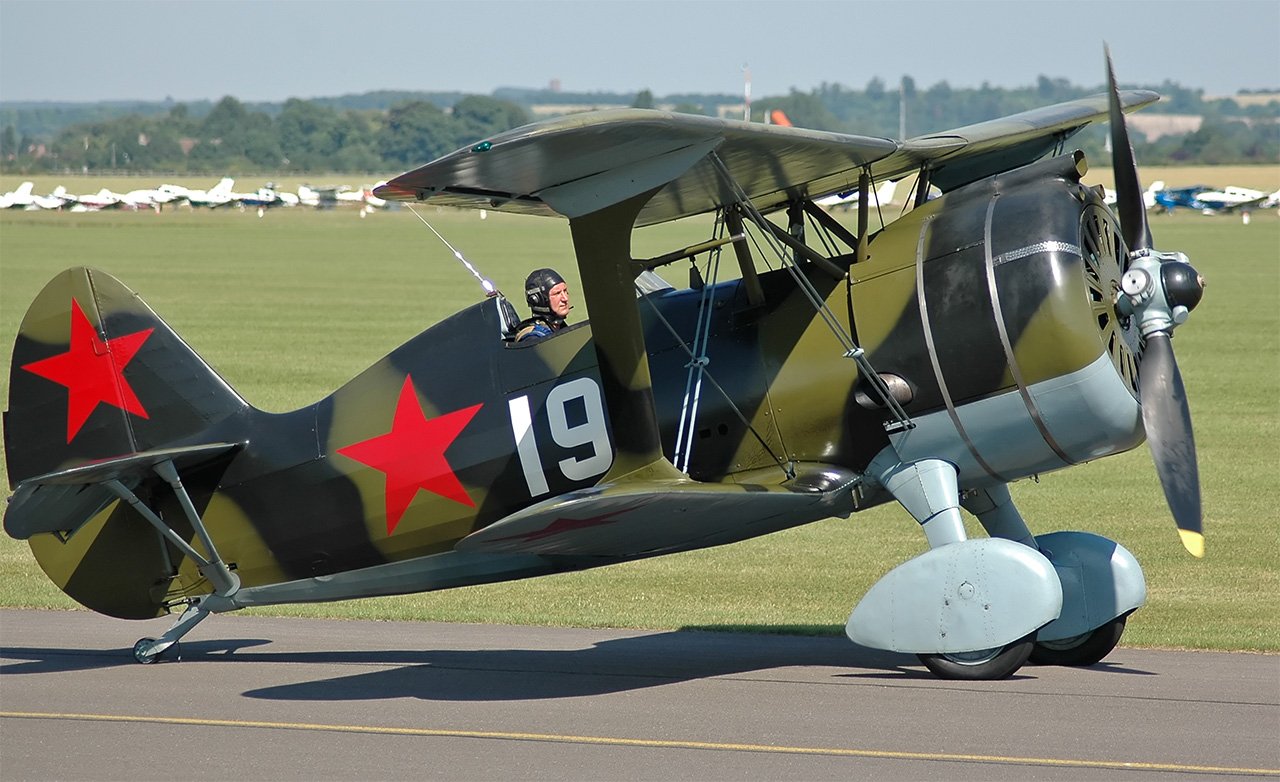
The Polikarpov I-15bis, also designated as the I-152, was a significant aerodynamic and structural evolution of the earlier I-15 fighter. Designed under the leadership of Nikolai Nikolaevich Polikarpov and his design bureau, the I-15bis sought to address pilot concerns regarding visibility and production efficiency. While the original I-15 utilized a distinctive "gulled" upper wing known as the "Chaika," the I-15bis implemented a longer-span, straight upper wing with a conventional cabane center-section. Additionally, the aircraft replaced the Townend ring engine fairing with a full NACA-type cowling, similar to the I-16 monoplane, to enhance engine cooling and overall speed.
Production of the I-15bis took place in Soviet state aircraft factories from the autumn of 1937 until approximately 1940. A total of 2,408 units were manufactured, making it one of the most numerous biplane fighters ever produced. The aircraft was powered by air-cooled radial piston engines; early production models utilized the Shvetsov M-25, while later versions from mid-1938 onward were equipped with the more powerful M-25V.
In military service, the I-15bis was deployed globally in several late-1930s conflicts. In the Second Sino-Japanese War, the Soviet Union supplied 347 I-15 and I-15bis aircraft to China by 1939, with approximately 250 Soviet volunteer pilots operating them. While the aircraft outclassed the Japanese Kawasaki Ki-10, it struggled against monoplanes such as the Nakajima Ki-27 and Mitsubishi A5M2a. The type also saw action during the Spanish Civil War as a standard fighter for the Republican Air Force and participated in the 1939 Battle of Khalkhin Gol on the Mongolian-Chinese border, as well as the Soviet-Finnish Winter War.
During the German invasion of the Soviet Union in June 1941, over 1,000 I-15bis fighters remained in service. Although they were part of the first line of defense against the Luftwaffe, they were quickly outclassed and largely relegated to ground-attack and training roles by 1942. The aircraft was armed with four 7.62 mm ShKAS machine guns—two in the upper fuselage and one in each wing—and could carry up to 220 lb of bombs or RS-82/RBS-82 rockets. Small numbers of captured aircraft were also utilized by Germany and Finland.
Today, the legacy of the I-15bis is preserved in museums, including a specimen at the Military Aviation Museum in Virginia Beach, believed to have served with the 145th Assault Air Regiment. Another notable surviving example is a two-seat UTI trainer version specifically built for Vasily Stalin, the son of Joseph Stalin.