
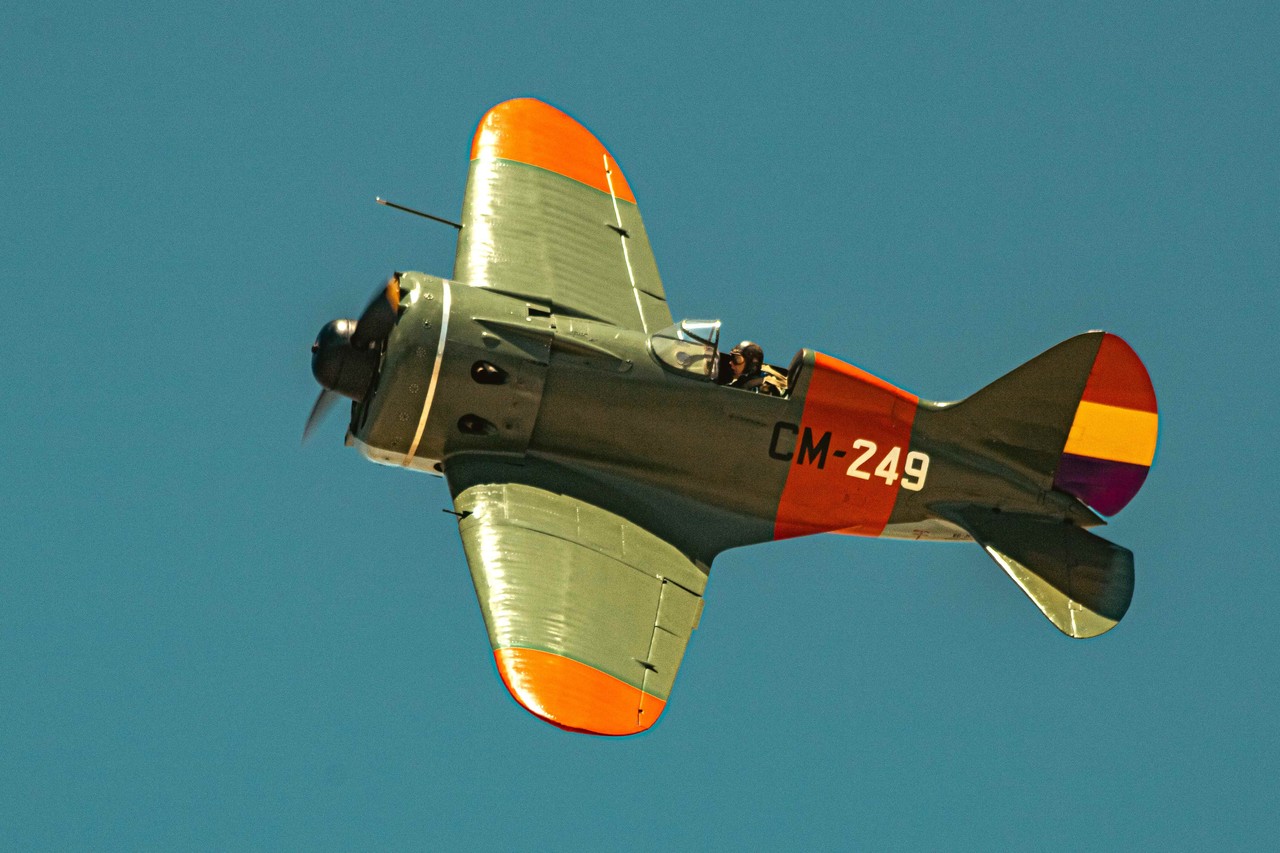
Combat Service and International Impact
The I-16 earned its combat credentials in three major conflicts before World War II began. During the Spanish Civil War from 1936 to 1939, Republican forces nicknamed it "Mosca" (Fly) while Nationalist pilots called it "Rata" (Rat). The aircraft's superior speed—up to 70 miles per hour faster than contemporary fighters—and exceptional maneuverability gave it significant advantages in aerial combat. In the Second Sino-Japanese War, 30 I-16s were delivered to the Chinese Air Force beginning August 3, 1939, where they fought against Japanese aircraft over Chinese skies.
During World War II, the I-16 served as the backbone of Soviet fighter aviation in the conflict's early stages. By June 1941, 579 I-16s were concentrated near Soviet borders, though they proved vulnerable to modern German Bf 109F fighters. The aircraft's role evolved from pure fighter to ground-attack missions, with later variants carrying up to 1,100 pounds of bombs or six RS-82 rockets. The Soviet VVS 155th Fighter Squadron operated I-16s until 1942, when many were withdrawn from front-line service due to obsolescence.
The Polikarpov Design Legacy
Nikolai Nikolaevich Polikarpov led the design bureau that created the I-16, working under extraordinary circumstances. Imprisoned in the late 1920s for slow progress on fighter designs, Polikarpov continued his aviation work under forced labor before his release. His TsKB-12 prototype impressed Soviet officials so thoroughly that production orders were placed on November 22, 1933, even before the aircraft's maiden flight.
The Polikarpov Design Bureau operated as a key Soviet aviation organization from the 1920s through the 1940s before being absorbed into the larger state aviation industry. The bureau was eventually merged into complexes under designers like Lavochkin and Yakovlev following World War II, and no longer exists as an independent entity today.
Revolutionary Design and Engineering
The I-16's most significant innovation was its retractable landing gear system, a world first for mass-produced fighters. Early variants used the M-22 nine-cylinder radial engine, a Soviet-licensed version of the Bristol Jupiter producing 480 horsepower. Later models received more powerful engines, including the Shvetsov ASh-62 generating 1,000 horsepower, which boosted maximum speed to 303 miles per hour.
Manufacturing occurred primarily at Soviet factories, including Gorky Aircraft Plant Number 21, where a 1939 example with serial number 2421028 was built. The aircraft featured armament ranging from two 7.62mm ShKAS machine guns in early variants to four guns in later models, with ground-attack versions carrying external ordnance.
Pilot Experience and Handling
Soviet pilots nicknamed the I-16 "Ishak" (Donkey) due to its challenging handling characteristics. The aircraft's reputation for difficulty led to the saying, "if you can fly an I-16, you can fly anything." Despite its tricky nature, the fighter could complete turns in 16 to 18 seconds and maintain speeds between 280 and 292 miles per hour in combat situations.
Valery Chkalov, the famous Soviet test pilot, flew the prototype on its maiden flight and praised the aircraft's performance capabilities. The I-16's combination of speed and maneuverability made it formidable in the hands of skilled pilots, though its demanding flight characteristics required extensive training.
Production and Variants
Total production figures vary among sources, with estimates ranging from approximately 8,900 aircraft (7,000 fighters plus 1,900 trainers) to over 10,292 in all versions. Major variants included the I-16-1 with basic armament, the Type 24 and Type 29 with enhanced weapons systems, and the UTI two-seat trainer version. Manufacturing continued from mid-1934 through 1941, when production ended as more modern fighters entered service.
The aircraft served with multiple air forces including the USSR, Republican Spain, China, Finland, and Mongolia. Export deliveries included 250 aircraft to China, demonstrating the type's international significance during the late 1930s.
Surviving Legacy
Today, only about 12 I-16s survive from the thousands produced, with approximately six remaining airworthy. Sir Tim Wallace recovered six wrecks in 1992, which were restored using ASh-62IR engines, with the first restored aircraft flying on September 9, 1995. Two airworthy examples operate in the United States, while others fly in New Zealand.
The Military Aviation Museum in Virginia displays a restored 1939 I-16 built at Gorky Aircraft Plant Number 21, recovered in 1991 from a crash site in Karelia. The I-16's historical significance extends beyond its combat record—it bridged the gap between biplane fighters and modern monoplane designs, establishing design principles that influenced fighter development worldwide. Its appearance in the 1935 Moscow May Day flyover symbolized Soviet aviation achievement and technological progress during the pre-war period.