
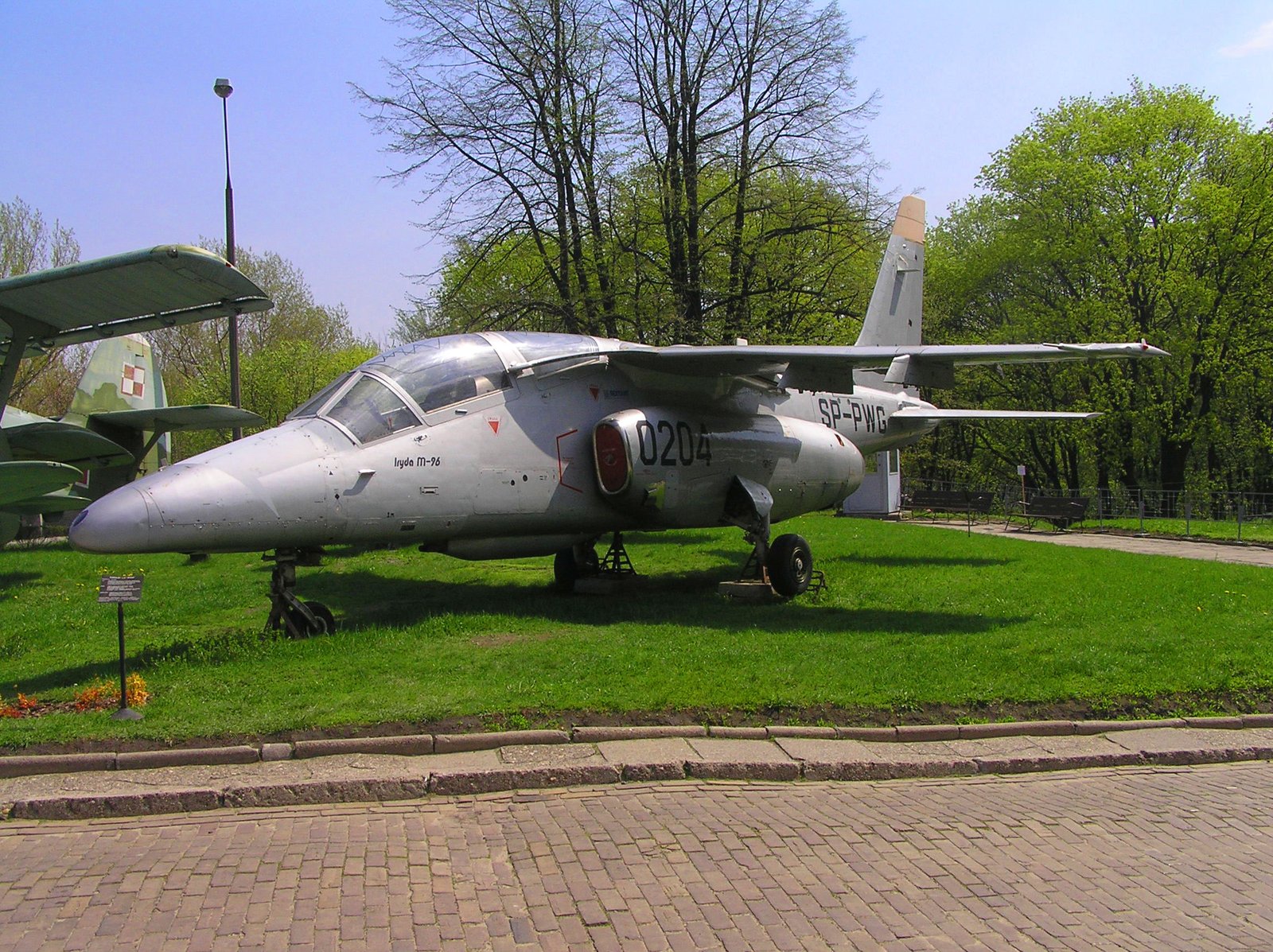
Design and Development
Work on the I-22 Iryda began in 1976 as a project to replace the aging TS-11 Iskra jet trainer. The aircraft was envisioned as a multi-role platform capable of serving as an intermediate and advanced trainer, as well as a light attack and tactical reconnaissance aircraft. Designed for the Polish Air Force, the I-22 featured a tandem two-seat cockpit under a single canopy and high-mounted swept wings with a swept tailplane to ensure modern handling characteristics. The first prototype took flight on March 3, 1985.
Production and Manufacturer
The aircraft was designed and manufactured by WSK PZL-Mielec (later PZL Mielec) in Mielec, Poland. Production occurred in small numbers between approximately 1984 and 1995. While exact figures vary slightly, records indicate that 17 flyable aircraft were produced, including five prototypes. Additionally, two non-flying airframes were constructed for static and fatigue testing, bringing the total number of built units to 19. The original manufacturer, PZL Mielec, continues to operate today as a subsidiary of Lockheed Martin, producing aircraft such as the M28 and S-70i Black Hawk.
Technical Specifications and Powerplant
The standard I-22 was powered by two PZL K-15 turbojet engines, each producing 14.7 kN (3,300 lbf) of thrust. This configuration allowed for a maximum speed of 940 km/h (Mach 0.82) at an altitude of 5,000 meters and a service ceiling of 13,700 meters. The aircraft had a wingspan of 10.52 meters and a maximum take-off weight of 7,700 kg. For armed roles, the I-22 was equipped with a ventral 23 mm GSh-23L cannon with 200 rounds and four under-wing hardpoints capable of carrying up to 2,000 kg of external stores, including S-5 rocket pods, R-60 missiles, and FAB-250 or FAB-500 bombs.
Service History and Legacy
The I-22 served exclusively with the Polish Air Force, with operational use occurring between 1992 and 1996. Despite its design for close air support and counter-insurgency, the Iryda never saw combat. The program was eventually cancelled due to a combination of technical accidents and political and financial disputes. Various upgraded versions were developed, including the M-93 (with M-93K and M-93V sub-variants, the latter utilizing Rolls-Royce Viper 545 engines) and the M-96. Today, no I-22s are known to be airworthy, though some survive as museum pieces, such as airframe nb 301 preserved in Mielec.