
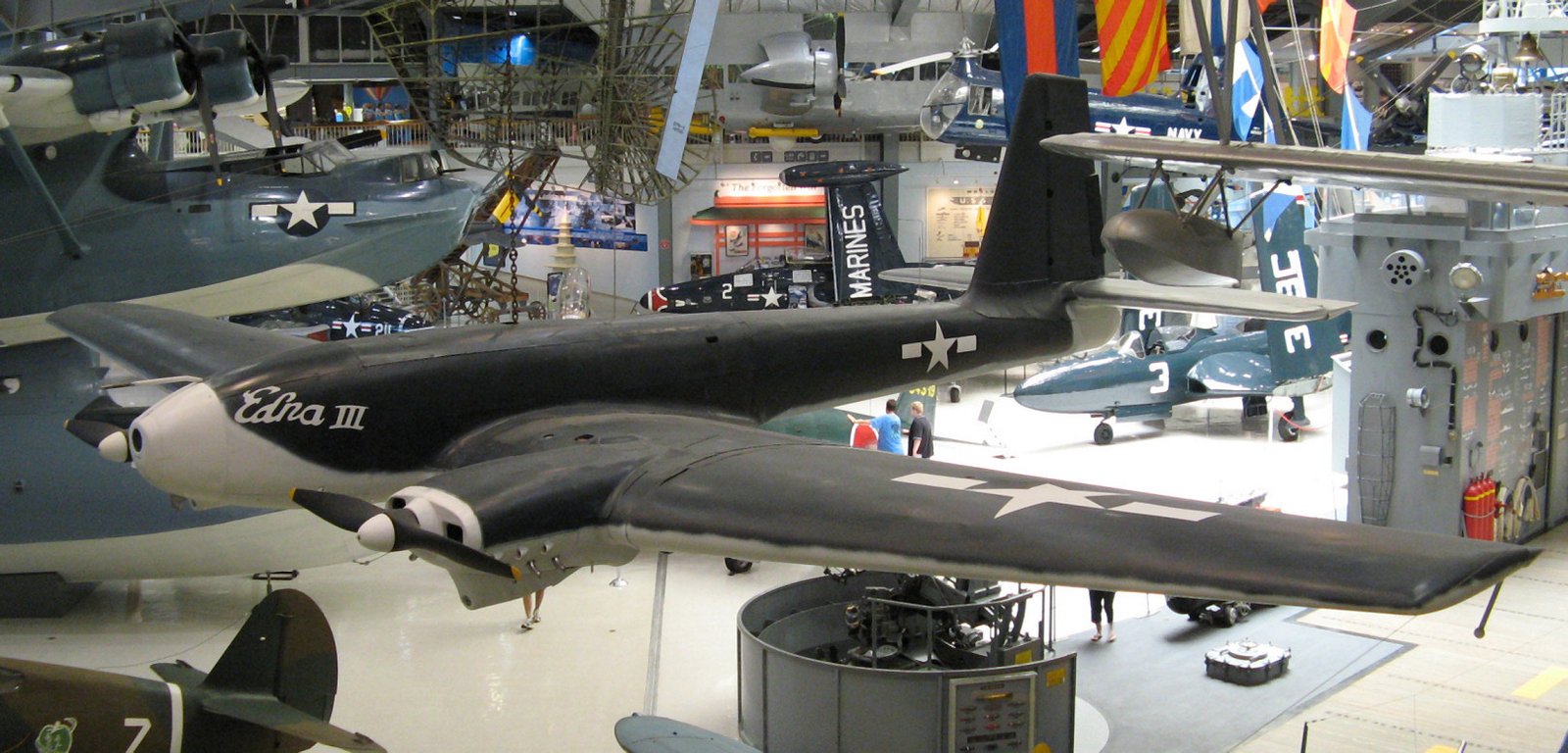
The Interstate TDR, most notably the TDR-1, was a groundbreaking unmanned combat aerial vehicle (UCAV) developed for the United States Navy during World War II. Conceived as an expendable attack aircraft, it is historically recognized as one of the first practical television-guided assault drones and a direct ancestor to modern cruise missiles.
Development began in April 1942 following a Navy request to the Interstate Aircraft and Engineering Corporation. The prototype first flew in 1942, and while the aircraft was ready for use by late 1942, it did not enter combat until 1944. Production took place in DeKalb, Illinois, where the Wurlitzer piano company provided essential wood-fabrication expertise as a subcontractor. Although the initial Navy contract called for two prototypes and 2,000 production units, the order was later reduced to 300. Ultimately, 189 production TDR-1 aircraft were completed before the program was canceled on October 28, 1944.
Technically, the TDR-1 was powered by two Lycoming O-435-2 air-cooled, horizontally-opposed six-cylinder piston engines, each producing approximately 230 hp. The aircraft featured a wingspan of roughly 48 feet and a length of about 37 feet, achieving a maximum speed of approximately 140 mph and an operational range between 426 and 435 miles. While designed for unmanned missions, the airframe included provisions for a single onboard pilot to facilitate ferry flights to forward operating bases.
Operationally, the TDR-1 was controlled via radio and RCA television equipment from a separate aircraft, typically a Grumman TBF or TBM Avenger. The U.S. Navy formed Special Task Air Group 1 (STAG-1) under the Special Air Task Force (SATFOR) to deploy these drones to the Russell Islands in the Southwest Pacific. On September 27, 1944, the TDR-1 flew its first operational mission. Over a two-month period, 50 drones were launched, resulting in 31 successful hits against Japanese airfields, bridges, grounded ships, and anti-aircraft positions. A notable strike occurred on October 27, 1944, against Rabaul, where 31 of 50 launched drones reached their targets. The program was terminated the following day due to technical reliability issues and the increasing effectiveness of conventional airpower.
Beyond the TDR-1, the U.S. Army Air Forces evaluated one unit under the designation XBQ-4, though no further orders were placed. Today, the legacy of the TDR is preserved at the National Naval Aviation Museum in Pensacola, Florida, which houses a surviving example known as "Edna III."