
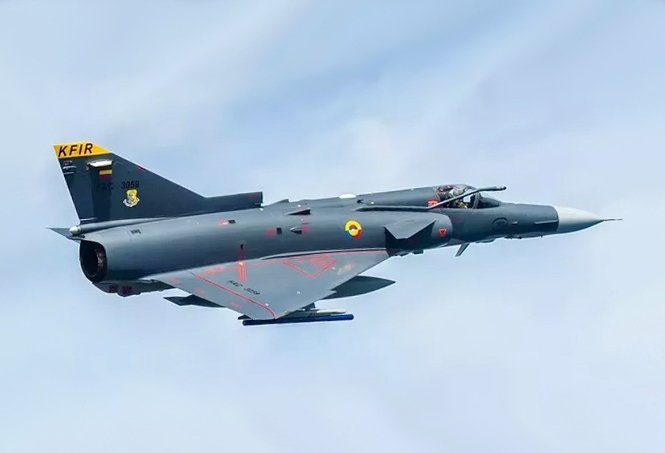
Production and Manufacturer History
The IAI Kfir was developed and manufactured by Israel Aircraft Industries (IAI) in Israel. The company, which began in 1953 as the Bedek Aviation Company under the initiative of Shimon Peres, originally focused on maintaining aircraft for the Israel Defense Forces before expanding into indigenous design and production during the late 1950s. By the time the Kfir was developed, the company operated as Israel Aircraft Industries, and it is known today as the government-owned Israel Aerospace Industries, employing approximately 14,000 people as of 2021.
Design and Technical Specifications
Developed as a direct response to a French arms embargo imposed after 1967, the Kfir represents Israel's drive for aerospace self-reliance. The aircraft is based on the Dassault Mirage 5 airframe but incorporates Israeli avionics and a license-built General Electric J79-J1E turbojet engine. This engine provides 5,200 kgf of dry thrust and 8,150 kgf with afterburner. The early-production model is a single-seat fighter with a delta-wing configuration, a wingspan of 8.22 meters, an empty weight of 7,280 kg, and a maximum loaded weight of 14,700 kg.
Performance figures for early variants include a maximum speed of 1,390 km/h at sea level and Mach 2.3 at maximum altitude, with a service ceiling of 17,680 meters and a range of 768 km. For armament, the aircraft is equipped with two 30 mm DEFA 552A cannons (140 rounds per gun) and can carry up to two AIM-9D, AIM-9G, or Shafrir 2 missiles. It is capable of carrying up to 4,295 kg of external ordnance, including Mk.80-series bombs, Zuni rockets, and GAU-4 20 mm cannon pods.
Service History
The Kfir first flew in June 1973 and entered service with the Israeli Air Force (IAF) in 1975, with the first units assigned to the 101st "First Fighter" Squadron. In February 1976, the 113th "Hornet" Squadron also began operating the type. The aircraft's first combat action occurred on November 9, 1977, during an airstrike on a training camp at Tel Azia, Lebanon. It later saw extensive use during the 1982 Lebanon War. However, the arrival of the F-15A "Baz" in 1976 shifted the Kfir's primary role from air-superiority to attack missions. The IAF eventually retired the type in the 1990s.
Beyond Israel, the United States Navy utilized the aircraft as an adversary training platform under the designation F-21A. The Colombian Aerospace Force and the Sri Lanka Air Force remain current operators. Sri Lanka acquired its aircraft in the early-to-mid 1990s and used them for strikes against rebel targets during its civil war. As of 2024, Sri Lanka operates five Kfirs, one of which recently completed a life-extension upgrade.
Legacy
With approximately 220 airframes manufactured across several variants, the Kfir is remembered as a milestone in Israeli aviation. Its versatility is evidenced by its continued operation in Colombia and Sri Lanka, as well as its role as an aggressor aircraft for U.S. training programs.