
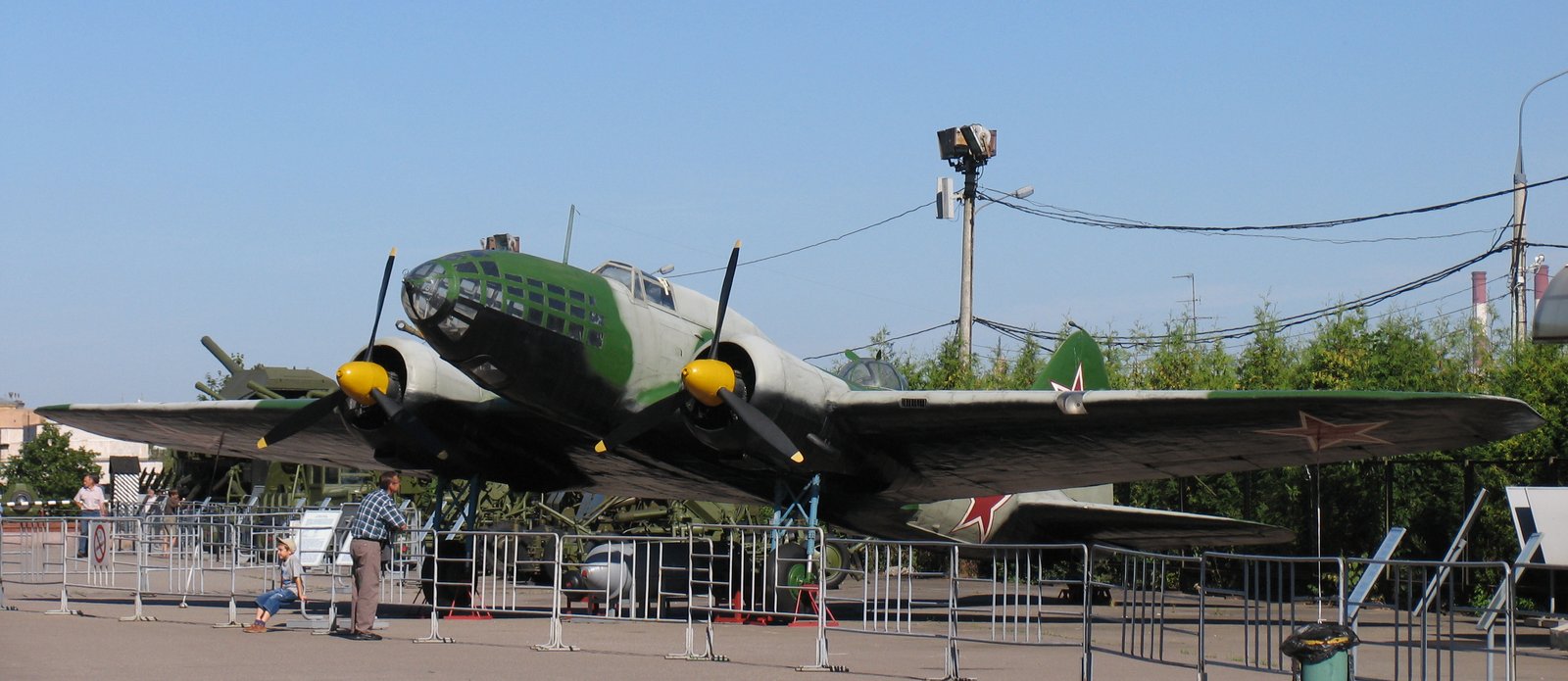
The Ilyushin Il-4, originally designated as the DB-3F, was a twin-engined, long-range land-based bomber designed by Sergey Vladimirovich Ilyushin and his team at the TsKB / OKB-39 design bureau. The prototype first flew in 1938, with test flights occurring in the autumn of that year. The aircraft was designed for versatility and long-distance operations, featuring a slender fuselage and a mid-set wing that allowed for a high payload-to-weight ratio. It was capable of carrying up to 2,500 kg of bombs internally and externally, though typical loads were often reduced to 1,000–1,500 kg to maximize its range.
Production began in 1939 and continued through the Great Patriotic War, ending around 1944–1945. Total production figures vary, with estimates ranging from 5,214 to 5,256 aircraft, though it is generally accepted that just over 5,000 were built. Manufacturing was distributed across several Soviet state plants: Plant No. 39 in Moscow (the institutional predecessor to the Khrunichev State Research and Production Space Center), Plant No. 18 in Voronezh (now the Voronezh Aircraft Production Association), Plant No. 126 in Komsomolsk-on-Amur, and the Irkutsk Aviation Plant, which expanded production following wartime evacuations from the western USSR.
Power was provided by two Shvetsov M-88 or M-88B 14-cylinder, twin-row air-cooled radial piston engines, each producing approximately 1,100 hp for take-off. These engines enabled a maximum speed of roughly 430–445 km/h at an altitude of 6,000 m and a ferry range of up to 3,900 km. The Il-4's long-range capabilities were demonstrated in 1941–42 during symbolic raids on Berlin launched from bases near the Baltic Fleet and Leningrad.
In military service, the Il-4 was operated by the VVS RKKA and Soviet Naval Aviation. While the standard bomber targeted industrial centers and communications nodes, the Il-4T variant served as a land-based torpedo-bomber, carrying one large or two smaller torpedoes to attack Axis shipping in the Black Sea, Baltic, and Arctic theaters. The aircraft's crew typically consisted of four members: a pilot, navigator/bombardier, radio operator/gunner, and a dorsal gunner. Today, the Il-4 exists only as a few non-airworthy museum pieces or wrecks, serving as a testament to Soviet long-range strike capabilities during the early-to-mid war period.