
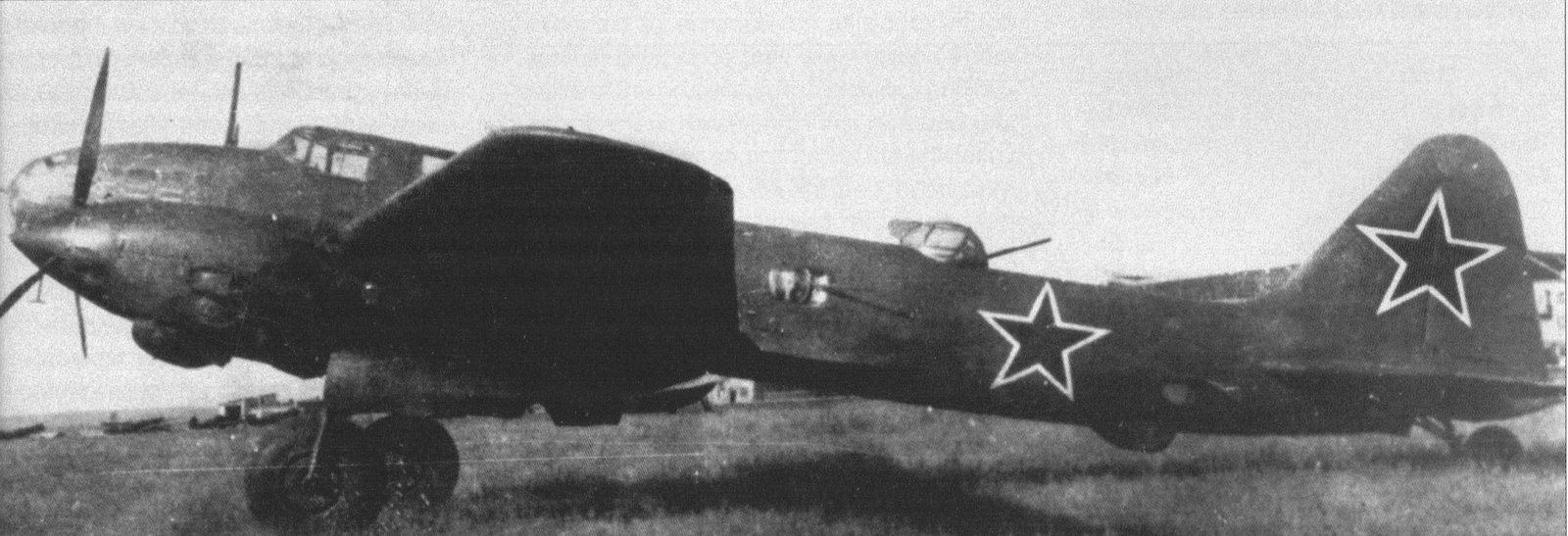
The Ilyushin Il-6 was designed by the Ilyushin OKB under the leadership of Sergey V. Ilyushin to serve as a fast, long-range bomber capable of replacing the Il-4. Design work commenced in mid-1942, initially focusing on a high-speed aircraft powered by radial engines. However, the project was soon recast to prioritize extreme endurance for maritime missions and distant strikes, leading to a revised design powered by fuel-efficient diesel engines. Prototype production began in December 1942 at the Irkutsk Aviation Plant (Plant No. 39), and the sole aircraft was completed by the summer of 1943.
The prototype first took flight on August 7, 1943, in Irkutsk, piloted by the renowned Soviet test pilot Vladimir Konstantinovich Kokkinaki. The aircraft was powered by two Charomskiy ACh-30BF (M-30) V-12 liquid-cooled diesel piston engines, each producing approximately 1,400 kW (1,900 hp) and driving three-bladed constant-speed propellers. This configuration allowed the Il-6 to reach a maximum speed of 464 km/h at an altitude of 6,200 meters and a cruise speed of 340 km/h. With a 1,000 kg bomb load and an all-up weight of 18,150 kg, the aircraft achieved a calculated range of 5,450 km.
Designed for heavy defensive capabilities, the Il-6 featured five 20 mm ShVAK cannons located in the nose, two beam positions, a dorsal turret, and a ventral position. Its offensive capacity was substantial, with a maximum bomb load of 4,500 kg, consisting of 2,500 kg internally and 2,000 kg on external underwing pylons (either as bombs or two 1,000 kg torpedoes). The crew consisted of five or six members, including two pilots who sat side-by-side in the cockpit.
Despite its technical promise, the project was cancelled in 1944 before state trials were completed. The cancellation was driven by reliability issues with the Charomskiy diesel engines, particularly in cold weather, and a shift in wartime priorities toward jet propulsion. The Il-6 never entered operational service or participated in combat. It remains significant as the final piston-engined bomber designed by the Ilyushin OKB. No airframes are known to have survived in museums or private collections.