
Service History
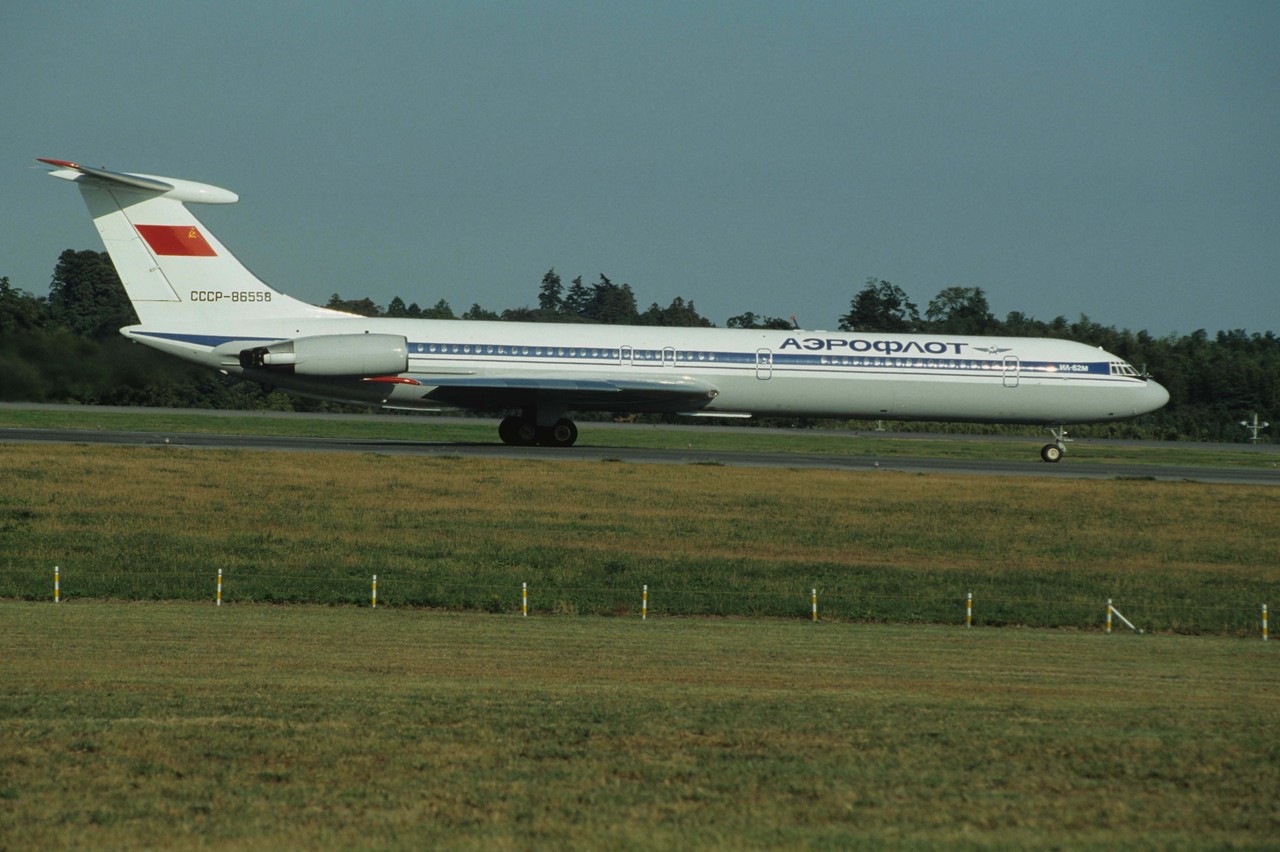
The Il-62 dominated Soviet long-range aviation for three decades, with Aeroflot operating the type on intercontinental routes from Moscow to destinations across Europe, Asia, and the Americas. The aircraft entered scheduled passenger service on March 10, 1967, flying from Moscow to Novosibirsk and Khabarovsk, followed by its first international service to Montreal on September 15, 1967. By the 1970s, the Il-62 had become the backbone of Aeroflot's intercontinental fleet, carrying passengers on prestigious routes including Moscow-New York, Moscow-Havana, and Moscow-Tokyo.
The Manufacturer
The Ilyushin Design Bureau, officially designated OKB-240, was founded by Sergei Vladimirovich Ilyushin and became one of the Soviet Union's premier aircraft design organizations. Established in 1933, the bureau had previously created successful designs including the Il-2 Sturmovik attack aircraft and the Il-18 turboprop airliner. The Il-62 was manufactured at the Kazan Aircraft Factory in the Russian Soviet Federative Socialist Republic, which had been producing aircraft since World War II. Following the Soviet Union's dissolution, the Ilyushin bureau continued operations as part of Russia's consolidated aerospace industry, though it never again achieved the commercial success of the Il-62.
Design and Development
Sergei Ilyushin personally led the design team that created the Il-62, with the project beginning in the late 1950s to meet Aeroflot's requirement for a long-range airliner capable of flying nonstop from Moscow to New York. The prototype was publicly revealed on September 24, 1962, when Soviet Premier Nikita Khrushchev inspected the aircraft. At its first flight, the Il-62 held the distinction of being the world's largest jet airliner, nearly identical in size and engine power to the British VC-10.
Development proved challenging, with the aircraft initially flying with Lyulka AL-7 engines producing 73.55 kN of thrust because the intended Kuznetsov NK-8-4 engines were not ready. This four-year delay between first flight and commercial service reflected extensive testing and refinement of both airframe and powerplant systems.
Engine and Technical Specifications
Production Il-62s were equipped with four Kuznetsov NK-8 turbojet engines mounted in pairs on pylons at the rear fuselage, a configuration that provided a clean wing design and reduced cabin noise. The aircraft was engineered for 25,000 to 30,000 flight hours and 7,000 to 8,000 cycles, with operational data showing a time between engine failures of 481 hours. The design incorporated triple redundancy, allowing continued flight on three engines with minimal risk during emergency procedures.
The aircraft's maximum wing loading reached 563 kilograms per square meter at maximum takeoff weight, with wing stress at takeoff calculated at 175 N/kg during 1.5g maneuvering. Flight testing demonstrated the Il-62's capabilities in 1966 when a proving flight covered 3,822 miles between Moscow and Khabarovsk in eight hours at an average speed of 478 mph.
International Operations
Beyond Aeroflot, the Il-62 served airlines throughout the Soviet sphere of influence and friendly nations. Czechoslovak Airlines operated seven aircraft, Interflug of East Germany flew six, and LOT Polish Airlines used five on European and intercontinental routes. The Civil Aviation Administration of China acquired five Il-62s for domestic and international services, while Tarom of Romania operated three aircraft. Cuba's national airline Cubana flew one Il-62, and North Korea received multiple aircraft from the Soviet Union for government and airline use.
Production and Legacy
Production at Kazan continued from 1965 to 1995, ultimately delivering 292 aircraft comprising five prototypes, 94 standard Il-62s, and 193 improved Il-62M variants. This production total exceeded the combined output of its wide-body successors, the Il-86 and Il-96, reflecting the Il-62's commercial success and operational reliability.
The final four aircraft remained unsold at the factory in 1997, marking the end of an era in Soviet aviation. The Il-62's extended production run demonstrated the enduring value of its design, with fuel costs of just 0.052 EUR per passenger-kilometer making it economically competitive throughout its career. Today, the Il-62 stands as a symbol of Soviet technological achievement and the nation's ability to compete in the global airliner market during the height of the Cold War.