
Service History
The Il-76 entered Soviet Air Force service in June 1974 and quickly became the backbone of Soviet strategic airlift capability. By the 1980s, the aircraft had largely replaced the aging Antonov An-12 fleet and established itself as the primary heavy-lift transport across the Warsaw Pact nations. The aircraft's unique capability to operate from 3,500-foot unpaved runways while carrying substantial payloads made it invaluable for supplying remote military installations across Siberia and the Arctic regions.
Commercial operations began with Aeroflot in 1976, where the Il-76T civilian variant proved equally successful. The aircraft's robust design and reliability made it a favorite among cargo operators worldwide, with approximately 960 aircraft built across all variants since production began.
Military Operations
The Il-76 saw extensive combat service during the Soviet-Afghan War, where its ability to operate from high-altitude airfields proved crucial. Military variants designated Il-76M featured defensive armament including a tail-mounted 23mm cannon, reflecting the aircraft's expected operations in hostile environments.
During the 1991 Gulf War, several Iraqi Air Force Il-76s were impounded when they fled to Iran, where they entered Iranian service. The aircraft has since served with air forces across Europe, Asia, and Africa, often serving dual roles as both strategic transports and aerial refueling tankers.
The Designer and Development
Sergei Ilyushin's design team, led by Gienrich Vasilyevich Novozhilov, began work on the Il-76 in 1967 to meet demanding Soviet requirements. The specification called for an aircraft capable of carrying 40 tonnes over 5,000 kilometers in less than six hours – a significant challenge that required innovative engineering solutions.
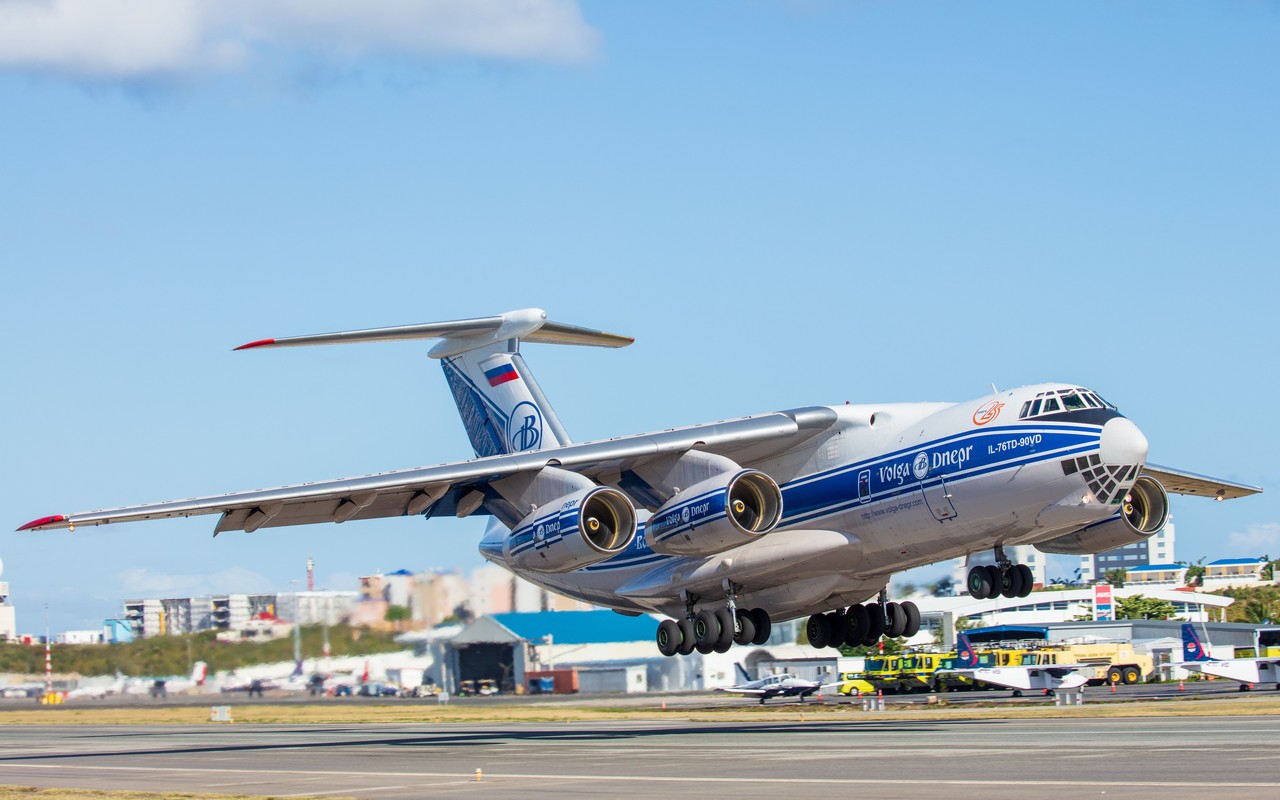
The design team's breakthrough came in combining the high-wing configuration with four powerful Soloviev D-30KP turbofan engines, creating an aircraft that could match the payload capacity of the American C-141A Starlifter while operating from much shorter, unprepared airstrips. Full development approval came in late 1969, with the prototype making its maiden flight on May 25, 1971.
Production Legacy
Production was assigned to State Factory Number 84 in Tashkent, Uzbekistan, which had previously manufactured An-12 transports. The first production aircraft flew on May 8, 1973, with service deliveries beginning later that year. By the fall of the Soviet Union, approximately 700 Il-76s had been built.
Modern production continues with the Il-76MD-90A variant, featuring new Aviadvigatel PS-90A engines that provide 20 percent greater payload capacity and 25 percent increased range. The modernized aircraft entered production at Aviastar-SP in Ulyanovsk, Russia, with the first example rolling out on June 16, 2014. Current production stands at seven aircraft per year, with plans to increase to 18 annually.
Technical Innovation
The Il-76's four Soloviev D-30KP turbofan engines each produce substantial thrust, enabling operations at maximum takeoff weights of 418,878 pounds. The aircraft's 3,200-square-foot wing area and robust landing gear allow operations from semi-prepared airstrips that would challenge most strategic transports.
The spacious cargo compartment measures over 150 feet in length, accommodating everything from main battle tanks to humanitarian supplies. Military versions can transport 126 fully equipped paratroopers, while medical evacuation variants accommodate 114 stretcher patients with full medical facilities.
Pilot Perspective
Pilots praise the Il-76's straightforward handling characteristics and reliability in adverse conditions. The aircraft's maximum speed of 560 miles per hour at Mach 0.82 makes it one of the faster strategic transports, while its service ceiling of 43,000 feet allows operations above most weather. The cockpit requires a crew of four, including two pilots, flight engineer, and navigator.
The aircraft's reputation for operating in extreme conditions has made it a favorite for polar research missions and disaster relief operations. Water bomber variants designated Il-76P serve firefighting roles, while specialized versions include mobile disaster relief hospitals.
Current Status
Today, the Il-76 remains in extensive service with military and civilian operators worldwide. Russia operates the largest fleet, with the Ministry of Defence receiving its first Il-76MD-90A in April 2019. Major operators include the Indian Air Force, various African air forces, and numerous cargo airlines.
Production continues with 27 aircraft ordered through 2028, ensuring the Il-76's legacy extends well into the 21st century. The aircraft's combination of payload capacity, range, and austere airfield capability remains unmatched in its class, cementing its position as one of aviation's most successful strategic transports.