
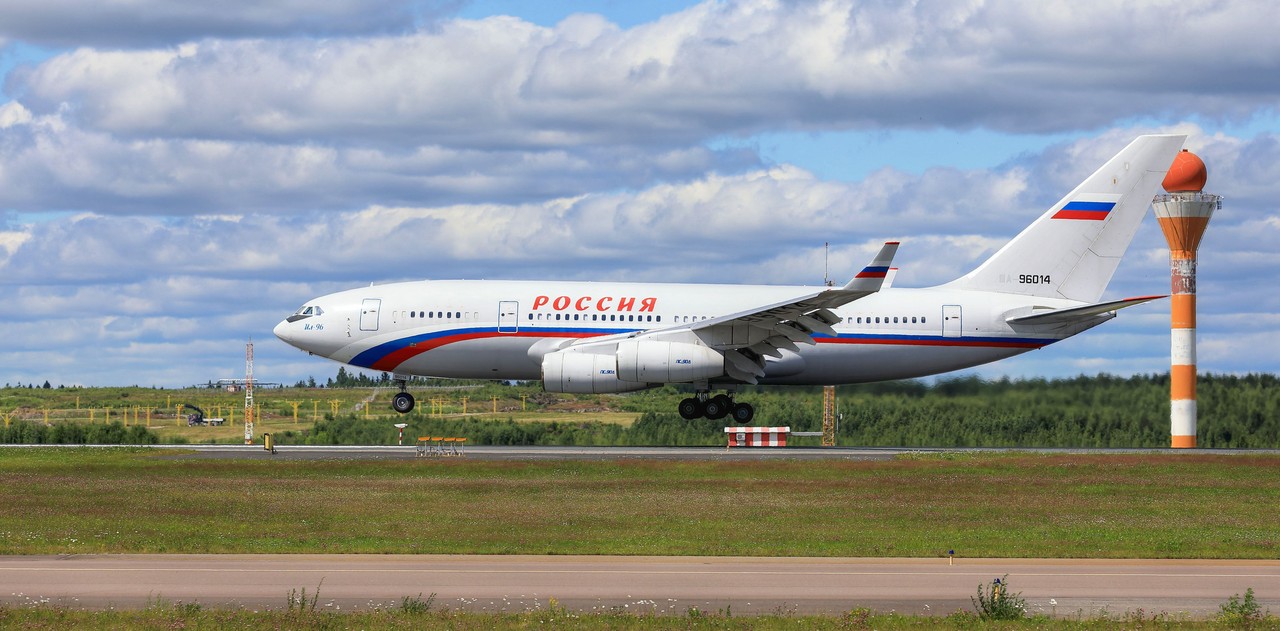
Development and Design
The Il-96 emerged from the Ilyushin Design Bureau's determination to create a true long-range successor to the Il-86, capable of matching Boeing and Airbus offerings in the international market. Heinrich Novozhilov, serving as chief designer, led the development team that received State Prizes for their ambitious widebody project. The design objectives centered on achieving a 6,000 nautical mile range while incorporating advanced features like winglets for improved efficiency and a completely redesigned wing structure.
The prototype's maiden flight on September 28, 1988, marked a significant milestone for Soviet aviation. Test pilot Stanislav Bliznyuk, a Hero of the Soviet Union who had previously set 21 speed records in the Il-76, commanded the 40-minute demonstration flight from Moscow's Khodynka Aerodrome. The flight path over central Moscow served as a deliberate showcase of Soviet engineering capabilities during the final years of the USSR.
Technical Innovation
Powering the Il-96 are four Aviadvigatel PS-90A high-bypass turbofan engines, each delivering 35,300 pounds of thrust. These two-shaft engines, manufactured in Perm, Russia, represented a significant advancement in Soviet propulsion technology when they entered production in the late 1980s. The PS-90A's reliability has contributed directly to the Il-96's remarkable safety record, with no fatal accidents recorded over more than three decades of operation.
The aircraft's performance specifications include a maximum speed of 559 mph and a service ceiling of 42,979 feet. The standard crew complement consists of three members—pilot, copilot, and flight engineer—though some variants have reduced this requirement through advanced automation systems.
Manufacturing and Production
Serial production took place at the Voronezh Aircraft Production Association (VASO), established in 1932 and later integrated into the United Aircraft Corporation under Rostec in 2006. VASO had transitioned from military to civil aircraft production during the 1970s and 1980s, positioning itself to handle the complete technological cycle for Il-96 manufacturing and maintenance.
Production numbers tell the story of commercial struggle despite technical achievement. Between 1988 and 2009, only 30 to 33 aircraft were completed across all passenger variants—a remarkably low output that reflected the aircraft's inability to capture significant market share against established Western competitors. The collapse of the Soviet Union and subsequent economic upheaval further complicated the Il-96's commercial prospects.
Service History
Aeroflot became the launch customer, introducing the Il-96 to commercial service on December 29, 1992. The Russian flag carrier operated approximately five units on long-haul routes, though the aircraft never achieved the widespread adoption that Ilyushin had envisioned. Cubana de Aviación in Cuba became the second and final major commercial operator, utilizing the type for international services.
The most successful application proved to be governmental VIP transport. Five Il-96-300PU variants serve in the Russian presidential fleet, providing secure long-range transportation for high-level officials. These specialized aircraft demonstrate the type's reliability and range capabilities in demanding operational environments.
The Ilyushin Legacy
The Ilyushin Design Bureau, founded by Sergey Ilyushin in 1933, had established its reputation through successful designs like the legendary Il-2 Sturmovik, the Il-18 turboprop airliner, and the versatile Il-76 cargo aircraft. The bureau survived the challenges following the Soviet collapse and continues operations today within the United Aircraft Corporation structure.
Despite the Il-96's limited commercial success, the program showcased Russian engineering capabilities in widebody aircraft design. The incorporation of advanced materials, modern avionics, and efficient powerplants demonstrated that post-Soviet aviation could produce technically sophisticated aircraft, even if market realities prevented widespread adoption.
Current Status and Assessment
By 2022, fewer than 30 Il-96s remained in service, primarily with Russian government operations and limited Cuban airline use. Passenger variant production officially ended in 2009, though sporadic manufacturing of the Il-96-400T cargo version has continued for specialized applications.
The aircraft's perfect safety record over more than three decades stands as perhaps its most significant achievement. While commercial airlines worldwide embraced Boeing 777s and Airbus A330s, the Il-96's operational history proves that Russian engineering could match Western standards for reliability and safety, even if economics and market access prevented commercial success.
Today, the Il-96 serves as both a symbol of post-Soviet ambition and a reminder of the challenges facing aircraft manufacturers attempting to break into the established duopoly of Boeing and Airbus in the widebody market.