
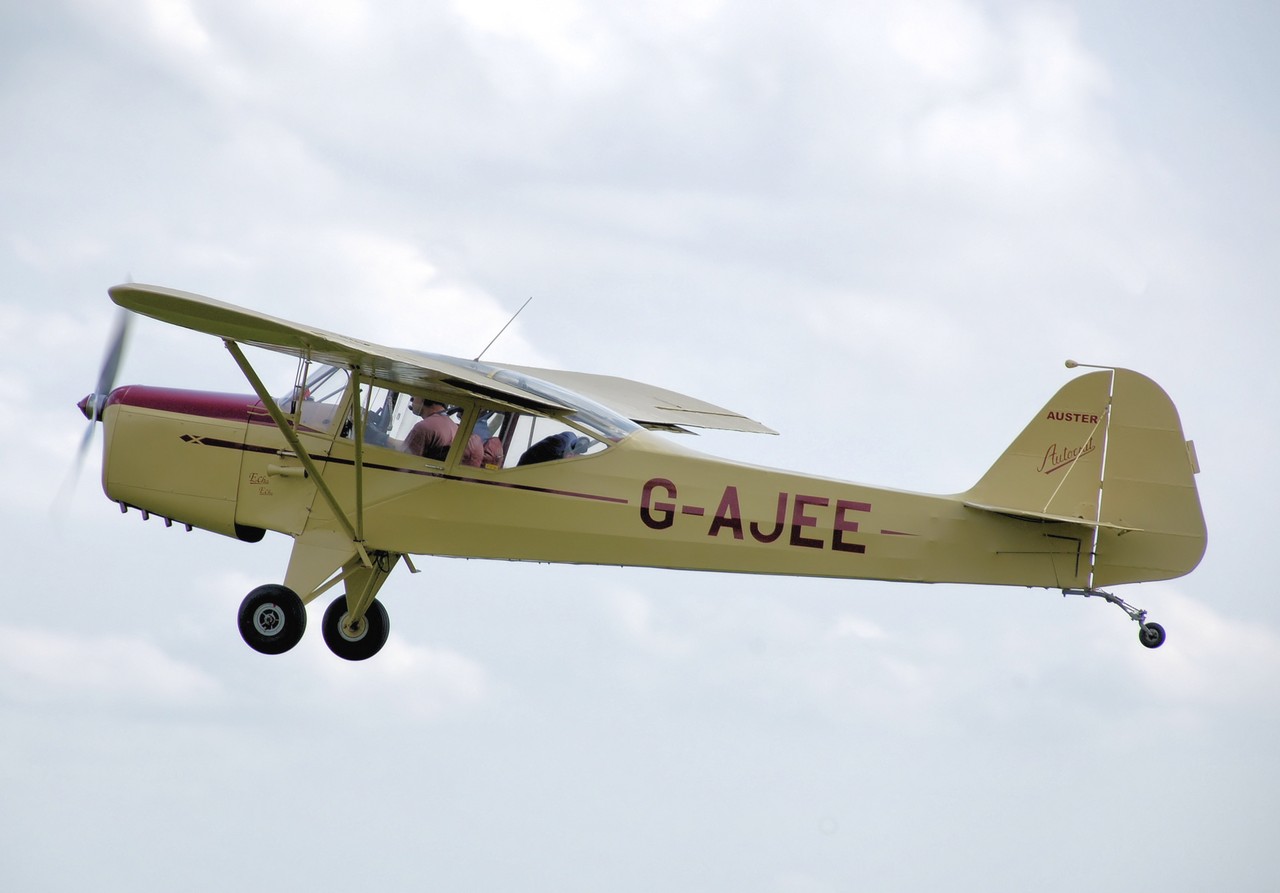
Postwar Aviation Pioneer
The Autocrat emerged as Britain answered the question of what to do with successful wartime aviation technology when peace returned. Rather than abandoning the proven Taylorcraft-Auster observation aircraft designs that had served the Royal Air Force so effectively, engineers at the company saw an opportunity to create something entirely new for the civilian market.
Development and Design Origins
The aircraft's lineage traced directly to the Air Observation Post series that had proven invaluable during World War II. Between 1942 and 1945, the company had manufactured over 1,630 military aircraft including the Taylorcraft-Auster Mk I, Mk III, and Mk IV variants. As the war wound down, designers began adapting this robust military foundation for civilian touring use.
The prototype development centered around a modified Auster 5 (registration G-AGOH) fitted with a 100-horsepower Blackburn Cirrus II engine for initial trials. This experimental aircraft demonstrated the viability of converting the military observation platform into a practical three-seat touring machine. The dedicated J/1 prototype followed, incorporating strengthened structure to meet British Civil Airworthiness requirements in what became known as the "Plus C" configuration.
Manufacturing Excellence
Production commenced in December 1945 with the delivery of the first aircraft, G-AGTO, marking a significant milestone in British aviation history. Auster Aircraft Limited's facility in Rearsby, Leicestershire became the birthplace of over 400 Autocrats built through 1952, with each aircraft sold for just over £1,000.
The manufacturing story itself reflected the changing nature of the aviation industry. Originally established as Taylorcraft Aeroplanes (England) Limited in November 1938, the company had secured production and selling rights for the British Empire and Europe. Construction began in February 1939 at rented premises in Thurmaston, with their first aircraft (G-AFNW) completed by April 24, 1939, and taking its maiden flight on May 3, 1939. The company's transformation was completed in March 1946 when it renamed itself Auster Aircraft Limited, deliberately severing ties with its American Taylorcraft license origins.
Engine Variations and Performance
The Autocrat family showcased remarkable adaptability through its various powerplant options. The standard J/1 utilized the Blackburn Cirrus Major inline piston engine, available in variants producing between 100 and 150 horsepower. Later examples received Lycoming O-320-A1A engines developing up to 150 horsepower.
Specialized variants expanded the aircraft's capabilities. The J/1N Alpha, with 45 new examples built between 1956 and 1957 primarily for Australian export, featured the 130-horsepower de Havilland Gipsy Major I engine and incorporated stability improvements including a higher fin. The J/1S Autocrat stepped up to the 145-horsepower de Havilland Gipsy Major 10 Mk 2-2 engine, while the J/1A variant, introduced in 1949, added a fourth seat specifically for joyriding operations.
Global Service and Notable Achievements
The Autocrat's appeal extended far beyond Britain's shores. Beginning in 1946, exports reached an impressive array of destinations including Argentina, Australia, Belgium, Brazil, Ceylon, Denmark, Egypt, France, Iraq, Jordan, Netherlands, New Zealand, Norway, Pakistan, South Africa, Southern Rhodesia, Sweden, Switzerland, Trinidad and Tobago, Uganda, and Uruguay.
Private owners, aero clubs, and small charter firms employed the aircraft for passenger flights, joyriding, banner towing, and aerial photography. The type achieved a unique distinction in October 1946 when an Autocrat became the first civilian aircraft to land aboard HMS Illustrious, the Royal Navy aircraft carrier, during operations in the English Channel.
Technical Innovation and Practical Design
The Autocrat represented thoughtful engineering focused on reliability and practicality rather than groundbreaking performance. Its high-wing configuration provided excellent ground visibility and stable flight characteristics essential for touring and observation work. The robust structure, evolved from military requirements, offered durability that served civilian operators well in varied conditions worldwide.
The three-seat standard configuration proved ideal for small charter work and private touring, while four-seat variants like the J/1A and J/1N Alpha expanded utility for commercial operations. This flexibility allowed operators to match aircraft configuration to specific mission requirements.
Lasting Legacy
The Autocrat's significance extends beyond its production numbers. As the foundation for the entire Auster family, it spawned variants including 70 J/1B Aiglets built from 1950 and the J/5 series that continued production until 1958. Australian operators developed local conversions like the Kingsford Smith Kingsmith, featuring 150-horsepower Lycoming O-320 engines with improved seating and soundproofing.
Numerous examples remained airworthy well into the 2010s, with private owners maintaining aircraft in the United Kingdom, Australia, New Zealand, and other countries where the type had established footholds. Museum preservation includes examples at institutions like the Museum of Transport and Technology in Auckland, New Zealand, ensuring future generations can appreciate this pioneering postwar design.
The Auster J/1 Autocrat earned its place in aviation history not through record-breaking performance or revolutionary technology, but through practical excellence and global adaptability that helped establish the template for successful postwar light aircraft manufacturing.