
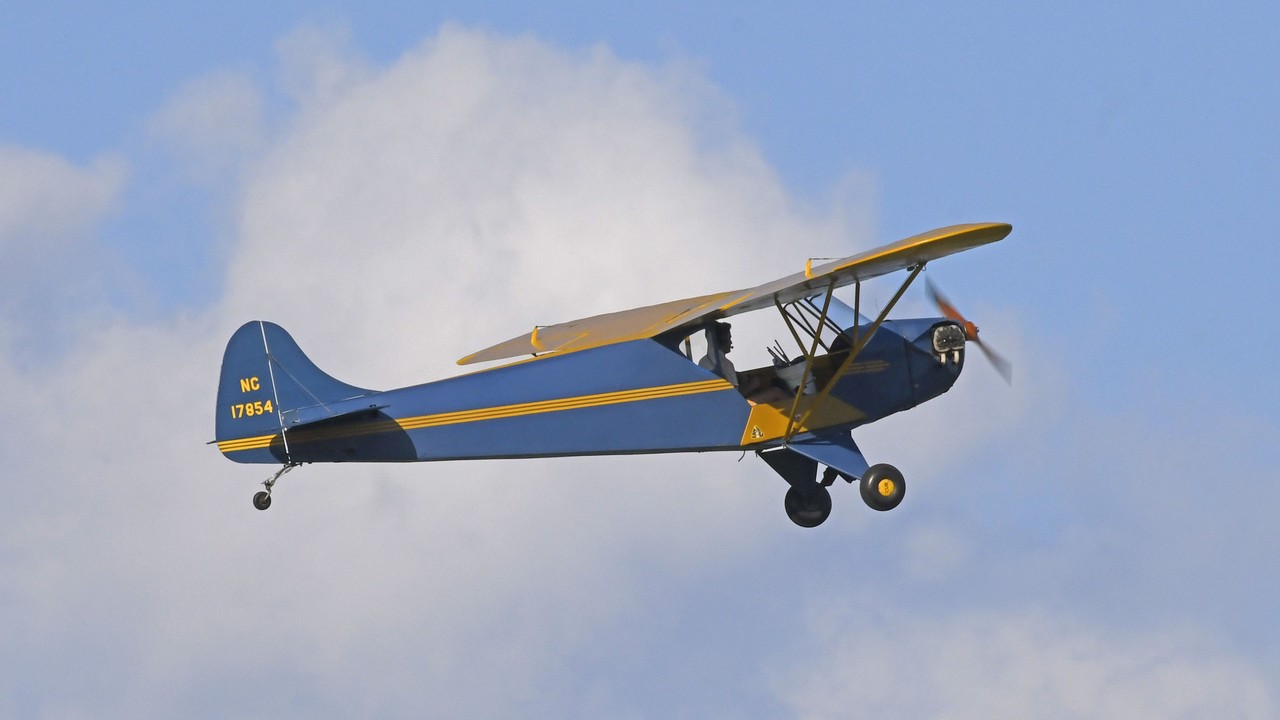
The Birth of an Aviation Dynasty
The J-2 Cub emerged during aviation's golden age as an affordable solution to private flying, priced at $1,470 new or available for rental at $10 per hour. By 1941, Cubs represented one-third of all general aviation aircraft in the United States, making "Cub" synonymous with light aircraft in American aviation culture. The J-2's simple design philosophy and gentle flying characteristics democratized aviation, transforming flying from an elite pursuit into an accessible recreational activity.
Design Innovation and Development
Clarence Gilbert Taylor designed the J-2 as an evolution of his earlier E-2 Cub, incorporating significant aesthetic and functional improvements. The new design featured rounded wingtips, fin, and rudder that replaced the angular lines of its predecessor, while wider tires improved ground handling characteristics. Taylor's design objectives centered on creating a stable, economical trainer that would appeal to flight schools and private owners seeking an easy-to-fly aircraft.
The J-2's tandem seating arrangement, borrowed from military trainer concepts, placed the pilot and passenger in fore-and-aft positions rather than side-by-side. This configuration provided better weight distribution and improved the aircraft's training characteristics, making it ideal for instruction purposes.
Manufacturing Transitions and Challenges
Production began in October 1935 at Taylor Aircraft's facility at Harri-Emery Field in Bradford, Pennsylvania. The manufacturing story took several dramatic turns, including a devastating factory fire in 1937 that destroyed the Bradford facility. During this transitional period, Aircraft Associates in California assembled some J-2s, marketing them as "Western Cubs" between 1936 and 1937.
William T. Piper's acquisition of Taylor's shares in 1935 marked the beginning of the Piper aviation empire. After the Bradford fire, production resumed in May 1937 at a new factory in Lock Haven, Pennsylvania. The company officially became Piper Aircraft Corporation in November 1937, with C.G. Taylor having departed in 1935 to establish Taylorcraft.
Engine and Performance Characteristics
The Continental A-40 engine provided the J-2's power, initially as the 37-horsepower A-40-3 variant from October 1935, later upgraded to the 40-horsepower A-40-4 in September 1936. This reliable inline piston engine delivered adequate performance for the aircraft's intended training and recreational roles, though power was modest by any standard.
With its 40-horsepower engine, the J-2 achieved a maximum speed of 85 mph, prioritizing gentle handling characteristics over performance. The aircraft's forgiving flight characteristics made it particularly suitable for student pilots, contributing significantly to its success in the training market.
International Service and Wartime Operations
While the J-2 itself saw limited military service, its international story includes an intriguing chapter in Denmark. Beginning in May 1938, 45 J-2 and J-3 kits were exported to Denmark for assembly by Cub Aircraft. Approximately 30 aircraft were completed before the Nazi invasion on April 9, 1940.
Following Denmark's occupation, these Cubs entered Luftwaffe service. In a remarkable production effort, 49 U.S.-built Cubs were completed in just 12 days during April 1941. German pilots nicknamed these aircraft "Flitfires" due to their RAF-style markings, though they served primarily in liaison and training roles rather than combat missions.
Production Legacy and Surviving Aircraft
Exactly 1,207 J-2 Cubs rolled off production lines between 1935 and 1938, when manufacturing transitioned to the improved J-3 Cub. This production total, while modest by later standards, represented significant success for a light aircraft in the 1930s economic climate.
The J-2's legacy extends far beyond its own production numbers. It established the design foundation for the J-3 Cub, which would become one of aviation's most successful aircraft with over 27,000 examples built by 1947. The J-2 also spawned the float-equipped J-2S variant, demonstrating the design's versatility.
Museums and Preservation
Remarkable for an aircraft produced in the 1930s, over 100 J-2 Cubs remained on the U.S. civil aircraft register as of 2009, testament to the type's durability and continued appeal. Notable preserved examples include the 1937 Piper J-2 Cub at the Smithsonian-affiliated Pioneers of Flight museum, designated as the "first official Piper J-2" and completed on November 2, 1937. The Yanks Air Museum in Chino, California, also displays a restored J-2, ensuring future generations can appreciate this pivotal aircraft.
The J-2 Cub's significance transcends its modest specifications, representing the democratization of American aviation and establishing a design lineage that continues influencing light aircraft development today.