
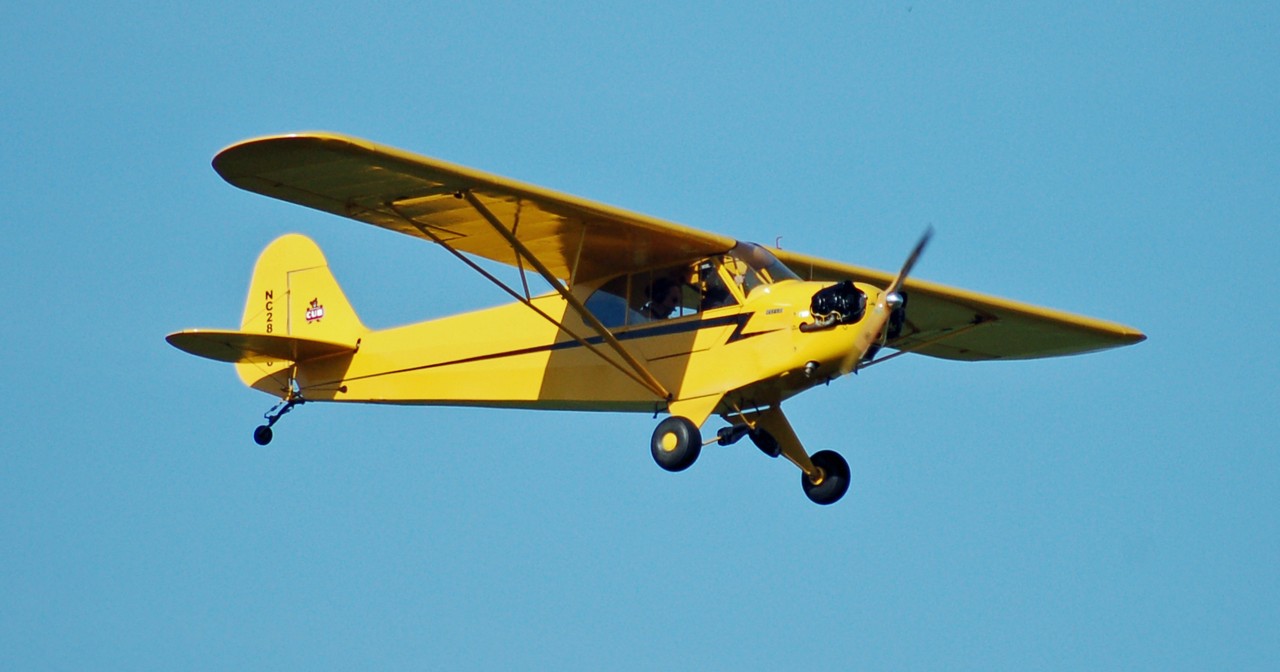
The Democratization of Flight
By 1941, the Piper J-3 Cub had become the cornerstone of American aviation training, with production ramping to one aircraft every 20 minutes during wartime peak manufacturing. The Civilian Pilot Training Program alone absorbed 3,016 Cubs in 1940, establishing the aircraft as the primary vehicle for creating the massive pilot workforce that World War II would demand.
Wartime Service as the L-4 Grasshopper
More than 5,000 military variants served during World War II under the L-4 Grasshopper designation, performing liaison, observation, reconnaissance, and artillery spotting missions across all theaters. The United States Army Air Forces relied heavily on these unarmed aircraft for courier duties and medical evacuation, with their exceptional short takeoff and landing capabilities proving invaluable in forward operating areas where conventional aircraft could not operate.
The Piper Aircraft Legacy
William T. Piper transformed a bankrupt company into an aviation empire after acquiring Taylor Brothers Aircraft Company in 1930. Following a devastating factory fire in Bradford, Pennsylvania on March 16, 1937, Piper relocated operations to Lock Haven, Pennsylvania, officially renaming the enterprise Piper Aircraft Company in November 1937. Piper's vision of creating the "Ford Model T of aviation" drove mass production techniques that made the J-3 affordable at $1,300 with basic powerplant options.
Design Innovation and Engineering
Walter Jamouneau led the engineering team that refined the earlier Taylor E-2 and J-2 Cubs into the definitive J-3 configuration. The design incorporated pilot-requested improvements including a stronger steel tube fuselage, larger upholstered seats, a roomier cabin, and heel-operated brakes. The aircraft received certification on September 17, 1938, for the J3L variant, with floatplane capability approved May 2, 1939.
Powerplant and Performance
The J-3 Cub utilized primarily Lycoming O-145 series engines, ranging from the O-145-A1 producing 50 horsepower to the O-145-A2 and A3 variants generating 55 horsepower. Alternative powerplants included the Continental A-40 at 40 horsepower and Franklin engines, with 65-horsepower options becoming available by 1940. This modest power output, combined with the aircraft's lightweight fabric construction, delivered exceptional slow-speed handling characteristics and short-field performance that defined the Cub's operational envelope.
Production Expansion and International Reach
Piper's manufacturing capacity exploded during the war years, with the company establishing a second facility in Ponca City, Oklahoma in 1946 that alone produced nearly 7,800 Cubs that year. International production extended the aircraft's global footprint, with 130 J-3C-65 models assembled in Hamilton, Ontario by Cub Aircraft Corporation Ltd., plus additional units manufactured in Denmark and Argentina. The final assembly occurred in Toronto by Leavens Bros. in 1952, marking the end of an era.
Pilot Experience and Characteristics
With a maximum speed of 75-85 miles per hour, service ceiling around 10,000 feet, and range of 200-300 miles, the J-3 Cub prioritized docile handling over performance. Its high-wing configuration provided inherent stability, while the tandem seating arrangement with the pilot positioned in the rear seat offered optimal weight distribution and visibility. The aircraft's forgiving flight characteristics made it virtually stall-proof, earning the trust of thousands of student pilots.
Enduring Legacy and Museum Preservation
Thousands of J-3 Cubs continue flying today, testament to their robust construction and enduring appeal. Notable museum examples include specimens at the National Air and Space Museum (registration NASM A19771128000, built 1941), San Diego Air & Space Museum, and The Hangar Flight Museum in Canada. One remarkable survivor built in 1941 accumulated over 6,000 flight hours before restoration in 1975, demonstrating the type's exceptional longevity.
Modern Revival and Cultural Impact
The J-3 Cub's influence extends far beyond its production numbers, having established the template for modern light aircraft manufacturing. Contemporary companies including Cub Crafters in Washington and American Legend Aircraft in Texas continue producing aircraft directly inspired by the original Piper design. The distinctive "Cub Yellow" paint scheme became so iconic that "Cub" entered aviation vernacular as a generic term for all light aircraft, cementing the J-3's position as the most culturally significant training aircraft in aviation history.