
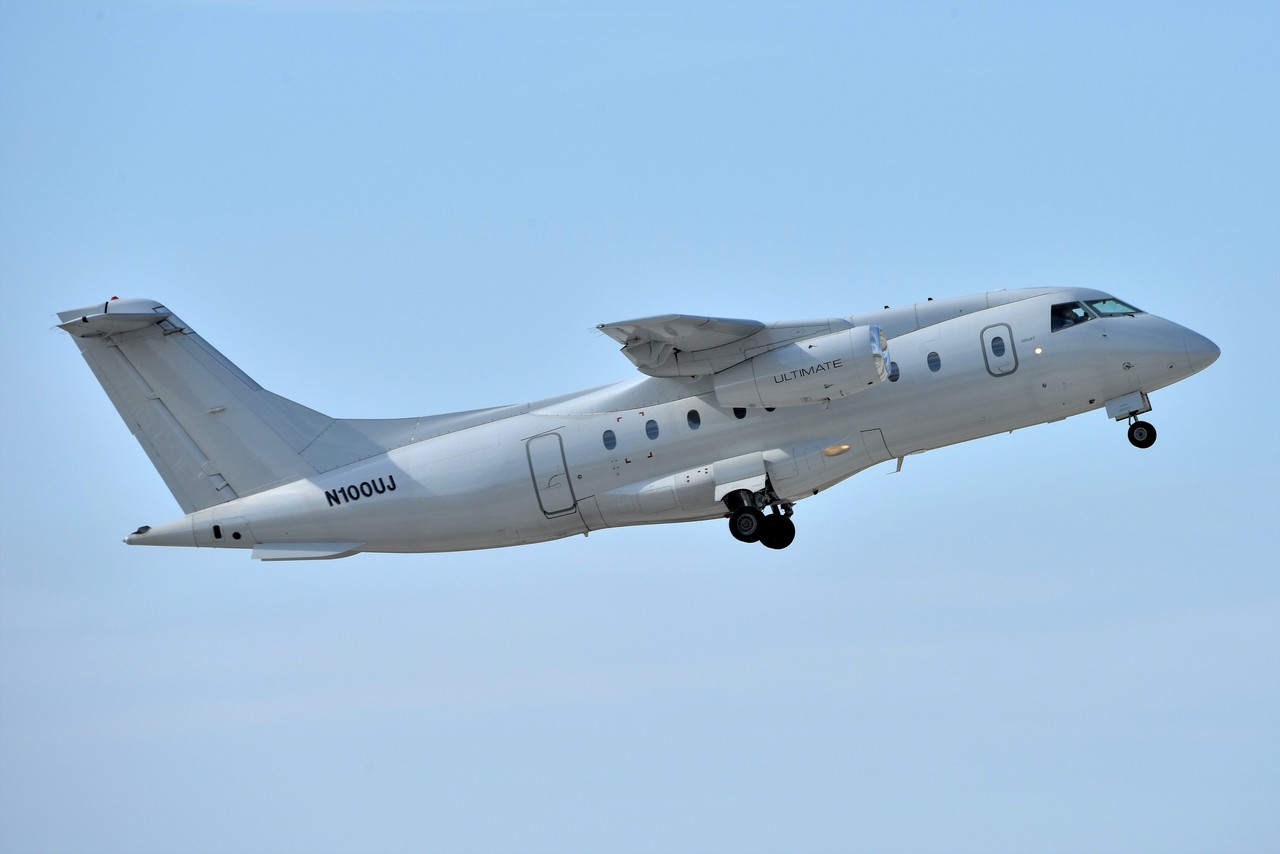
Development and Design
The 328JET emerged from Fairchild Dornier's strategic decision to adapt their successful turboprop Dornier 328 for the rapidly expanding regional jet market. Development formally launched in February 1997, utilizing the proven airframe of the turboprop version to accelerate the program timeline. Chief test pilot Meinhardt Feuersenger, who had previously flown the turboprop 328, along with Peter Weger, took the first prototype aloft on 20 January 1998 from Oberpfaffenhofen.
The engineering team strengthened the original design to accommodate the increased performance demands of jet propulsion. They installed reinforced landing gear and braking systems, integrated a Honeywell Primus 2000 electronic flight instrument system, and made an auxiliary power unit standard equipment. By October 1997, Dornier announced performance improvements that pushed the cruise speed to 400 knots through minor modifications to the trailing edge flaps.
Engine and Performance
After evaluating multiple powerplant options during the early development phase, Dornier selected twin Pratt & Whitney Canada PW306B turbofan engines, each producing 26.9 kilonewtons of thrust. This powerplant combination gave the 328JET a maximum speed of 750 kilometers per hour and a service ceiling of 11,000 meters. With optional long-range fuel tanks, the aircraft could fly 2,740 kilometers nonstop, enabling routes such as London to Ibiza or New York to Atlanta with a full passenger load.
The aircraft maintained the same basic cabin arrangement as its turboprop predecessor, offering flexibility between executive transport with 15 passengers and high-density commercial service accommodating 32 passengers. Baggage capacity remained generous at 30 suitcases, making it attractive for both business and leisure markets.
Certification and Early Service
The 328JET achieved Joint Aviation Authorities certification on 8 July 1999, followed by Federal Aviation Administration approval seven days later on 15 July 1999. Skyway Airlines received the first delivery in July 1999, marking the aircraft's entry into commercial service. Initial operations proved promising, with the growing fleet logging 100,000 flight hours by June 2001 while maintaining a 99.23 percent completion rate.
Production ramped up steadily during the program's early years, with Fairchild Dornier delivering 15 aircraft in 1999 and 33 in 2000. Hainan Airlines became another significant early customer, operating the type on regional routes throughout China. The aircraft found its niche serving thin routes where larger regional jets proved uneconomical.
Manufacturing Challenges
The 328JET program faced immediate challenges from intense competition in the regional jet market, particularly from established players like Bombardier's CRJ200 and Embraer's ERJ 135. Despite the aircraft's technical merits and operational reliability, Fairchild Dornier struggled to achieve the sales volumes necessary to sustain production profitability.
By late 2002, mounting financial pressures forced Fairchild Dornier into bankruptcy, effectively ending the original production run after delivering 122 aircraft. The company's collapse left 18 partially completed aircraft on the production line and cast uncertainty over parts support for existing operators.
AvCraft Revival
Virginia-based AvCraft Aviation acquired the entire 328 program in March 2003, including the incomplete aircraft and production tooling. The company resumed manufacturing in December 2003, delivering their first completed 328JET to Hainan Airlines on 11 September 2003. AvCraft managed to complete and deliver the remaining aircraft through 2005 before financial difficulties forced them into administration.
During development, Fairchild Dornier had planned a stretched variant designated 428JET, designed to accommodate 44 passengers and compete directly with larger regional jets. However, the parent company's financial collapse terminated this program before any prototypes were completed.
The Dornier Legacy
The 328JET represented the final chapter of the storied Dornier aviation legacy that began in 1914 when Claude Dornier established his aircraft company. Dornier had built its reputation manufacturing innovative all-metal flying boats and airliners during the interwar period, relocating operations to Spain and Switzerland when post-war restrictions prohibited German aircraft production.
After returning to Germany in 1954, Dornier continued developing advanced aircraft designs until financial distress led to acquisition by Fairchild Aircraft in 1996. The merger created Fairchild Dornier, but the 328JET's commercial struggles meant it became the last aircraft to bear the Dornier name in commercial aviation.
Market Impact and Legacy
Although the 328JET achieved technical success with reliable operations and satisfied operators, it arrived during a period of rapid consolidation in the regional aircraft market. Larger manufacturers with established customer relationships and broader product lines ultimately dominated the sector, leaving limited market space for specialized manufacturers.
The aircraft's 122-unit production run, while modest compared to competitors, demonstrated the viability of converting successful turboprop designs to jet power. This approach influenced later aircraft development programs, though none matched the 328JET's direct adaptation strategy. Today, remaining examples continue serving operators worldwide, testament to the aircraft's sound engineering despite its commercial challenges.